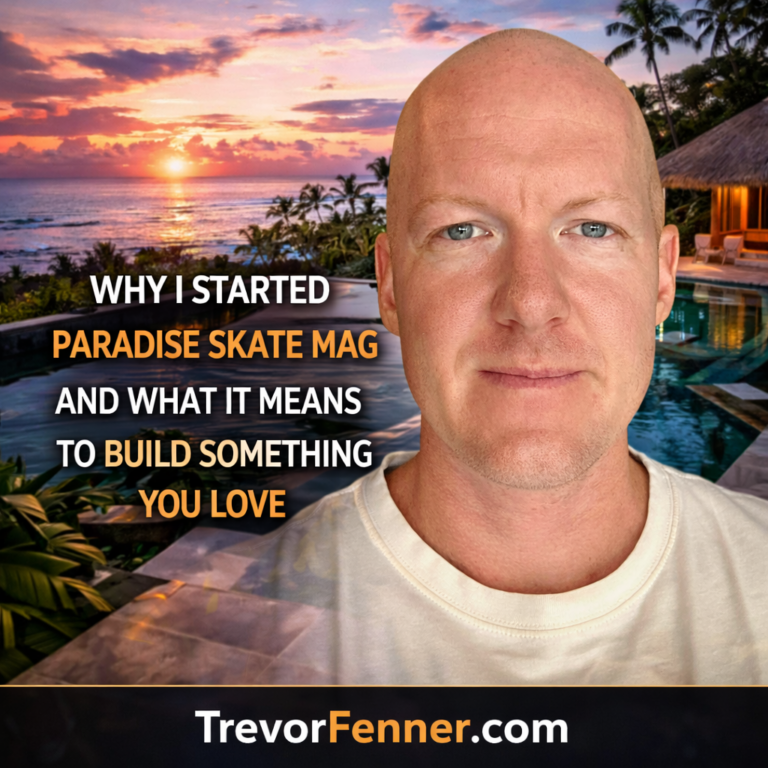
Not everything I build is about revenue.
That might sound strange coming from someone who runs a dropshipping education platform, an ecommerce store, and a portfolio of niche content sites. Most of what I do is deliberately built around generating income and the specific kind of freedom that income creates. I’m not romantic about that. Business is business and I take it seriously.
But Paradise Skate Mag is different. It started from a different place, it runs on different fuel, and it means something to me that is separate from whatever business value it generates.
This is the honest story of why I built it and what I’ve learned about the specific experience of building something you genuinely love.
How It Started
I’ve been skateboarding my whole life. Seattle as a kid, through college in Los Angeles, into the years of building businesses and moving around. When I left LA in 2016 and started traveling Southeast Asia, one of the first things I did in every new city was find the local skate scene. Chiang Mai had almost nothing, just some street spots and a run-down park. Bangkok had Queen’s Park, Dreg Park, the university park. Better, but not what I was looking for.
Then I got to Bali and skated Amplitude for the first time.
Amplitude was the best skatepark in Southeast Asia and the broader Oceania region when I arrived in 2019. Significantly better than anything I’d skated in the region. The bowls, the construction quality, the community of people who used it: all of it was at a level that surprised me. And beyond Amplitude there was a genuine skate culture in Bali: street spots, other parks, a community of local and international skaters, and a steady stream of traveling pros and amateurs who came through because the island had built a real reputation in the skate world.
I started filming. Not because I had a plan or a platform in mind. Because I was a skater in a place with good skating and I had a camera and I wanted to document what was happening. That impulse, the desire to capture something worth capturing, is as old as skate culture itself. The best skate media in history started with someone who loved skating deciding to film it.
Paradise Skate Mag grew out of that. A place to publish the footage, tell the stories, document the scene in Bali and the wider skate culture I was part of. It became a real project over time, with a consistent identity and a genuine audience of people who care about the same things I care about.
What Made It Different from My Other Projects
Everything else I build starts with a market opportunity. I identify a niche with the right characteristics, confirm the economics make sense, build toward a specific outcome. That process is deliberate and rigorous and it’s the foundation of everything that works in Ecommerce Paradise and my ecommerce store.
Paradise Skate Mag started with love, not opportunity analysis. I didn’t research the skate media market before I started filming. I didn’t model out the monetization before I built the platform. I started because I wanted to document something that mattered to me, and the project developed from there.
That inversion of the usual sequence produces something different in the output. Content created from genuine passion for the subject has a quality that market-researched content doesn’t always have. The details you notice. The stories you choose to tell. The framing you bring to what you’re documenting. All of that reflects the specific knowledge and perspective of someone who is inside the thing they’re covering rather than studying it from the outside.
Skaters can tell immediately whether skate media is made by someone who actually skates. The authenticity is visible in what gets filmed, how it gets framed, what gets treated as significant. Paradise Skate Mag is made by a skater for skaters and that’s apparent in the content in ways that can’t be manufactured.
The Specific Experience of Building Something You Love
I want to describe something that’s hard to articulate but that I think is important for anyone who is building projects and wondering whether they should be building something they love rather than just something that makes economic sense.
The experience of working on Paradise Skate Mag is genuinely different from the experience of working on my other projects. Not better or worse in any absolute sense. Different in the specific way that it feels from the inside.
When I’m filming a session at Amplitude, or heading out into the streets of Bali with a traveling skater who wants to get some clips, or editing footage for a Paradise Skate Mag piece, the work doesn’t feel like work in the way that writing another product description or reviewing another ad campaign feels like work. It feels like doing something I would be doing anyway, with the additional dimension that it produces something worth sharing.
That quality of intrinsic engagement, doing the thing because the thing itself is worth doing rather than because of what it produces, is not something you can generate through discipline or systems. It either exists because the work connects to something you genuinely care about or it doesn’t.
I’m not saying that work you love is always enjoyable or never hard. Filming in difficult conditions is demanding. Editing footage takes time and attention. Building and maintaining any media platform involves operational work that has nothing to do with the creative core. The work of Paradise Skate Mag is real work. But the fuel behind it is different from the fuel behind my other projects and that difference is significant.
What It Has Taught Me About the Portfolio Approach
Running both commercially-oriented projects and a passion project has clarified something for me about how to build a sustainable portfolio of work over the long term.
The commercially-oriented projects generate the income and the freedom. Ecommerce Paradise teaching high-ticket dropshipping, providing done-for-you services, coaching, and ads management: this is the engine. My ebike store is the ecommerce operation that generates its own revenue through selling products people actually need.
Paradise Skate Mag is the project that reminds me why I’m building all of it.
That might sound like I’m framing it as purely psychological rather than economically meaningful. But I think it’s more practically important than that. The passion project, the thing you’re doing because you love it rather than because of what it produces, is what keeps the commercially-oriented work from becoming purely transactional. It keeps the creative capacity alive. It provides a reference point for what building something genuinely matters feels like, which sharpens your sense of what you’re trying to create across all of your work.
The people I’ve watched burn out from building online businesses are almost always people who built entirely for economic output with nothing in the portfolio that had intrinsic meaning for them. The work became a means to an end and then the end started feeling insufficient to justify the means. Having something you’re building because it matters to you, independently of what it produces, changes the entire emotional architecture of the portfolio.
The Business Reality of Paradise Skate Mag
I want to be honest about the economics because I think the romantic version of building something you love often glosses over the practical reality.
Paradise Skate Mag is not currently my primary revenue source. It generates some revenue through sponsorship opportunities, featured content spots for skaters and brands wanting authentic reach in the skate community, and the general brand equity it builds around my name and presence in the Bali skate world. It has real value in the portfolio. But it is not generating the kind of returns that Ecommerce Paradise or my ebike store generate.
This is fine. The portfolio approach means that not every project needs to carry the same economic weight. The projects that generate the most revenue create the space for the projects that generate the most meaning. That balance is deliberate and I think it’s the right model for anyone who wants to build a sustainable creative and professional life over the long term.
What Paradise Skate Mag does that the other projects don’t is connect the business life I’ve built to the physical, creative, community-based life I actually want to be living. It closes a loop between who I am and what I’m building that purely commercially-oriented projects can’t close on their own.
What Sponsorship and Collaboration Mean for the Mag
One of the aspects of Paradise Skate Mag that I’m building more deliberately in 2026 is the sponsorship and collaboration side. Brands that want authentic reach in the Bali skate scene, skaters and crews who want quality documentation of what they’re doing, and companies with genuine relevance to skate culture looking for featured content spots are all natural partners for what we’re doing.
The key word is authentic. Skate culture has an extremely low tolerance for forced or inauthentic brand integration. The sponsorships and collaborations that work in skate media are the ones where there’s a genuine fit between what the brand stands for and what the media property is doing. Paradise Skate Mag is not a vehicle for brands that want to borrow skate credibility without having earned any. It’s a platform for brands and skaters who are genuinely part of the world we’re documenting.
If you’re a skater, a brand, or someone with a connection to the Bali skate scene or the broader Southeast Asian skate community and you’re interested in working with Paradise Skate Mag, the contact page at paradiseskatemag.com is the right place to start that conversation.
What Building Something You Love Actually Requires
I want to end with something practical for people who are thinking about starting a project they genuinely care about alongside or instead of the commercially-driven work.
Building something you love still requires the same discipline and consistency that any other project requires. The love provides the fuel but it doesn’t eliminate the work. Showing up to film when the conditions aren’t ideal. Publishing content when the creative output of a particular session isn’t your best. Doing the operational and administrative work that every media property requires. None of that gets easier because you love the subject.
What love changes is the relationship to the work when it’s hard. When a commercial project hits a difficult patch, the question is whether the economics justify pushing through. When a passion project hits a difficult patch, you push through because you’re not ready to stop building the thing. That’s a more durable motivation than economic justification and it produces different long-term behavior.
The research supports this intuition. According to research from the University of Rochester on self-determination theory and intrinsic motivation, activities pursued for intrinsic reasons, because they are inherently interesting or meaningful, produce significantly more sustained engagement and creative output over time than activities pursued primarily for external reward. Paradise Skate Mag exists at that intersection of intrinsic motivation and genuine creative output, and I think that’s visible in the content.
Build the thing that makes economic sense. And build something you love. The second one will make the first one more sustainable than you expect.
Trevor Fenner is the founder of Ecommerce Paradise and Paradise Skate Mag. He has been building location-independent ecommerce businesses since 2013 and currently lives in Bali, Indonesia, where he skates, films, and documents the local and traveling skate scene.
About Trevor Fenner
Founder of Ecommerce Paradise and publisher of Paradise Skate Mag. I’ve been building location-independent ecommerce businesses since 2013 — and living the life they pay for in Bali, Indonesia with my wife Widi.
Want to Build Your Own Location-Independent Business?
Get unstuck with a private 1-on-1 consulting call — or keep reading the honest lessons I’ve picked up building businesses from Bali.
Trevor Fenner is a Seattle-born entrepreneur, skateboarder, and expat who left Los Angeles in 2016 to build a location-independent life in Southeast Asia. After living in Chiang Mai and Bangkok, he settled in Bali in 2019, where he has been based ever since. He is the founder of Ecommerce Paradise, an education and services platform helping entrepreneurs build high-ticket dropshipping businesses, and operates Electric Bikes Paradise, an ecommerce store specializing in electric bikes, scooters, and mobility equipment. He also runs Paradise Skate Mag, a skate media project documenting the Bali skate scene and broader skate culture, and is building Bali Cat Paradise, a blog centered on the nearly twenty cats he and his wife care for at their home in Bali. Trevor writes about ecommerce and entrepreneurship, expat life in Southeast Asia, and the lessons skateboarding has taught him about business and life.