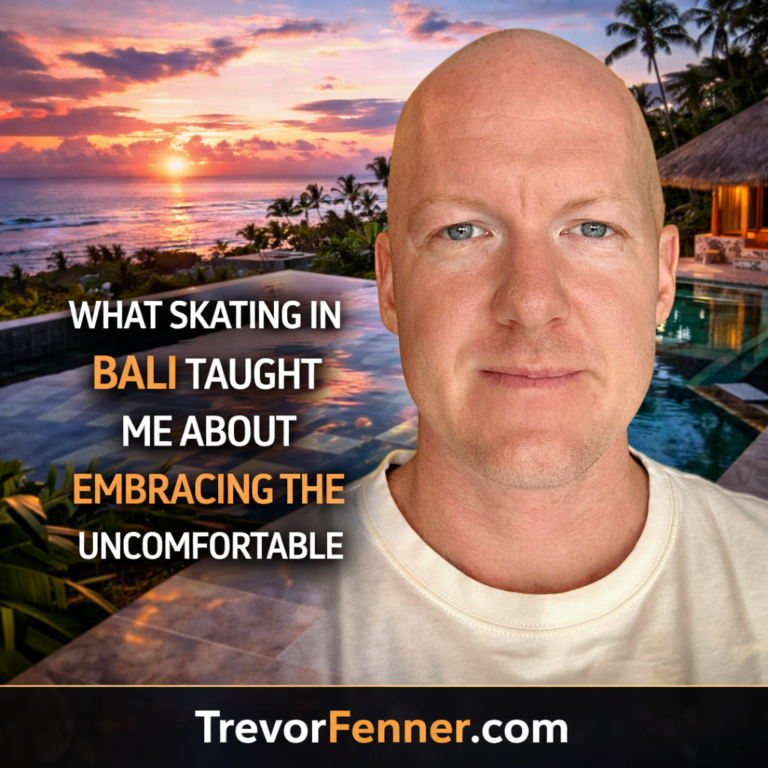
I didn’t move to Bali because it was comfortable.
I moved because my life in Los Angeles had become something I didn’t recognize anymore. A marriage that had turned toxic, a routine that felt more like a rut than a life, and a persistent sense that I was capable of something more than what I was settling for. Leaving wasn’t comfortable. It was one of the most disruptive decisions I’ve ever made. I sold everything, bought a one-way ticket, and started over on the other side of the world at an age when most people in my position were doubling down on stability.
The discomfort was the point. I just didn’t fully understand that yet.
Skating has been part of my life since I was a kid in Seattle, and one of the things it teaches you over years of practice is a specific relationship to discomfort. Not tolerance of it. Not the gritted-teeth endurance of something unpleasant. A genuine understanding that discomfort is almost always a signal that you’re at the edge of your current ability, which is exactly where growth happens. Learning to read that signal correctly, to distinguish between discomfort that’s telling you to push through and discomfort that’s telling you to back off, is one of the most valuable skills skating develops.
What Bali did was give that lesson a whole new set of contexts to operate in. And what I’ve learned from skating here, from building a life here, and from building businesses from here, is that embracing the uncomfortable is not a philosophy you adopt. It’s a practice you develop through repeated exposure to situations that require it.
The First Session at a New Spot
Every skater knows the feeling of skating somewhere unfamiliar for the first time. New terrain, unfamiliar transitions, surfaces that behave differently than what you’re used to. The tricks you have wired at your home spot don’t always translate immediately. Your muscle memory is calibrated for a different environment and the new one requires recalibration.
The first time I skated Amplitude in Bali I was amazed by the quality of the park but also had to adjust to it. The bowls have their own specific shape and rhythm. The flow lines that work there are different from anything I’d skated regularly. Getting comfortable at Amplitude took sessions, not hours.
That recalibration process is uncomfortable in a specific way. You’re in a place that should feel like your element and it doesn’t quite yet. You look less competent than you feel inside. The gap between what you know you’re capable of and what you’re currently executing is visible to everyone around you.
Most people’s instinct in that situation is to avoid the discomfort: stick to the stuff you know, stay in the parts of the park where you feel confident, don’t try things you’re not sure will work in front of people who might be watching. That instinct is understandable and it’s completely counterproductive. The only way through the recalibration period is through the discomfort of it.
Building businesses in new niches, on new platforms, in new markets, produces exactly the same experience. You have skills and experience that should apply, and then you start and discover that the new terrain requires recalibration. The first month running Google Ads in a new niche feels like skating an unfamiliar park: the principles are the same but the specific application requires adjustment that only comes from doing it in the new environment. I cover the full adjustment process in my guide on what high-ticket dropshipping actually requires because the recalibration phase is where most new store owners misread the situation and quit.
What Bali Itself Demanded
Moving to Bali was not a smooth transition. The visa situation required constant navigation. The culture was genuinely different from anything I’d grown up with in ways that took real time to understand. The time zone made staying in contact with business partners and clients in the US logistically demanding. The infrastructure, while good in the developed expat areas, was not the seamless Western experience I’d been accustomed to.
None of that was comfortable. All of it was exactly the kind of productive discomfort that produces growth.
The visa complexity pushed me to understand Indonesian immigration at a level I never would have reached if the process had been easy. That knowledge has been genuinely useful, including for advising other entrepreneurs who are thinking about building location-independent businesses and living internationally. The cultural adjustment has enriched my perspective in ways that comfortable familiarity never could have. The time zone challenge is what pushed me to develop the nocturnal work schedule that has turned out to be one of the most productive arrangements I’ve ever had: starting work by 11pm at the latest, working through to 7 or 8am, with the quiet of Bali at night and the full US business day available to me simultaneously.
If I had moved somewhere easier, I would have missed all of that.
The Discomfort of Being a Foreigner in Someone Else’s Skate Scene
When you show up to skate somewhere new as an outsider, there’s a social dimension to the discomfort that’s separate from the physical one. You don’t know anyone. You don’t know the unspoken social rules of the spot. You don’t know who the respected locals are or how the pecking order works. You’re visible and unproven.
The Bali skate scene has a real local community. There are Indonesian skaters who have been skating here for years, who know every spot on the island, who carry a level of respect in the local scene that a traveling foreigner arrives without. Walking into that as an outsider required a specific kind of humility: putting your skating out there, being willing to be seen trying and sometimes failing, and letting the quality of your skating and your respect for the community speak over time rather than trying to establish yourself through words.
That process is uncomfortable. It’s also one of the most reliable ways I know to build genuine connection with people in any context. The skaters I’ve built the best relationships with in Bali are the ones I earned those relationships with by showing up consistently, skating honestly, and being genuinely interested in what they were doing rather than trying to make an impression.
Building business relationships in a new market works the same way. The supplier relationships that have become the backbone of my ebike store were built through the discomfort of cold outreach, of being unknown, of having to prove the value of the partnership before any trust existed. The Ecommerce Paradise community relationships I’ve built with students over the years started with someone willing to be vulnerable enough to ask for help with something they didn’t know how to do. My full framework for building those supplier relationships from scratch is in the complete supplier guide.
Tricks You’ve Been Avoiding
Every skater has tricks they’ve been avoiding. Not because they can’t physically do them but because something in the mental approach has created a block. The trick is at the edge of your ability and the last time you tried it seriously something went wrong, or you came close enough to falling that the fear response got activated, or the consequences of getting it wrong are painful enough that your brain has been looking for reasons to not fully commit.
In Bali I’ve had to confront several of those tricks. Partly because the quality of the parks here makes certain things possible that weren’t practical in other places I’ve skated. Partly because filming for Paradise Skate Mag creates a context where pushing toward harder things has a purpose beyond personal progression. And partly because being in an environment that’s already demanded so much discomfort-tolerance from me in other areas of life has made me more willing to bring that same posture to the skating.
The pattern I’ve noticed with avoided tricks is consistent: the approach toward them is always more uncomfortable than the actual execution once the mental block breaks. The anticipation of the discomfort is almost always worse than the discomfort itself. And the relief and satisfaction of landing something you’ve been avoiding is disproportionately large compared to the difficulty of the trick itself, because you’re not just landing the trick, you’re also resolving the specific anxiety that surrounded it.
Business has the same dynamics. The conversation with a supplier you’ve been putting off. The ad campaign you’ve been afraid to launch. The price increase you’ve been avoiding having with existing clients. The course or coaching offer you’ve been holding back because it doesn’t feel ready. The approach toward each of these is almost always worse than the execution. And the resolution of the avoidance produces a disproportionate sense of forward momentum.
Falling in Front of Other People
There is no avoiding falling in public when you’re skating at a level that involves real progression. You’re going to eat it in front of people sometimes. On a trick you’ve done a hundred times. On something you were sure you had. In front of skaters you respect. In front of people who are filming.
Learning to fall without letting it collapse your state is one of the most practically important things skating teaches. Not pretending it didn’t hurt when it did. Not performing invulnerability. Just shaking it off, getting back up, and trying again without carrying the fall into the next attempt as mental weight.
Failing publicly in business is the same experience with different specifics. A product launch that underperforms. A service that doesn’t deliver the results you promised. A piece of content that misses. A business decision that turns out to be wrong in ways that are visible to your audience or your clients.
The entrepreneurs who progress through those failures are the ones who have developed the skating equivalent of a good fall: acknowledge what happened, extract what’s useful from it, and get back up without carrying the failure into the next attempt as debilitating weight. I’ve written about specific business failures I’ve been through, the bike shop with Scott, the Flippa sale below value, the early ad campaigns that burned money, in my posts on the biggest mistakes from my first year of dropshipping because I think the specific details of what went wrong and how I got back up are more useful than abstract advice about resilience.
The Island as a Teacher
Bali has a specific quality that I’ve noticed in the years I’ve been here: it has a way of surfacing whatever you’ve been avoiding dealing with.
This is partly just the natural effect of removing the distractions that most modern environments provide in abundance. Without the commute, the social obligations, the ambient noise of a busy city, the things you’ve been pushing to the background have a tendency to become impossible to ignore. For me that included the reality of my first marriage, which I finally dealt with properly after arriving in Bali rather than continuing to defer it. It included some beliefs about what I was capable of building that I’d been avoiding testing. It included a relationship to risk that I’d developed in the safe and structured environment of LA that didn’t serve me in a context that required more genuine courage.
The skating has been part of that process. Amplitude and the broader Bali skate scene have been a physical practice of exactly the same thing the island has been teaching in other areas of life: you get better by going toward the discomfort rather than away from it. The bowl that looks too steep is exactly the one worth dropping into. The trick that scares you is exactly the one worth working on. The unfamiliar situation is exactly the one worth staying in rather than retreating from.
That lesson has shaped everything I’ve built here, including Ecommerce Paradise and the Ecommerce Paradise masterclass that reflects years of staying in the uncomfortable process of figuring out what actually works rather than retreating to what was familiar.
What Embracing the Uncomfortable Actually Looks Like
I want to be specific about this because I think the phrase gets used in ways that make it sound more dramatic than it actually is day to day.
Embracing the uncomfortable doesn’t mean seeking out suffering or manufacturing difficulty for its own sake. It means not avoiding things simply because they produce anxiety or require you to be in a position of not knowing. It means going to the skatepark on the nights when you don’t feel like you’ll skate well. It means sending the supplier outreach email you’ve been drafting for a week. It means launching the ad campaign with imperfect information rather than waiting until the information is perfect. It means getting on the plane to the country where you don’t speak the language and figuring it out when you get there.
The tools I use to manage the operational complexity of doing all of this across multiple businesses and time zones: Wise for international money management, SafetyWing for health coverage that removes one category of uncertainty from living internationally, Google Workspace for keeping the operational infrastructure organized across everything. These tools don’t eliminate the discomfort of building something real. They reduce the friction that isn’t worth the discomfort, which leaves more capacity for the discomfort that is.
According to research from the American Psychological Association on stress inoculation and adaptive performance, graduated exposure to manageable levels of stress and discomfort builds the psychological resilience that enables higher performance under genuinely challenging conditions. Skateboarding is, among other things, a practice of exactly this: repeated voluntary exposure to manageable challenge that builds the capacity to handle larger challenges over time. The same mechanism operates in business building and in the decision to build a life somewhere genuinely unfamiliar.
Bali taught me that the uncomfortable thing is usually the right thing. The skating reinforced it every session. And the businesses I’ve built here are the evidence that the lesson was worth learning.
If you’re building toward a location-independent business and the discomfort of starting, of committing, of putting real money and time into something with uncertain outcomes is what’s holding you back, the free beginner’s guide at Ecommerce Paradise is the starting point. The masterclass covers the complete system. And one-on-one coaching is available for the people who want to work through their specific situation directly rather than alone.
The discomfort of starting is real. So is everything waiting on the other side of it.
Trevor Fenner is the founder of Ecommerce Paradise and Paradise Skate Mag. He has been building location-independent ecommerce businesses since 2013 and currently lives in Bali, Indonesia.
About Trevor Fenner
Founder of Ecommerce Paradise and publisher of Paradise Skate Mag. I’ve been building location-independent ecommerce businesses since 2013 — and living the life they pay for in Bali, Indonesia with my wife Widi.
Want to Build Your Own Location-Independent Business?
Get unstuck with a private 1-on-1 consulting call — or keep reading the honest lessons I’ve picked up building businesses from Bali.
Trevor Fenner is a Seattle-born entrepreneur, skateboarder, and expat who left Los Angeles in 2016 to build a location-independent life in Southeast Asia. After living in Chiang Mai and Bangkok, he settled in Bali in 2019, where he has been based ever since. He is the founder of Ecommerce Paradise, an education and services platform helping entrepreneurs build high-ticket dropshipping businesses, and operates Electric Bikes Paradise, an ecommerce store specializing in electric bikes, scooters, and mobility equipment. He also runs Paradise Skate Mag, a skate media project documenting the Bali skate scene and broader skate culture, and is building Bali Cat Paradise, a blog centered on the nearly twenty cats he and his wife care for at their home in Bali. Trevor writes about ecommerce and entrepreneurship, expat life in Southeast Asia, and the lessons skateboarding has taught him about business and life.