
The best AI tools for content creation are the ones that remove a specific headache from your workflow. If you already have useful ideas but struggle to turn them into something people can read or watch, that is a different problem from having nothing useful to say in the first place.
I would start with your source material, not a pile of subscriptions. A recording of an explanation, a real customer question you have permission to discuss, or a verified product document gives you something concrete to work from. AI can help organize that material. It cannot make an unsupported claim true.
My approach at Ecommerce Paradise is to keep business education practical. Show the reader what to check, explain the trade-offs, and give them a next step they can actually take. That is the standard I would apply to AI-assisted content too.
This is a focused shortlist of two tools for two jobs: capturing spoken source material and turning an edited brief into a visual explanation. It is not a ranking of every AI platform, and it does not claim hands-on testing of every paid feature. I reviewed the providers’ public pricing and documentation on October 11, 2026.
Affiliate disclosure: some links in this article are affiliate links. I may earn a commission if you buy through them, at no additional cost to you. Product screenshots show public provider pages, not evidence of personal testing or business results.
Have useful ideas sitting in recordings? Compare Otter’s transcription plans before choosing a subscription.
Best AI tools for content creation at a glance
| Tool | Best fit in this workflow | Starting option | What to check |
|---|---|---|---|
| Otter.ai | Capturing speech as editable source notes | Free Basic; standard Pro monthly US$16.99 per user | Recording minutes, imported-file limits, speakers and consent |
| Gamma | Turning reviewed notes into presentations and visual explanations | Free with 400 signup credits; paid rates vary by location | Per-seat billing, credit allowance, exported layout and factual accuracy |
These tools are not interchangeable. Transcription helps you capture what was said. Presentation generation helps you organize something you have already checked. Neither is a substitute for research, an editor, or permission to use someone else’s material.
The prices in this comparison are not a combined package. Otter displayed US dollars, while Gamma displayed Indonesian rupiah in my research session. Do not add those figures together or assume a regional offer will appear in your account.
Two AI tools worth considering for a source-first workflow
1. Otter.ai for turning spoken explanations into source notes
I would consider Otter.ai when your content starts with speech. Maybe you explain a process clearly on a recording, then spend too long listening through it again to find the useful parts. A searchable transcript can make that review easier.
The important word there is review. A transcript is a working document. Before you quote it, check the original audio for the speaker, wording, numbers, and context. A misplaced decimal or a missing word can change the meaning of an entire paragraph.
For an ecommerce article, I would use the transcript to find the questions and explanations worth developing. A discussion about delivery might suggest a guide to freight access, inspection, or scheduling. It does not establish that every supplier follows the same policy, so the actual policy still needs checking.
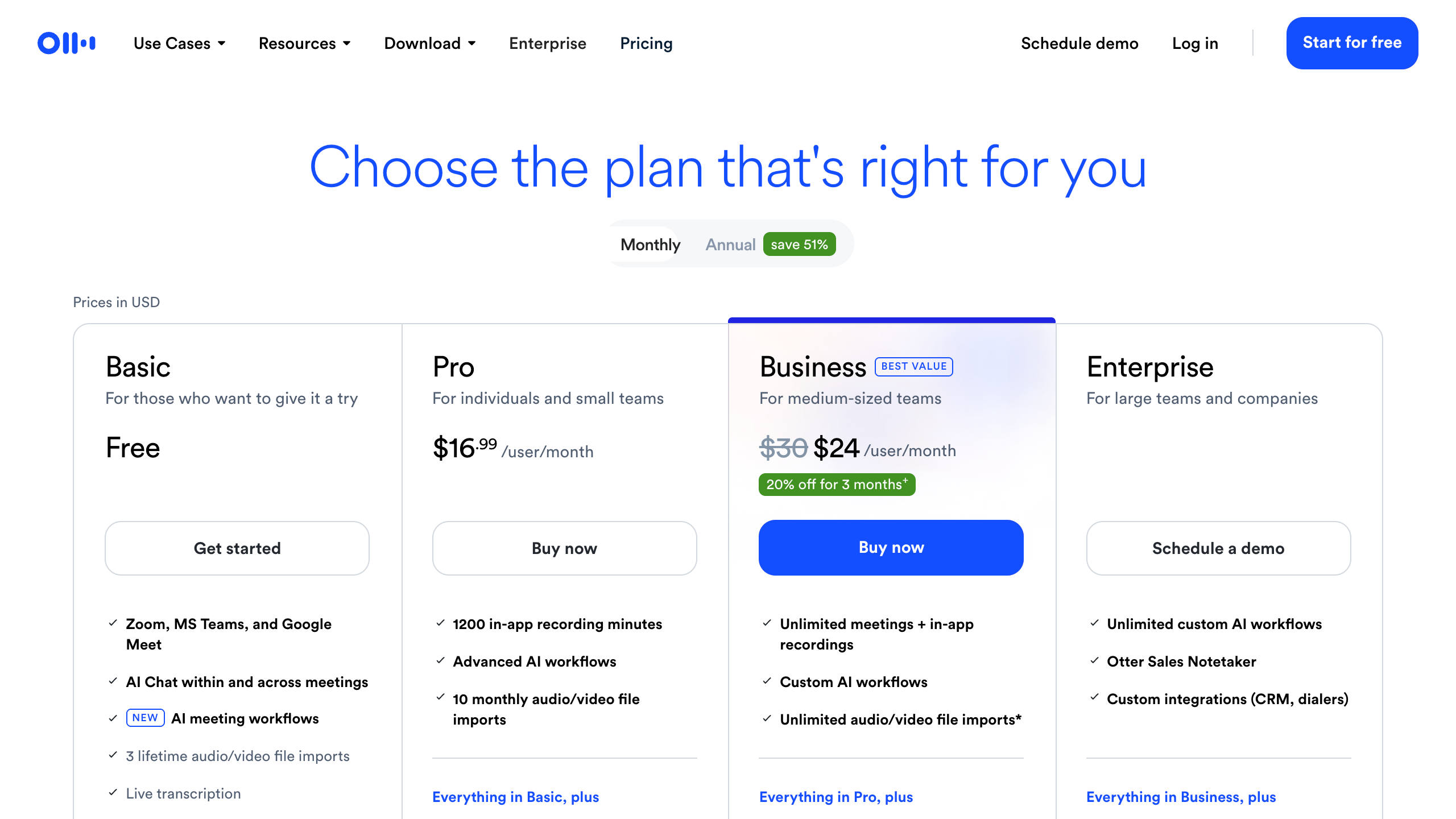
Otter’s Basic plan is free and lists 300 monthly transcription minutes with three lifetime audio or video file imports. Basic also has a 30-minute maximum per conversation. That could be enough to try a short, non-sensitive recording before paying, but three lifetime imports are not three new imports every month.
Standard Pro monthly pricing was US$16.99 per user. The annual view displayed US$8.33 per user per month as an annual-billing equivalent. Pro lists 1,200 minutes in the shared monthly transcription pool, ten monthly file imports, and up to 90 minutes per conversation. Read both the usage table and the price card before deciding which limit matters for your work.
Business showed a regular monthly price of US$30 per user alongside an introductory US$24 offer for three months for first-time subscribers. Its annual equivalent was US$19.99 per user per month. The lower promotional figure is not the regular ongoing monthly price.
Business advertises unlimited meetings and in-app recordings, but its comparison table still lists 6,000 monthly minutes per user for imported-file transcription. Keep that distinction in mind if you plan to upload a library of existing videos. Unlimited file counts do not mean unlimited imported audio duration.
My recommendation is to choose the smallest plan that handles your actual recording pattern. A solo creator does not automatically need a team plan because the higher tier has a longer feature list. Try a representative recording, check the transcript, and see whether it genuinely reduces your editing work.
The downside is that capturing more material can become another form of procrastination. If you record ten explanations and never turn one into a useful article, the subscription is not solving the problem. Set a clear output for each recording, such as one guide answering one reader question.
2. Gamma for turning an edited brief into a visual explanation

I would consider Gamma when you have the facts and need help presenting them. Its public plans cover presentations, documents, websites, social content, and images. For this workflow, the useful job is creating a first visual structure from a brief you have already edited.
Think of a short explanation of how an order moves from checkout to supplier confirmation to delivery scheduling. You can supply the real sequence and ask for one clear idea per slide. Then you review whether the resulting presentation actually explains the process without adding steps that your business does not follow.
Gamma’s Free plan lists 400 credits at signup and up to ten slides per prompt. Its help documentation says those free credits do not automatically refresh. The public plan also lists imports from PDF and PowerPoint, with exports to PDF, PowerPoint, PNG, and Google Slides.
That gives you a reasonable starting point for a small experiment. Make a short explanation, export it, and open the exported file. Check headings, line breaks, tables, and any images at the size your audience will actually see. An attractive editing canvas is not the same as a finished file.
Plus lists 1,000 monthly credits, removal of Gamma branding, and advanced image models. Pro lists 4,000 monthly credits, custom branding, analytics, and API access. Ultra lists 20,000 monthly credits. Those are plan allowances, not guarantees that every generated output will be useful.
The regional monthly view I checked showed Plus at IDR 100,000 per seat per month and Pro at IDR 250,000. With annual billing selected, those became monthly equivalents of IDR 80,000 and IDR 200,000, with annual charges of IDR 960,000 and IDR 2,400,000 per seat. Taxes may apply, and your location can show different pricing.
I would start with Free unless you can name the paid feature you need. Removing branding for regular client-facing presentations is a concrete reason to consider Plus. Buying a much larger credit allowance because it sounds productive is not. Check your own account offer rather than converting a regional screenshot into an assumed universal price.
The downside is that AI-generated structure can look polished while saying very little. If a slide reads like a vague motivational quote, replace it with a specific instruction or remove it. The goal is to help someone understand the decision, not to fill a deck with impressive-looking cards.
Have the facts but need a cleaner explanation? Check Gamma’s free option and current regional plans.
Start with a real reader question
Before opening either tool, write the question your content will answer. Make it specific enough that you can tell whether the finished piece did its job. “How should a customer prepare for a freight delivery?” gives you a useful direction. “Create amazing ecommerce content” does not.
Then write what the reader should know by the end. They might need to understand the difference between curbside delivery and installation, which access measurements to check, and who confirms the appointment. Those answers should come from the current supplier documents and the actual offer, not from a model filling in gaps.
If you are still choosing the audience for your store, use my high-ticket niches list to explore a focused category. Go deep before you go wide. It is easier to create useful content when you understand one buyer’s questions than when you are trying to cover every possible product.
A good brief includes the question, the intended reader, the verified facts, and what you do not yet know. Unknowns should stay visible. If the delivery date depends on a destination and supplier confirmation, say that instead of letting AI replace the uncertainty with a reassuring promise.
Build an article from notes without losing your voice
I would use a simple sequence: record the explanation, review the transcript, select the useful points, and draft the article. Do not ask the software to turn every sentence of a recording into polished prose. Spoken explanations usually include repetition, tangents, and details that do not belong in the final piece.
After using Otter to capture the source, keep the actual recording available during editing. Mark the parts that support a claim and remove passages that rely on missing context. A summary should not quietly upgrade “might be possible” into “will happen.”
For the first draft, explain one point per paragraph. Name the condition, describe the trade-off, and tell the reader what to check next. If the paragraph could appear on any business blog without changing a word, it probably needs a more concrete example.
For example, “AI improves efficiency” is not useful advice. “Review the transcript for model numbers before turning a product discussion into a buying guide” is. It gives the reader a task and explains where the mistake can happen.
Read the final version out loud. Would you actually say that sentence to someone asking for help? Replace corporate language with direct explanations. Keep the nuance, but remove the strange transitions and inflated claims that make AI-assisted writing feel disconnected from a real person.
Keep product content tied to real evidence
This matters even more for high-ticket products. A customer considering a substantial purchase needs correct dimensions, clear delivery information, and realistic expectations. A generated image or confident paragraph does not establish those details.
If you are new to the model, my guide to what high-ticket dropshipping actually involves explains the business side. The store’s job includes explaining the offer accurately and coordinating the order. Publishing attractive content does not remove those responsibilities.
For supplier-dependent claims, follow the process in my guide to finding and qualifying high-ticket suppliers. Confirm authorization, delivery terms, returns, and warranty handling with the supplier before using those details in public content.
Supplier Paradise, my supplier research business, can help you build a lead shortlist. A lead is a starting point for research, not proof that a company will approve your store or provide a particular margin. Do not feed a directory entry into AI and publish the result as a verified supplier recommendation.
Use actual manufacturer images or your own photography when describing a specific product, with the necessary permission. An illustrative graphic can explain a general idea, but it should not be passed off as a real product demonstration, customer result, or screenshot of a feature you have not used.
Need stronger source material before creating supplier content? Use the supplier qualification walkthrough first.
Turn one useful explanation into a small content package
Once the article is accurate, you can repurpose it. I would create one short visual explanation, one email introduction, and one video outline from the same edited source. Each format needs its own structure, but the facts should remain consistent.
For a presentation in Gamma, provide the final outline instead of an unfinished transcript. Give it the main question, the verified sequence, and the specific facts that must not change. Review the result against the article, not against how polished the slides look.
The email can explain why the question matters and point the reader toward the next decision. The video outline can demonstrate the process using real materials. Neither needs to reproduce the entire article word for word. Keep the content useful for the channel instead of stretching one idea into twenty repetitive posts.
Start with a small package you can finish. If you cannot review three outputs properly, producing thirty is not progress. A manageable routine is better than a large queue of drafts that nobody has checked.
Budget for accepted work, not generated work
The number I would track is cost per finished, accepted piece. Include the subscription, any additional usage, and the time spent fixing the output. A cheap tool can become expensive if it creates more editing than it removes.
Here is a hypothetical example, not a claim about either provider. Suppose a tool costs $20 for a month and helps you finish four useful pieces. That is $5 in software cost per accepted piece before your labor. If you generate forty drafts but finish only one, the relevant figure is $20, not fifty cents.
Track why you rejected outputs too. Was the source weak? Did the prompt lack a clear question? Did the export break the layout? Those problems have different fixes, and a larger subscription does not necessarily solve any of them.
For team plans, check whether every seat is billed. Annual prices often display a monthly equivalent while charging the year upfront. Review the renewal terms and your actual workload before committing. I would rather see you finish a modest content routine than buy a stack of tools you rarely open.
Handle recordings and private information carefully
Use recordings you have the right to make and process. Get appropriate consent from participants and follow the requirements that apply to your situation. If you are unsure, ask a qualified professional rather than treating an AI-tool tutorial as legal advice.
Do not upload customer payment details, identity documents, or private account information just to create an article. You can usually explain a process with a fictional example that is clearly labeled and contains no real customer data. Check the provider’s privacy terms, sharing settings, and retention options before using sensitive material.
Your business setup also matters. My business formation guide for high-ticket dropshipping covers the broader foundation to discuss with your advisers. Content tools do not replace the work of organizing your business, permissions, and responsibilities.
Keep an editable source file outside the published page. Save the approved wording, the date of your research, and the relevant product conditions. When pricing or an offer changes, that record makes an update much easier than trying to remember why you wrote a particular sentence.
Still choosing the business behind the content? Explore focused niche ideas before building your publishing routine.
How I would choose between these tools
If finding and reviewing spoken ideas is the bottleneck, start by checking Otter’s current plans. Use a short recording that represents the kind of work you actually do. Check accuracy and editing time before deciding whether the paid limits are worth it.
If you already have a clear, factual brief but struggle with visual structure, start by checking Gamma’s free option. Make one small presentation, export it, and review the finished file. The test is whether it makes the explanation clearer.
You may not need both. You may not need either if your current process already works. The purpose of this shortlist is to match a tool to a real job, not to convince you that every creator needs more software.
My selection criteria here are task fit, visible plan limits, a low-commitment starting option, and the ability to review the output before publishing. This is a research-based comparison, not a controlled accuracy test, a security audit, or a promise of more traffic.
Frequently asked questions
What are the best AI tools for content creation for a small business?
It depends on the task. This shortlist covers Otter for spoken source material and Gamma for visual explanations. Start with the part of your workflow that is slowing you down, then test whether the tool improves one finished piece.
Can I create content without paying for an AI subscription?
Yes. Both providers have free starting options with limits. Otter Basic has transcription and import restrictions, while Gamma’s initial free credits do not automatically refresh. You can also write and design content yourself without either tool.
Can I publish an AI-generated article without editing it?
I would not. Check factual claims, quotations, dates, product terms, and any instructions before publishing. You are responsible for what your business tells readers, even when software produced the first draft.
Does Gamma’s annual price mean I pay that amount monthly?
No. The annual view displays a monthly equivalent and an annual charge. Prices are per seat and may vary by location and taxes. Read the selected billing option and the actual checkout offer before subscribing.
Will these tools increase my traffic or sales?
There is no guarantee. They may help with parts of production, but useful content still needs a clear audience, accurate information, appropriate distribution, and a relevant offer. Track the finished work and the reader’s response rather than assuming more generated content means better results.
My recommendation: fix one production problem first
Start with one reader question and one piece of source material you can verify. If a recording is the easiest way to explain the answer, use transcription to make it easier to edit. If a visual sequence would help, turn the edited outline into a short presentation and check the export.
Keep the factual work in your hands. Do not invent personal testing, supplier promises, testimonials, or business results to make a piece sound more convincing. The useful part of your content is the judgment that tells someone what to do and what to watch out for.
If you need help turning a business idea into a clear plan, my private high-ticket dropshipping coaching is an option to review. If you want help with a store build, you can also review the scope of my done-for-you build and launch service. Those are separate business services, not included with either software subscription.
Build a focused business and a useful content routine. Review the coaching offer and decide whether the scope fits your next step.
Related guides
These guides cover the business decisions your content should support:
- What is high-ticket dropshipping?
- High-ticket niches list
- How to find and qualify high-ticket suppliers
- Business formation for high-ticket dropshipping
- Supplier Paradise’s high-ticket supplier research guide
Research note: official Otter pricing and usage comparison, Gamma pricing, and Gamma subscription help were reviewed October 11, 2026. Prices and features can change. Gamma figures shown here are the localized rupiah offer observed during research, not a universal US-dollar rate. Provider screenshots identify their capture date and selected billing view.

Trevor Fenner is the founder of Ecommerce Paradise. His main projects are Ecommerce Paradise, Supplier Paradise, and Review Paradise, which is currently in development. TrevorFenner.com publishes research-based reviews and practical guides to online business tools and remote-work services, with clear affiliate disclosures.