

The best business broker is the one that fits your business model, your records and the level of help you actually need. So start with the work included in the engagement, not the size of the marketplace. A big marketplace does not automatically make it the right service for your sale.
For an online business, compare financial verification, buyer qualification and transfer responsibilities. Write down the fees and payment terms separately from the asking price. A valuation estimate is not an offer, and it’s definitely not cash received at closing.
I’ve been on the seller side of this. In 2022 I sold a multi-store ecommerce portfolio doing about $7M a year, so I know a sale is a big, detailed process with a lot of moving parts. Keep that in mind before you treat any listing price as money in the bank.
Here’s what I’d do first. Define your reason for buying or selling before you browse listings. Ownership includes customer obligations, supplier relationships and real operating work, and the business needs to fit your available time and experience.
At Ecommerce Paradise, I focus on understanding the operation before choosing tools or services. An acquisition needs evidence about the existing business plus a clear plan for taking over responsibility. If you’re new to the model, my guide to what high-ticket dropshipping is explains how many of these stores operate.
This research-based shortlist compares Empire Flippers and Flippa for online businesses. No transaction, valuation application or brokerage engagement was completed for this guide. Independent legal, tax and accounting advisers should review your proposed deal.
Disclosure: some links are affiliate links, and qualifying purchases earn me a commission at no extra cost to you. I own Ecommerce Paradise and Supplier Paradise. Referral compensation does not establish eligibility, buyer interest, sale timing or a particular transaction price.
Compare the service scope
| Service | Route to investigate | Main fit question | Cost question |
|---|---|---|---|
| Empire Flippers | Curated online-business marketplace | Does the business meet current eligibility rules? | What is the blended commission for your proposed deal? |
| Flippa | Self-service or broker-assisted selling | Which responsibilities does the selected package include? | What are the upfront, success and separate transaction fees? |
Use those 2 questions per row as your starting checklist. If you can’t answer them in writing, you’re not ready to compare prices yet.
Empire Flippers for a qualifying established business
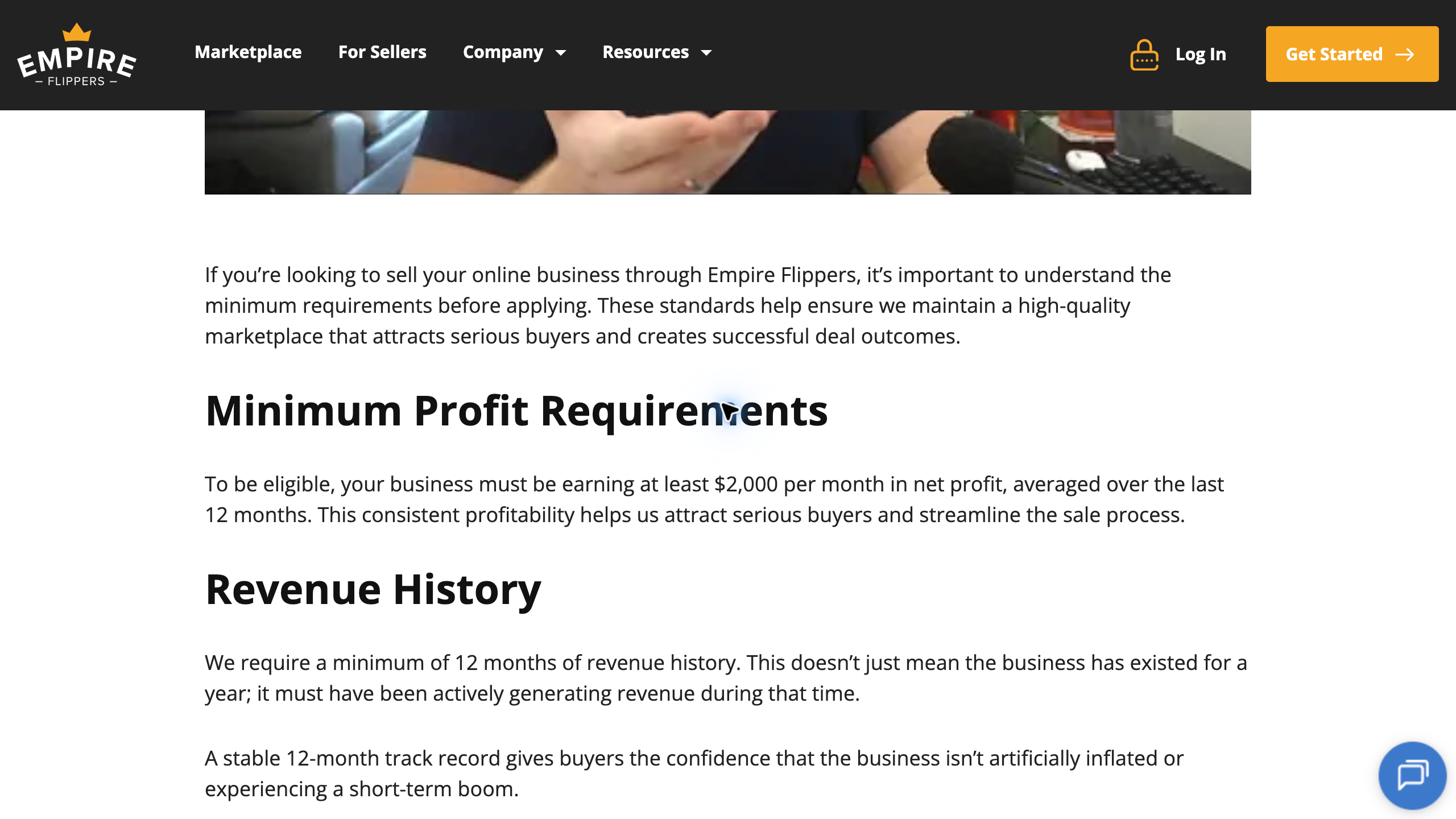
I’d look at Empire Flippers for an established online business with records that support the proposed sale. Review eligibility before you prepare an application. A marketplace’s screening does not replace your own transaction review.
The Empire Flippers listing requirements page specifies $2,000 in average monthly net profit over 12 months, 12 months of active revenue and 3 months of Google Analytics or Clicky data. The broader official selling guide contains both $2,000 and $3,000 threshold language for 12-month averages. So ask the team to confirm your business’s current eligibility in writing before you prepare an application.
Additional business-type restrictions apply. Minimum figures do not guarantee acceptance.
The current Empire Flippers seller FAQ lists no listing fee and a blended commission schedule. Sales through $66,666.66 carry a $10,000 commission. Above that threshold through $700,000, the stated rate is 15% of the sale price.
Incremental value above $700,000 through $5 million carries 8%, with 2.5% on value above $5 million. Don’t apply the smallest percentage to the entire deal. Get the current written calculation for your proposed terms.
Here’s a hypothetical $1 million sale under the published schedule. The commission is $105,000 on the first $700,000 plus $24,000 on the next $300,000, for a total of $129,000. The $871,000 remainder is before other costs, taxes, debt repayments or closing adjustments.
Applying 8% to the entire sale would understate the published commission. This is a fee illustration, not a quote, offer or valuation.
The FAQ describes at least 2 months of listing exclusivity and migration services. Confirm the engagement’s scope, conditions and exclusions before you sign. No eligibility application, migration or sale was performed for this comparison.
Use Empire Flippers’ current seller process to check fit. I like it as a route to investigate for an established business because its published requirements and commission schedule give you something concrete to check. Keep buyer questions, supporting records and unresolved transfer permissions visible instead of assuming a listed business is ready for every buyer.
Flippa for listing or broker-assisted routes
I’d compare Flippa’s selling routes after you decide which responsibilities need outside help. Self-service exposure and a dedicated brokerage engagement are different purchases. Read the selected scope before you pay.
The public pricing page asks you to pick an asking price and separates self-service packages from broker support. Fees and displayed offers depend on that context. One visible entry price is not a universal quote for every business.
Ask for the upfront charge, listing duration and success-fee calculation together. Identify optional upgrades and any separate payment or escrow costs. Write down how a different final sale price or deferred consideration changes the charges.
Ask who qualifies buyers, handles document requests and leads negotiation. A general support description does not mean each responsibility is included. Save the selected package and actual agreement for review with your advisers.
For buyers, define the business model and operating workload before you browse. A larger selection gives you more research options, not proof that any one listing suits you. No listing purchase, broker engagement or transaction test was completed for this guide.
Check Flippa’s current service scope against the help you need. I like that it offers both a self-service route and broker support, so you can match the spend to how much work you want to hand off. Resolve open fee and responsibility questions before you treat the package as a complete sale-management arrangement.
Define the help you are hiring
A marketplace listing gives you exposure. A brokerage engagement gives you the responsibilities written in the agreement. Figure out who prepares the sale materials, screens buyers and coordinates negotiation before you compare the first advertised price.
Ask for a written responsibility list. A named contact does not mean that person reviews your financial records or leads the entire transaction. Record which tasks belong to you, the broker and your independent advisers.
Clarify whom the broker represents and how they get paid. A helpful conversation does not create a fiduciary relationship or remove conflicts. Your advisers should review the actual engagement instead of guessing obligations from a service headline.
Compare the scope against your available time. An experienced seller with organized records needs different help than an owner without a documented operation. The cheaper package sometimes leaves a lot of work with the seller.
Compare cash received and payment conditions
An asking price is not the amount available after closing. Separate selling fees, professional costs, debt repayment and adjustments. Keep tax questions with a qualified adviser instead of subtracting a guessed percentage from the headline.
The IRS page on the sale of a business explains that the sale price of a business gets allocated among its assets, and both buyer and seller use that method. That’s one reason a tax professional belongs on your team early. This is general information, not tax advice.
Here’s a hypothetical $200,000 offer. $160,000 at closing and $40,000 contingent on future performance are very different amounts, because the contingent part depends on the agreement and later events. This example shows payment structure, not a business valuation or actual offer.
Use separate columns for closing cash, fixed deferred payments and contingent consideration. Ask who measures performance and how disputes get resolved. A single combined number hides big differences between otherwise similar offers.
Confirm when the broker fee becomes payable and which consideration goes into the calculation. Deferred money creates its own timing question. Get the answer in writing before you compare the net proceeds of several offers.
Reconcile the financial evidence
Prepare monthly revenue and expense records with the underlying statements. A summary spreadsheet needs support for every figure. Ask an accountant to find discrepancies before you present the records as a dependable earnings history.
Keep explanations for unusual months right next to the relevant records. A supplier shortage, promotion or large refund changes how the numbers read. The explanation should name the event and the supporting evidence, not call every dip “temporary.”
Owner adjustments need careful review. Removing a genuine one-time cost is different from ignoring work the buyer will have to replace. Record the reasoning and the expected replacement expense so the proposed profit number makes sense.
Don’t treat revenue, cash receipts and profit as one interchangeable figure. Payment timing and expenses change the comparison. Ask your adviser which measure supports the transaction and how the records tie back to the operating business.
Check traffic and revenue concentration
Identify the sources behind the sales. A store that depends on one advertising account carries different risk than one with several independently supported channels. Record the spend, account ownership and evidence behind each channel’s reported results.
For an affiliate site, separate traffic from commission receipts. A ranking screenshot does not prove revenue or continued program approval. Review actual reporting periods and the conditions that affect the monetization setup.
Customer and supplier concentration deserve their own review. One important account or brand sometimes supplies a big share of revenue. Ask what happens if that relationship changes, without assuming the current contract carries over unchanged after a sale.
Keep observed facts separate from forecasts. A growth plan describes intended actions, not completed performance. The buyer needs a budget and operating plan for the future work, not a promise built on a nice-looking chart.
Establish transfer responsibilities before signing
List the domain, store, content rights, software, supplier arrangements and relevant accounts. Each dependency needs an owner and a transfer requirement. A single promise to “hand over the website” leaves important operating questions unanswered.
Ask each essential provider about its actual change-of-owner process. The seller’s existing permission does not prove approval for a new owner. Required consent belongs in the transaction plan, not as an assumed admin task after payment.
Affiliate accounts and rates need extra care. Buying content does not automatically buy the seller’s approval or compensation arrangement. Identify what transfers and what needs a new application before you rely on projected commission income.
Record the evidence that shows each item is complete. A changed account label is different from approved ownership and usable access. Your advisers should define the transaction conditions and what happens if a transfer is refused.
Supplier transfers can be a real pain in the butt. In high-ticket dropshipping especially, authorized supplier relationships are a big part of what you’re buying, so confirm the supplier will approve the new owner before you close.
Evaluate the weekly operating workload
Ask the seller to describe an ordinary week and a difficult week. Customer replies, delivery exceptions and supplier follow-up all belong in the workload. A small “owner hours” claim sometimes leaves out work done by contractors.
Compare that description with the procedures, records and team responsibilities. Identify the tasks that need the owner’s judgment. A business with undocumented relationships needs more transition prep than a simple task list suggests.
Separate maintenance from planned growth. Processing current orders is different from building campaigns, recruiting suppliers or revising content. Decide which responsibilities fit your experience before you budget for outside help.
Location independence does not remove customer obligations. I’ve been a digital nomad since about 2019, and somebody still has to answer time-sensitive questions during travel or time off. Define coverage and escalation instead of assuming remote ownership means the business runs unattended.
Organize a controlled document review
Ask your advisers which documents belong at each stage. Public marketing material and confidential transaction records need different handling. Never put customer identities, credentials or private financial information in a public listing.
Keep an index that names each document, its period and the person responsible for updating it. Conflicting spreadsheets need reconciliation. The reviewer should know which version supports the proposed figures.
Record every material question and answer next to its evidence. A verbal explanation that conflicts with the contract needs clarification. Keep the disagreement visible instead of picking whichever answer supports the decision you’d prefer.
No private records were requested or evaluated for this article. These steps describe preparation for your own authorized review. Marketplace marketing and public screenshots don’t prove the quality of a particular seller’s confidential documents.
Compare buying with building from scratch
An acquisition involves an existing operation with negotiated assets, obligations and relationships. A new store build creates a foundation without an established revenue history. The 2 routes need different evidence and budgets.
My high-ticket dropshipping guide explains the supplier-dependent model. Use the operating details to judge your responsibilities, not to predict earnings from a specific listing.
The high-ticket niches list supports category research. Understand the buyers, products and service expectations before you treat an unfamiliar store as a good acquisition.
My supplier sourcing guide gives you a commercial verification process. For an acquisition, include the new owner’s approval and any revised terms in the investigation.
Supplier Paradise is a research business I own. A directory lead does not establish dealer authorization, stock availability, margin or consent to transfer another owner’s arrangement.
Use my business foundation checklist for admin questions. Transaction-specific structure, tax and legal obligations need advice based on your actual circumstances.
Budget for the period after closing
The purchase price is only one part of the money you need. Operating bills, professional support and transition work need their own budget. A newly transferred business still has payment dates and customer obligations.
Identify supplier payment terms and the timing of customer receipts. Ask your accountant to review the working-capital assumptions. Revenue reported in a listing does not tell you the cash available on every day of the month.
Include replacement labor and essential software in the operating plan. A seller’s unpaid effort does not become free labor for the buyer. Write down which tasks you’ll do yourself and which need a paid arrangement.
No financing recommendation or affordability decision is made here. Use the actual transaction documents and your own financial position with proper advisers. A public broker comparison doesn’t have the evidence needed for an individual acquisition decision.
Specify the training and handover
A handover call is different from a written operating manual and scheduled assistance. Name the included training, its duration and response expectations. Open questions need an agreed route after the seller stops running day-to-day operations.
Cover current customer commitments and unresolved orders separately from general training. The new owner needs accurate information about outstanding responsibilities. A completed domain transfer does not resolve every order or return.
Ask who approves changes during the transition. Conflicting instructions from several people cause preventable mistakes. Keep one current procedure and record decisions before staff repeat an outdated process.
Prepare completion criteria for the handover. List the documents, access and approvals required, with a responsible person for each. Your advisers should handle unresolved items through the actual agreement, not informal reassurance.
Write the decision before committing
As a buyer, define your research criteria before you request introductions. Include the business model, the records you need and the responsibilities you’re willing and able to take on. An unfamiliar operation deserves its own learning period, not a decision based only on advertised returns.
List the skills missing from your current team. Supplier negotiation, technical maintenance and customer support sometimes need separate specialists. Ask about the practical replacement plan instead of assuming one assistant covers everything the seller used to do.
As a seller, prepare an accurate description of recurring tasks and unresolved problems. The buyer needs enough context to evaluate the work. Hiding a difficult supplier or a persistent delivery issue just delays the conversation and makes your records less useful.
Compare proposed timelines with the outstanding tasks. Financial reconciliation, adviser review and provider consent each need an actual response. A preferred closing date is not evidence those things are done.
Keep the responsible contact next to every open question. A general list of concerns gets more useful when each item has a decision owner and required evidence. Follow up on missing answers without treating silence as approval.
Record the review date on information that changes. Supplier stock, advertising costs and software charges all move over time. Ask what changed between when the listing was prepared and the proposed transaction instead of assuming every original figure is still current.
So what you should do is write a short decision note. Name the business model, the reason for the transaction and the help you need. Add the supported financial period, the actual fee quote and the unresolved conditions, because an unexplained preference needs more research.
Keep walk-away conditions explicit. Missing financial evidence, refused transfer consent or an unsuitable workload are real issues. Resolve them before emotional attachment replaces your original criteria.
Review the brokerage engagement separately from the purchase agreement. Each document creates different obligations. A platform’s support does not remove the need to understand the contract you’re signing.
My take on choosing a business broker
All right, let’s pull it together. Decide what help you’re hiring, then compare the written scope and the full fee calculation, not the headline percentage. Treat closing cash, deferred payments and contingent money as separate numbers.
Reconcile the financials, check concentration risk and confirm every transfer, especially suppliers and affiliate accounts, before you sign. And get independent legal, tax and accounting advice on the actual deal.
My private coaching is a business-building offer I own. It is not brokerage representation or individualized investment, legal or tax advice.
If you’d rather build than buy, my done-for-you build and launch service creates a new store for you. It is not an existing operating business or a promise of current cash flow or future resale value.
Frequently asked questions
Does a listing package include brokerage? Review the selected package and engagement. Name the person responsible for buyer qualification, negotiation, documents and transition before assuming full service.
Is a valuation the amount received? No. An estimate is not an offer or completed transaction. Fees, adjustments, deferred payments and contingencies affect the actual proceeds.
Do supplier and affiliate arrangements transfer automatically? No. Confirm requirements with the relevant provider. The existing owner’s approval does not prove consent for the buyer.
Does screening replace independent advice? No. Use advisers suited to the transaction. Marketplace screening does not resolve your contract, tax treatment or individual financial circumstances.
Related guides
The dropshipping explainer covers the operating model.
My niche research guide supports category investigation.
The supplier research guide covers commercial verification.
Use the business foundation checklist for admin preparation.
Supplier Paradise’s supplier guide gives you additional research context.

Trevor Fenner is the founder of Ecommerce Paradise. His main projects are Ecommerce Paradise, Supplier Paradise, and Review Paradise, which is currently in development. TrevorFenner.com publishes research-based reviews and practical guides to online business tools and remote-work services, with clear affiliate disclosures.