
The best free Shopify apps are the ones that solve an actual problem without creating three new ones. A free plan is useful when you understand its limits, know who will run it, and can remove it without losing control of your business.
I would not start a store by installing twenty apps from a list. Start with the customer journey. Can someone understand the product, find reliable delivery information, ask a question and place an order? If those basics are a mess, another popup is not going to fix them.
At Ecommerce Paradise, my approach is to build the business foundation before expanding the tool stack. For a supplier-dependent store, that starts with understanding how high-ticket dropshipping works. Apps support that process. They do not replace supplier approval, accurate product information or someone responsible for customer service.
This research-based shortlist covers four apps with published free plans as reviewed October 11, 2026. It is not a claim that I personally tested every feature. Two options handle reviews, one handles email, and one helps manage affiliate partners. You do not need all four, and a free app plan does not make Shopify, your marketing or your business free.
Affiliate disclosure: some links in this article are affiliate links. I may earn a commission if you buy through them, at no additional cost to you. I also own Ecommerce Paradise and Supplier Paradise.
Need review collection without another monthly subscription? Compare Judge.me’s current free plan.
The best free Shopify apps by the job you need done
| App | Job | Published free-plan boundary | Decision to make |
|---|---|---|---|
| Judge.me Product Reviews | Collect and display customer feedback | Unlimited product and store reviews, including photos and videos | Do its free displays and customization meet your needs? |
| Omnisend | Email forms, campaigns and workflows | Up to 250 people and 500 emails per month | Will campaigns plus automations fit the sending allowance? |
| Yotpo Product Reviews | Review requests and on-site display | Up to 50 monthly orders | Is this review system a better fit than your alternative? |
| UpPromote | Track your store’s affiliate program | One program and a $3,000 monthly referral-review allowance | Do you have partners to recruit and margin to pay them? |
These are different jobs, not a ranking of four interchangeable tools. Judge.me and Yotpo are alternatives for a review workflow. Omnisend serves a separate email-marketing role. UpPromote only belongs in the stack when you are ready to run a merchant affiliate program.
1. Judge.me Product Reviews for a straightforward review foundation
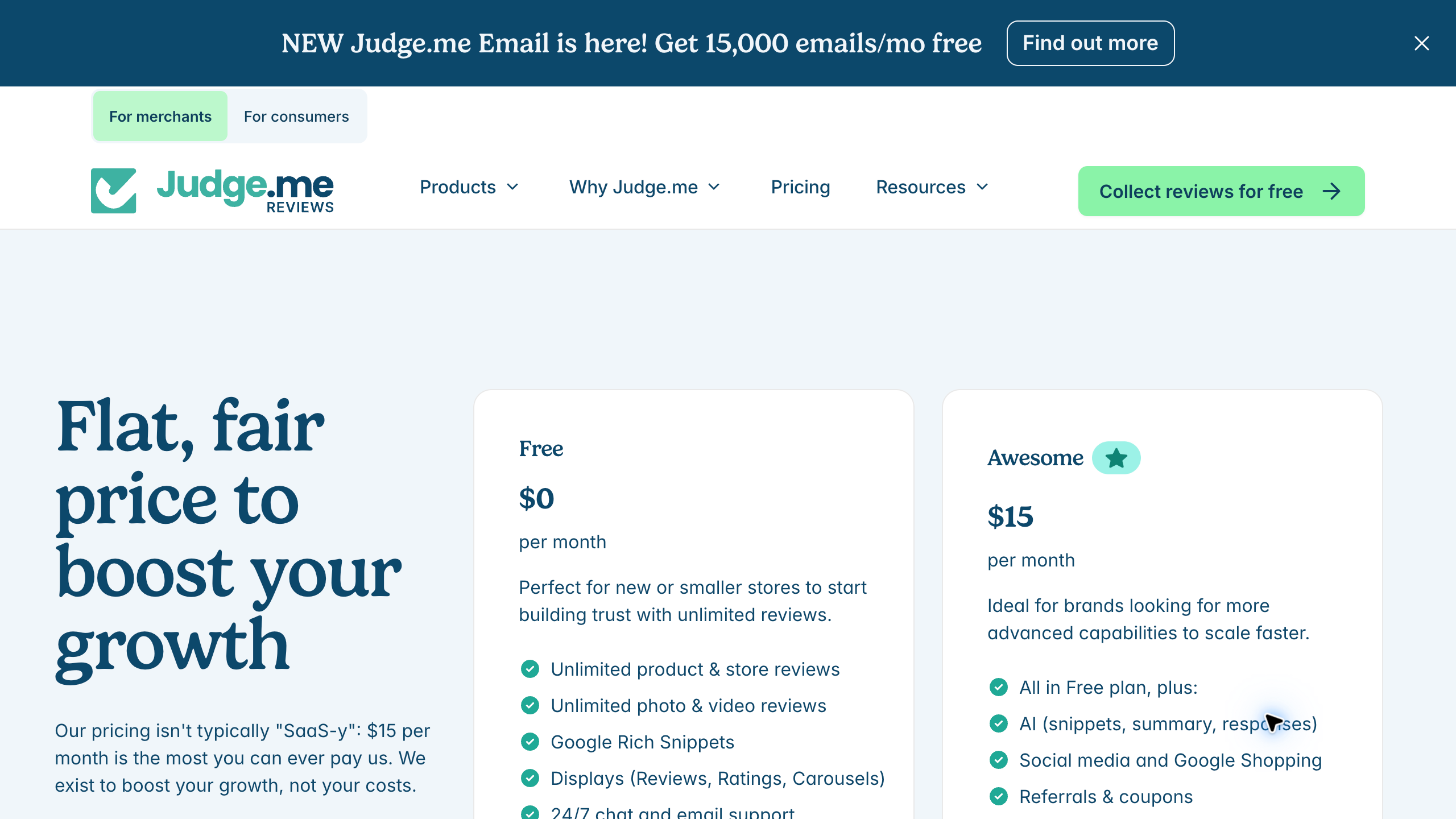
I would start by researching Judge.me if collecting and displaying genuine customer feedback is the missing piece. Its published free plan includes unlimited product and store reviews, photo and video reviews, review displays and Google rich snippets. The paid Awesome plan is listed at $15 per month for additional capabilities.
The practical question is not whether you can get a star badge onto the page. It is whether a buyer can find useful feedback about the exact product. A generic testimonial does not answer whether a particular model was easy to assemble, whether the instructions were clear or how delivery went.
I would prepare the product records before importing anything. Match the feedback to the correct product, preserve its source and date, and make sure you have permission to use it. Do not copy another retailer’s reviews and present them as purchases from your store. A review widget should make evidence easier to understand, not manufacture evidence you do not have.
For larger products, think carefully about when to request feedback. An order being marked fulfilled does not necessarily mean the customer has received, assembled and used it. Decide which event should trigger your process, then check that the selected plan can support the timing you need.
The free plan is worth investigating when its displays fit your theme and the basic collection process meets your needs. Do not assume every feature on the general marketing page belongs to the free tier. Judge.me Email is a separate product; an email allowance advertised for that app is not the same as the Product Reviews plan.
Compare Judge.me’s current plan details before paying for customization or integrations. I would upgrade for a specific requirement, not because a paid label makes the store feel more serious.
2. Omnisend for a small, permission-based email program
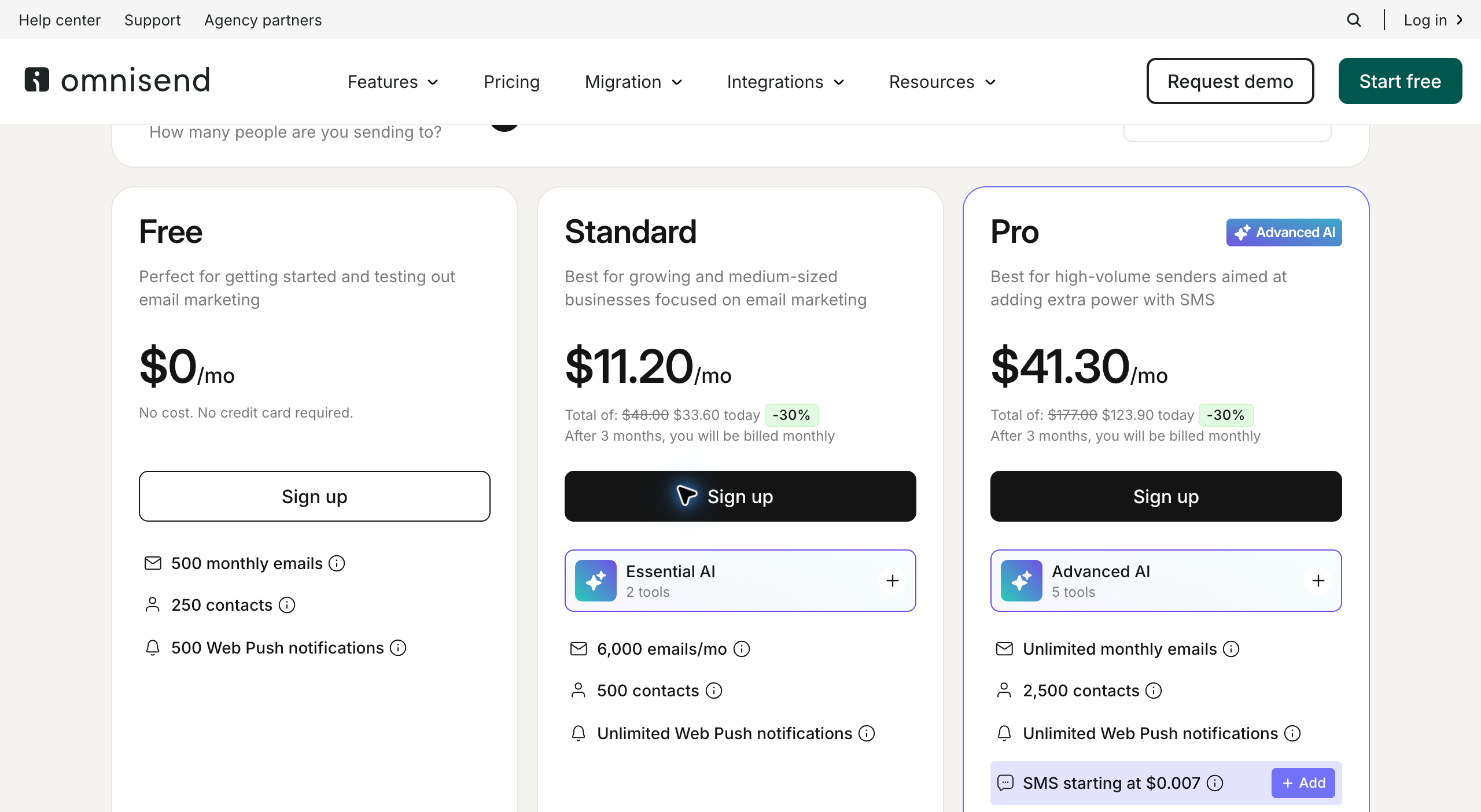
Omnisend is the email option I would put on this shortlist. Its Shopify listing shows a free plan for reaching up to 250 people with 500 emails per month, plus signup forms and welcome or abandoned-cart workflows. Those limits make it an entry-level working plan, not unlimited sending.
Here is a simple hypothetical example. Sending one campaign to 200 people uses 200 email sends. Sending another campaign to those same people uses another 200. That leaves 100 sends from a 500-email allowance before counting any welcome messages or other automations. Small subscriber numbers do not automatically mean small sending volume.
I would begin with a useful signup offer and a short welcome message. Explain what subscribers will receive and make the next step clear. For a high-ticket store, helpful material could answer a product-selection question or explain delivery preparation. You do not have to train every new subscriber to wait for a discount.
Check the actual consent and suppression behavior before enabling campaigns. A customer record is not automatically a marketing permission. Keep unsubscribed contacts out of future sends, review the integration settings, and get appropriate advice if you are unsure about the rules that apply to your audience.
Omnisend’s Standard plan is advertised from $16 per month for up to 500 contacts, with pricing increasing as the list grows. Treat that as an entry price, not a lifetime price for any size database. SMS is a separate cost question; this article does not promise unlimited free text messages.
Review Omnisend’s current contact and sending limits against a normal month of campaigns and automations. The useful outcome is a manageable communication process, not a pile of flows nobody has checked.
Start with a sending budget you understand. Check Omnisend’s free email allowance.
3. Yotpo Product Reviews as an alternative review workflow
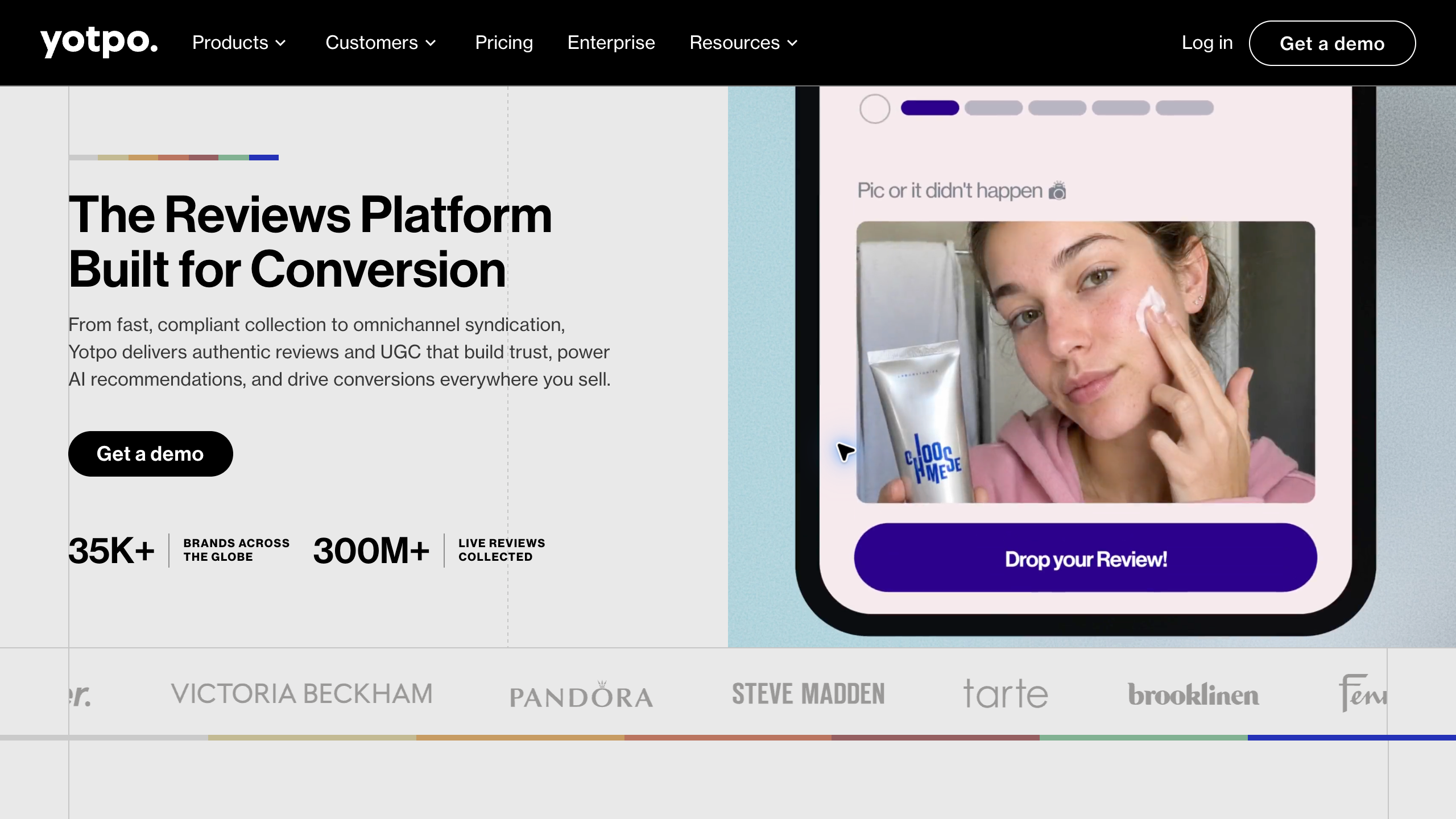
I would compare Yotpo Product Reviews when you want another review-system option. Its current free plan is limited to up to 50 monthly orders and includes automatic review requests and on-site display. That is different from an unlimited-review allowance and needs to be checked against your order volume.
The product name matters here. Yotpo offers more than one product, and pricing for Reviews is not automatically pricing for Loyalty or another service. Read the exact Reviews plan, not a general claim that the company offers something free. Confirm what happens as your monthly orders increase.
The Shopify listing puts features such as photo and video collection in the paid Starter tier. It lists an entry price of $15 per month while explaining that pricing changes with order volume. I would not describe that as a flat $15 plan for every store or assume every advertised review feature comes with Free.
Why research it when Judge.me is already on the list? Because a review system is a workflow, not just a price tag. Your existing data, display requirements and future needs may lead you toward a different choice. Write those requirements down before comparing the two.
What I would not do is install both and let both request feedback from the same customer. That creates duplicated messages and confusing ownership of the review record. Choose one primary collection process unless you have a deliberate migration plan and understand how the tools overlap.
Use Yotpo’s current signup and plan information to investigate that alternative. Check the selected product and allowance before authorizing any installation or paid upgrade.
4. UpPromote when your store is ready to recruit affiliates
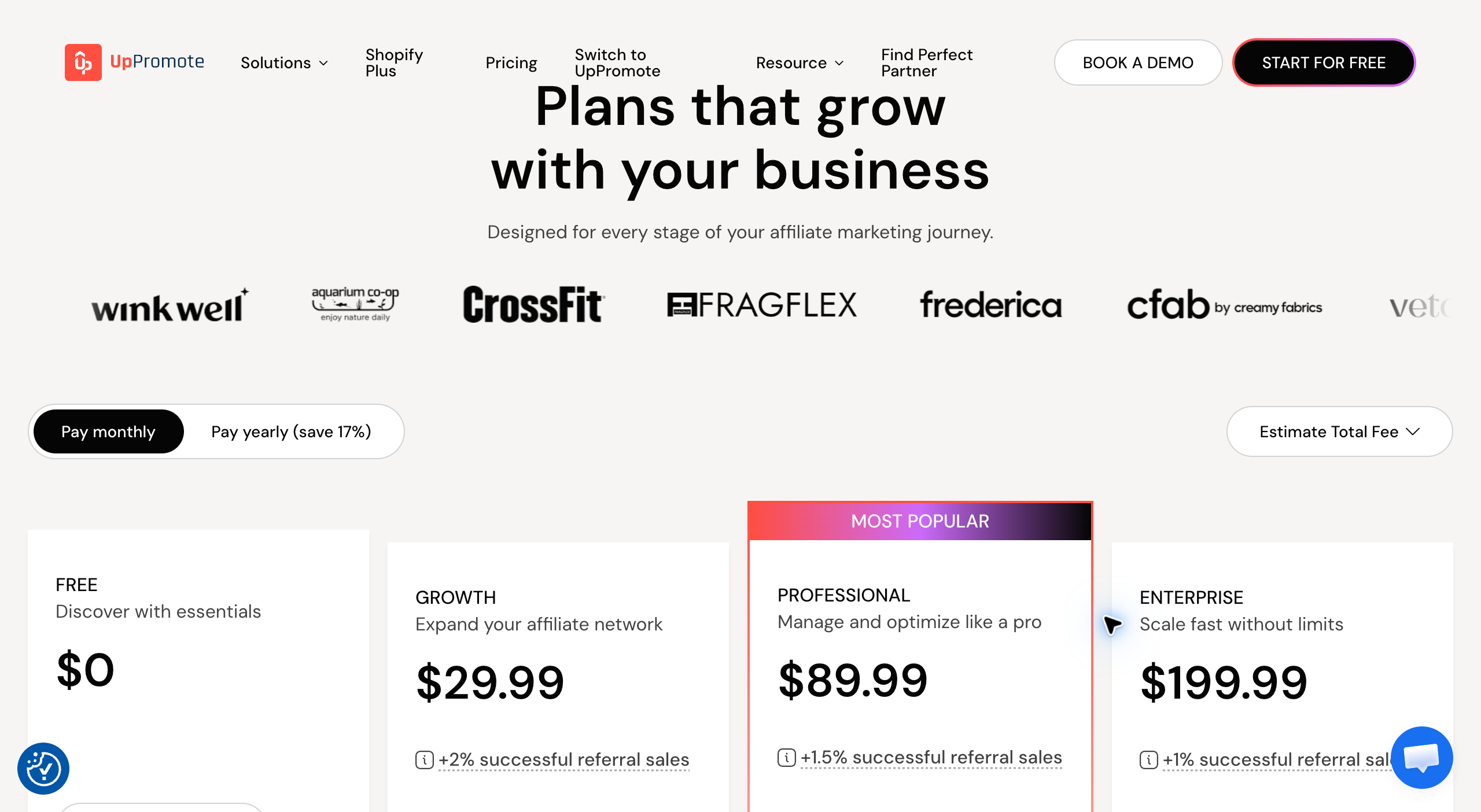
UpPromote is for running an affiliate program for your own store. Its published free plan includes one program, link and coupon tracking, and a $3,000 monthly referral-review allowance. The app listing also identifies an optional Creator Discovery add-on from $39 per month.
Keep the business model straight. This is not a supplier directory, an ad account or an automatic source of customers. It gives you a way to manage referral activity. You still need to find suitable partners, explain the offer and give them accurate material they can use.
A free app subscription also does not make affiliate sales free. You may owe commissions to partners under your own agreement. Payment costs, discounts and any optional tools belong in the calculation too. Decide those economics before inviting people into a program.
For a hypothetical $1,000 order, a 5% partner commission is $50. That is simple arithmetic, not a recommended commission rate or a claim about your margin. If your supplier cost, shipping and other obligations leave little room, adding a commission can make the order less attractive than it first appears.
The published Growth tier is $29.99 per month plus 2% of successful referral sales. Paid-tier performance charges and optional add-ons should not be confused with your separate partner commissions. Confirm the current definitions, approval rules and plan boundaries before choosing a tier.
I would research UpPromote’s free program after the store can handle ordinary orders reliably. Start with a small, relevant partner group and a written process for reviewing referrals and paying approved commissions.
What “free” means before you install anything
A free plan is an ongoing tier with stated limitations. A free trial gives you temporary access before a paid arrangement. Free installation means you can add the app without an initial installation charge, but its actual use may still generate costs. Those phrases are not interchangeable.
I would read the pricing panel and any separate billing explanation together. Look for contact limits, order limits, usage fees and paid add-ons. Then check whether the app charges through Shopify, through the provider or through both. An empty upfront price is not enough information.
Also distinguish app cost from business cost. You still need the underlying store, a product offer, fulfillment arrangements and a way to reach buyers. A free review tool does not supply customers willing to leave reviews. A free affiliate tool does not pay your partners for you.
This is why I have not turned every program in the affiliate catalog into a recommendation here. A tool belongs in a free-app article only when its verified plan fits the promise of the article. If the relevant activity needs a paid plan, it should not be presented as a free solution just because installation is available.
Build your foundation before building your app stack
Before selecting apps, write down your niche, supplier responsibilities and basic operating process. My high-ticket niches list can help with the research stage. Go deep before you go wide. Different categories have different buyer questions, delivery requirements and support needs.
For supplier work, follow my supplier qualification walkthrough. An app can move data around, but it does not prove that a manufacturer authorizes you to sell, that stock is available or that a warranty applies to your customer.
Supplier Paradise is my supplier research business. Use research leads to develop a shortlist and then verify the relationship directly. A directory entry is not a dealer agreement, guaranteed margin or confirmed stock feed.
My business formation guide is another foundation resource. Use it to organize questions for your professional advisers. Do not assume a tool subscription resolves legal, tax or privacy responsibilities for your particular business.
Understand the supplier process before automating it. Work through the supplier qualification guide.
Choose the smallest useful combination
For an early store, I would identify the single most important missing job. If you need a reliable way to collect feedback, compare the two review options. If people are subscribing but receiving nothing useful, work on the email process. If you have no partner relationships, an affiliate dashboard can wait.
Do not mistake a shortlist for an installation checklist. You may only need one app from this article. You may already have a tool doing the same job. Check your existing theme and settings before adding another layer, especially when the requested change is simply better product copy or a clearer contact method.
Give every selected app an owner. Write down who checks failed sends, reviews new feedback or approves referrals. If the answer is “the app handles it,” be more specific. Automation can carry out a rule, but someone still needs to decide whether the rule makes sense.
Set a review date after you have used the workflow for a meaningful period. Ask whether it solved the original problem, whether customers encountered friction and whether its limits still fit. Remove unused tools deliberately rather than letting subscriptions and permissions accumulate unnoticed.
Test the customer journey one change at a time
Before changing a live theme, keep a current backup or duplicate appropriate to the change. Record the settings you started with. If something breaks, you want a clear route back to a known state, not a vague memory of how the page used to look.
Then test the actual customer path on desktop and a phone. Can you read the review widget without horizontal scrolling? Can you close the signup form? Does the page still make the price, delivery information and contact route obvious? A useful feature should not get in the way of buying.
For email, use test messages and check the links, sender identity and unsubscribe behavior before enabling a sequence. For referrals, check the tracking and approval process with a controlled test appropriate to the provider’s instructions. Do not publish a commission promise you cannot calculate or administer.
Make one change at a time and keep a short change log. If you install several tools and edit the theme in one afternoon, it becomes harder to identify the source of a problem. A slower, recorded setup can save a lot of troubleshooting later.
Review permissions and plan an exit
Read the access requested at installation. Ask what customer, order, product or storefront data the app needs and why. A tool being free does not make its access harmless. Only authorize the scope you understand and are comfortable maintaining.
Also investigate how you would leave. Can you export the relevant records? What happens to review displays, forms, tracking links and historical reports after removal? Will there be theme code to clean up? Find those answers while the tool is working, not after you urgently need to replace it.
Keep provider account ownership and billing under the business’s control. If a contractor sets up the app, document who owns the account and how access will be removed when the work ends. Avoid a situation where a former helper is the only person who knows where an essential workflow lives.
A simple app register is enough to start. Record the tool, its purpose, owner, selected tier, usage boundary, billing route and exit notes. That gives you a useful operating document without needing another app to manage your apps.
When paying for an app makes sense
I would upgrade when a verified requirement exceeds the free tier and the cost fits the business. Reaching a contact cap, needing a particular integration or requiring a specific display can be a reasonable trigger. Wanting every feature on the pricing page is not a requirement.
Compare the full ongoing cost with the work the paid tier actually changes. Include any usage charges, partner commissions or other costs that apply to the workflow. Separate an introductory offer from the normal price you will pay after it ends.
If you need help deciding what belongs in a high-ticket store, my private coaching offer is an option to review. The point is to work through business decisions, not promise that a particular app will generate sales.
Still deciding what the store needs first? Review the coaching scope.
My recommendation: start lean and keep the limits visible
For reviews, begin by comparing Judge.me with Yotpo against your actual collection and display requirements. For a small email program, check whether Omnisend’s contact and sending allowances cover the work you intend to run. Research UpPromote when you have a real plan for recruiting and paying partners.
You do not earn points for having the longest app list. A smaller stack with clear ownership, accurate product information and reliable customer communication is a better starting point than a store packed with tools nobody understands.
My done-for-you store build and launch service is a separate option if you want help creating the store foundation. Review its current scope and requirements; it is not a guarantee of supplier acceptance, sales or profitability.
Choose the job, check the current plan and test the customer experience. Keep that order. It makes the free plan a useful decision instead of an excuse to install something you do not need.
Need help building the store foundation? Explore the build and launch service.
Frequently asked questions
What are the best free Shopify apps for a new store?
Start with the job you need done. This shortlist covers review collection, email communication and merchant affiliate tracking. Choose the relevant workflow rather than installing every option.
Does a free app make my Shopify store free?
No. A free app tier is separate from your store subscription and operating costs. Product costs, shipping, marketing and partner commissions can still apply.
Should I install both Judge.me and Yotpo?
Not by default. They overlap as review tools. Compare their requirements and choose one primary workflow unless you have a planned migration or another specific reason to run both.
Is Omnisend’s free plan unlimited?
No. The reviewed Shopify listing specifies up to 250 people and 500 emails monthly. Calculate campaigns and automation sends together before relying on that allowance.
Can I run an affiliate program at no cost with UpPromote?
The app has a published free tier, but that does not eliminate your separate partner commissions or other applicable costs. Confirm the referral-review boundary, optional add-ons and selected plan before launching.
Related Articles
These guides help you work on the store behind the app stack:
- Best Shopify themes for a store you can actually run
- Choose the business before the ecommerce platform
- What high-ticket dropshipping involves
- Finding and qualifying high-ticket suppliers
- Supplier Paradise’s supplier research guide

Trevor Fenner is the founder of Ecommerce Paradise. His main projects are Ecommerce Paradise, Supplier Paradise, and Review Paradise, which is currently in development. TrevorFenner.com publishes research-based reviews and practical guides to online business tools and remote-work services, with clear affiliate disclosures.