

The best virtual assistant websites help you find candidates for a job you’ve already defined. That’s the key. Write down the outcome, responsibilities and review process before you pay for recruitment, because a marketplace can’t tell you what your business needs to delegate.
Customer replies, catalog admin and supplier research take different skills and different authority. Give each role a clear scope. One broad assistant title shouldn’t hide several unrelated jobs.
At Ecommerce Paradise, I focus on understanding the operation before adding people or tools. I teach systems and SOPs for a reason. A store needs clear customer promises and someone responsible for exceptions, and that’s true whether you run it from Seattle or from Bali like I have since about 2019.
If you’re building a high-ticket store, my guide on what high-ticket dropshipping is explains the supplier-dependent model your assistant will need to understand.
This shortlist compares OnlineJobs.ph for direct recruiting, FreeUp for freelancer work and Upwork for broader project or ongoing hiring. These are different routes to look into, not guaranteed placements.
The real provider screenshots keep their October 11, 2026 dates. No candidate was contacted, hired or evaluated through an account for this comparison. Published rates and vetting descriptions don’t prove any particular person is a fit.
Disclosure: some links here are affiliate links, and qualifying purchases earn me a commission at no extra cost to you. I own Ecommerce Paradise and Supplier Paradise. Recruitment fees, worker pay and your management responsibilities each need their own review.
Compare the hiring route
| Website | Route | Cost to investigate | Your responsibility |
|---|---|---|---|
| OnlineJobs.ph | Direct recruitment focused on workers in the Philippines | Paid recruiting access and separately agreed worker compensation | Selection, role definition, management and appropriate agreements |
| FreeUp | Freelancer marketplace | Actual hourly or fixed quote. Published skill-tier estimates | Clear requirements, acceptance criteria and communication |
| Upwork | Broader project and ongoing-work marketplace | Freelancer price, applicable client fee and contract-initiation fee | Selection, milestones, review and account-access decisions |
Here’s the quick read. OnlineJobs.ph is direct recruiting for a role you’ll manage, FreeUp is a freelancer marketplace for defined work, and Upwork is a broader marketplace for projects or ongoing work. Pick the route that matches the working relationship you want.
OnlineJobs.ph for direct recruiting
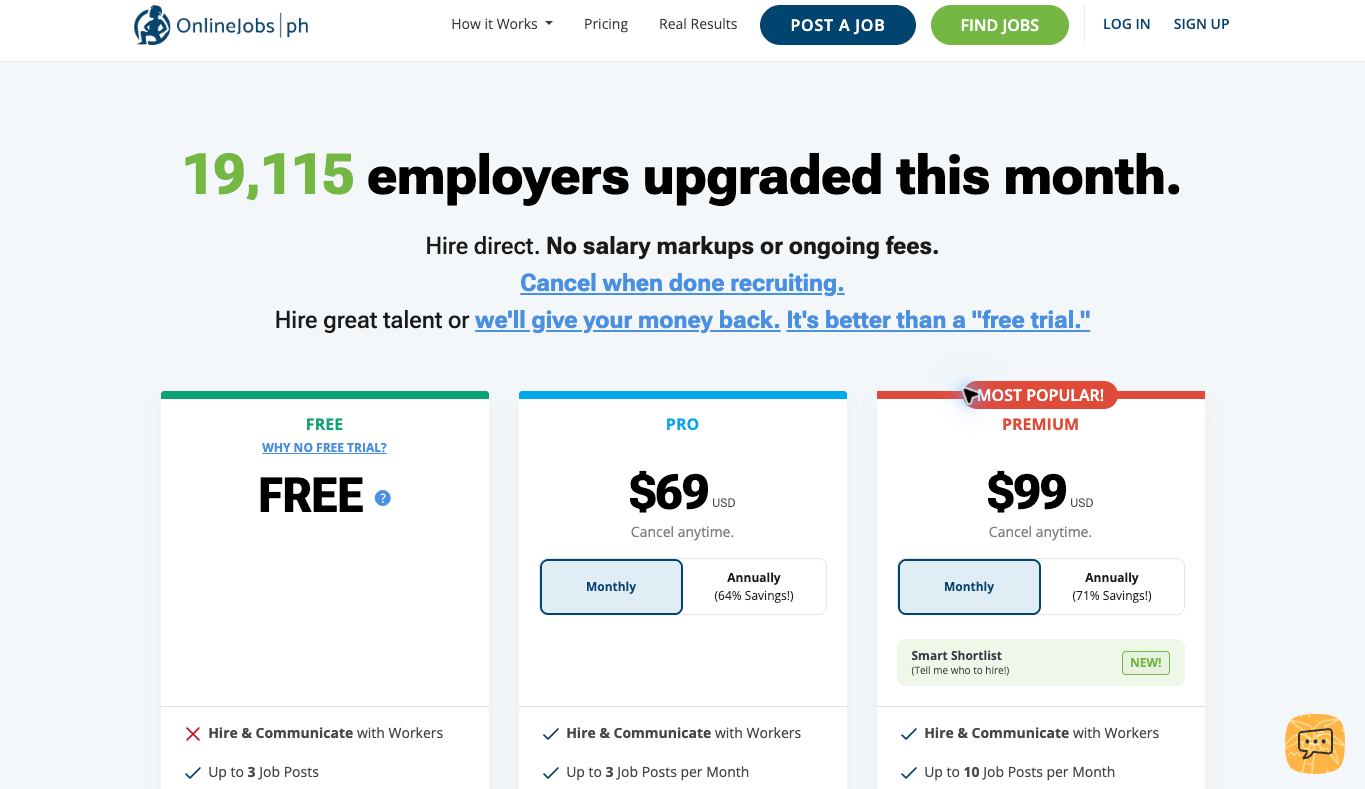
OnlineJobs.ph is a direct recruiting route focused on workers in the Philippines. I’d look at it for a recurring role when you have someone available to handle training and review. That’s where it fits best, because you’re the manager.
The current pricing-page FAQ lets you post and view applications before paying, but talking to workers requires paid access. So a free account is not a complete free hiring setup. Your plan and the pay agreement are two separate decisions.
The preserved monthly screenshot lists Pro at $69 and Premium at $99. Current public cards showed the same amounts, but billing-tab metadata stayed inconsistent after selecting Monthly. Check OnlineJobs.ph’s official pricing page and confirm the billing interval and renewal before you pay.
The provider states recruiting access doesn’t need to continue after you hire. Worker pay and your management responsibilities keep going under the actual arrangement. No applicant was contacted or hired for this comparison.
Judge relevant work, communication and availability without location-based assumptions about any individual. A marketplace description doesn’t prove fit for your specific role. Use a clear brief and review process.
FreeUp for defined freelancer work

FreeUp offers hourly and fixed-rate freelancer work with no startup or monthly marketplace fees. That makes it a good fit for scoped projects where you know the deliverable. Freelancer pay is still separate from that platform statement.
Current headline estimates list $5 to $15 hourly for entry-level work, $15 to $30 for mid-level and $30 to $75 or more for expert work. Skill-specific tables add more estimated ranges, and you can see them on FreeUp’s official pricing page. None of these is a guaranteed quote or a promise that a candidate is available for your project.
Know the difference between following a documented procedure and designing that procedure. Entering catalog data is a different job than defining the whole catalog workflow. Give the freelancer a clear output and acceptance criteria before you ask for a quote.
For hourly work, agree on capacity and progress reporting. For a fixed project, define the included records, allowed changes and exception handling. No freelancer evaluation or paid work sample was performed for this guide.
Upwork for project and ongoing hiring

Upwork is a broader marketplace option. Set your actual requirements before browsing profiles, so the proposed work matches the original need. It fits when you want a wide candidate search for a project or ongoing work.
Current Basic client support terms describe a marketplace fee of up to 7.99% on covered payments. Eligible US clients using a qualifying bank billing method get a reduced 3% rate. Business Plus has a different fee arrangement.
Current contract-initiation help describes $0.99 to $14.99 per new Marketplace or Project Catalog contract, with the actual amount varying. Special services use their own fee structures. Confirm the account and contract charges, and don’t treat the freelancer’s quoted rate as the whole cost.
Define milestones, review criteria and allowed access separately from payment admin. A marketplace contract doesn’t fix an unclear brief. No contract was started, funded or used to hire anyone for this comparison.
Write the job before choosing the website
Describe the outcome and the tasks that produce it. Accurate customer updates mean checking current order info, writing a response and escalating unresolved questions. A vague request to “manage support” leaves way too much unexplained.
Separate routine work from exceptions. An approved procedure covers ordinary actions. Refund disputes, unconfirmed delivery dates and sensitive information need a named decision owner.
Spell out what the role doesn’t include. Bookkeeping, ad strategy, design and customer support are different jobs. One broad assistant title shouldn’t make someone responsible for everything online.
Here’s what I’d do. Put the role in a short written brief before you ask for candidates. Record recurring tasks, required availability, review criteria and access boundaries, because a clear brief makes any quote more meaningful.
Choose the route around the working relationship
Direct recruiting, a fixed project and an hourly freelancer arrangement each need different management. Figure out whether the work repeats and who handles training. A profile database doesn’t create an operating process.
Look at OnlineJobs.ph’s recruiting arrangement for a defined recurring role you’re ready to manage. Keep the recruiting subscription separate from pay and professional responsibilities.
For a scoped assignment, look at FreeUp’s current quote process. The written deliverable should explain the skill you need and the review standard.
Look at Upwork’s marketplace arrangement when a broader project or ongoing candidate search fits. Confirm the contract type and client costs before you commit.
Compare the complete cost
An hourly rate only means something next to the expected work and applicable fees. A lower number doesn’t guarantee a smaller total or a better outcome. Include training and review time in the operating budget.
In a hypothetical example, 10 hours at $15 total $150 before platform charges. 6 hours at $25 also total $150. These figures show the comparison method, not a candidate quote or measured completion time.
Estimate normal and busy periods separately for recurring work. Launches and delivery exceptions change the workload. Agree on approval for extra hours before the arrangement depends on unplanned capacity.
Get professional guidance on contracts, worker classification, tax and local rules. The IRS explains the difference between an independent contractor and an employee, and it’s worth reading before you set up any arrangement. A marketplace’s admin tools don’t decide the correct legal setup for every role.
Use a small paid work sample
For your own authorized candidate evaluation, pick a representative paid task with a defined output. A big unpaid project is not a fair substitute for a clear interview and a scoped assessment.
Supply the instructions, deadline and a route for questions. Missing source information hurts both the fairness and usefulness of the test. An unclear brief shouldn’t turn into an assumed individual failure.
Use fictional or non-sensitive records where you can. A support scenario or small catalog example shows relevant skills without exposing real customers. Mark which facts the candidate should verify instead of guess.
Review the result against criteria you chose beforehand. Check accuracy, instruction-following and how they handled uncertainty. No candidate sample or hiring-performance experiment was performed for this article.
Define acceptance criteria for the deliverable
A catalog-cleanup request needs the included records, the fields allowed to change and the information that must stay. The reviewer should be able to confirm completion without inventing expectations after the fact.
For customer replies, define the approved source and the response boundary. A draft using an unconfirmed supplier date needs escalation. Smooth wording alone doesn’t make a customer promise accurate.
Record how exceptions get reported. A missing product spec or conflicting order detail should stay visible. The assistant needs permission to pause the affected task and ask for an answer.
Keep the reviewed version and the reasons for corrections. Another person should understand which output was approved. An accepted deliverable is different from a first draft submitted for feedback.
Give access in deliberate stages
Match access to the agreed responsibility. Product research doesn’t need payment admin. Drafting a reply doesn’t automatically need authority to issue a refund.
Use individual accounts and proper permissions where supported. Don’t hand out the owner’s login as your default training method. Record which systems the person can use and who approves changes.
Plan the end-of-relationship handoff before the work becomes critical. Identify how access gets removed, files get recovered and procedures get transferred. Sort out account ownership instead of depending on a contractor’s undocumented personal account.
Sensitive data and financial decisions need their own review. This guide doesn’t authorize customer-data disclosure, account permissions or payment access. No such changes were made for this comparison.
Document the recurring procedure
Write what starts the task, which information gets checked and what output is expected. Include a short example and the relevant exceptions. The procedure should support ordinary work without a question at every step.
Identify the current instruction version and its owner. Several conflicting documents need to be reconciled before training. An assistant shouldn’t have to guess which procedure is the approved one.
For supplier-dependent orders, define the source of stock and dispatch information. Record who chases missing answers and which promises need confirmation. Marketplace access doesn’t reveal the supplier’s actual operating terms.
Update the instructions when the arrangement changes. A revised return policy or communication route belongs in the procedure before anyone repeats old information to a customer. This is exactly the kind of SOP work that makes a business run without you hovering over it.
Set clear escalation rules
Define the difference between an ordinary question, blocked work and an urgent exception. “Ask me whenever something happens” leaves priority and response timing unclear.
Assign the decision owner for each important exception. Customer money, supplier approval and uncertain delivery estimates need real authority. An assistant should know which action stays on hold.
Include the needed information with every escalation. State the record, the unanswered question, the action already taken and the deadline. A good handoff cuts down repeated requests for the same context.
Encourage early reporting of uncertainty. Confident guesses create bigger problems than a specific question. Review recurring escalations for a missing source or unclear instruction.
Agree on communication and availability
Record working hours in an explicit time zone. Location-independent work doesn’t mean round-the-clock availability. Agree on normal response expectations and the channel for urgent issues.
I’ve lived and worked from Chiang Mai, Bangkok and Bali, so time zones are something I always plan around. Plan the overlap on purpose. Don’t leave it to chance.
Use short progress updates tied to the role. Finished outputs, next actions, blockers and needed decisions give useful context. Activity with no reviewable outcome gives less direction.
Pick a review rhythm that fits the person’s experience and the workflow. A new recurring process needs feedback before assumptions pile up. Don’t vanish during training and later impose expectations you never explained.
Give specific feedback about the work. Point to the incorrect detail, the approved version and the reason for the fix. Skip unsupported personality judgments when a clear instruction solves the issue.
Review quality rather than activity alone
Choose measures tied to the actual result. Support work needs accurate responses and resolved handoffs. Catalog work needs correct finished records, not just lots of edited fields.
Time records help explain workload, but they don’t prove quality by themselves. Fast work full of errors still needs fixing. Slow work caused by missing instructions means the process needs review along with the output.
Keep recurring problems visible. If the same information keeps going missing, repair the source or the handoff. Treating every occurrence as a new individual mistake leaves the real problem in place.
No worker performance or tracking experiment was conducted for this guide. These criteria describe your own proposed management review, not a claim about candidates from any platform.
Distinguish recruiting from a managed service
Recruiting gives you a route to candidates. A managed service sometimes includes supervision or defined deliverables, but only within its actual scope. The word management doesn’t mean every operational responsibility is covered.
Compare the written responsibilities before deciding which setup saves time. Identify who handles exceptions and what your business still has to supply. A service and an employee role deserve separate evaluation.
My private coaching is an offer I own for the bigger business decisions. It’s not job placement and not a guarantee of a successful hire.
Check the actual scope and current terms before buying any service. No recruitment agreement, contract or payment was made for this article. Provider descriptions are research inputs, not finished arrangements.
Connect the role to the business operation
My high-ticket dropshipping guide explains the supplier-dependent model. Your assistant needs to understand the real customer promises and the boundaries of the assigned role.
My high-ticket niches list gives you categories to research. Store operations depend on the actual products, fulfillment setup and buyer questions.
Use my guide to finding high-ticket suppliers for commercial verification. A supplier-contact task needs the actual question, the evidence and a follow-up owner.
Supplier Paradise is a research resource I own. Directory leads don’t authorize an assistant to promise stock, margins or dealer approval.
My business formation checklist frames the admin side. Worker-specific legal, tax and classification questions need proper professional advice.
Prepare the handoff record
Keep the role brief, approved procedures and review criteria together. The owner needs a clear current version. A new assistant should know where questions and finished outputs go.
Record scope changes before expanding the work. A recurring role gets clearer when responsibilities are explicitly agreed. Adding tasks informally can hide the need for another skill or more capacity.
Review the first finished routine before you delegate more critical work. Identify missing instructions and open access requirements. Expansion should follow real evidence that the process works.
Keep the approved handoff and the reviewed output together. If a requirement changes, record it before anyone continues the task. A clear version history helps you tell an accepted result apart from work that still needs review.
Choose the hiring route for the defined job
I’d look at OnlineJobs.ph’s employer arrangement for a recurring relationship you’re ready to manage. Confirm the recruiting commitment separately from pay.
For a scoped freelancer assignment, compare FreeUp’s current quote against the deliverable. Estimated ranges are not the final project price.
Look at Upwork’s current client arrangement for a broader marketplace search. Include the applicable fees and review responsibilities in the decision.
Frequently asked questions
Does a marketplace define the role?
No. Write the expected output and management process before choosing recruitment access.
Is OnlineJobs.ph free access a complete hiring arrangement?
No. The current pricing FAQ separates viewing applications from paid worker communication.
Does FreeUp’s lack of a monthly marketplace fee make work free?
No. Freelancer pay is still owed under the actual agreement.
Is an Upwork rate the entire client cost?
No. Review the actual marketplace and contract-initiation fees alongside the freelancer’s pay.
Should a new assistant get full store access?
No. Match permissions to the agreed task and define approval, ownership and removal procedures.
Related guides
My high-ticket dropshipping explainer introduces the operating model.
My niche research list supports category research.
My supplier research guide covers commercial verification.
Use my business foundation checklist for admin questions.
My guide to business phone services covers another support workflow.
My take on hiring a virtual assistant
So with that said, here’s the bottom line. Write the job first, then pick the website. OnlineJobs.ph fits a recurring role you’ll manage, FreeUp fits scoped freelancer work and Upwork fits a broader search.
Whatever route you choose, start small. Use a paid work sample, give access in stages, write the SOP and set clear escalation rules. It’s slower up front, but it saves you a pain in the butt later.
And if you’d rather skip building the store from scratch before you hire anyone, my done for you high-ticket store build sets up the foundation for you. Or go check out my free high-ticket dropshipping mini course to learn the model first.

Trevor Fenner is the founder of Ecommerce Paradise. His main projects are Ecommerce Paradise, Supplier Paradise, and Review Paradise, which is currently in development. TrevorFenner.com publishes research-based reviews and practical guides to online business tools and remote-work services, with clear affiliate disclosures.