
Reviews are useful when they help somebody make a better decision and help you improve the business. When I compare the best review management software, I am looking for a way to collect honest feedback, respond consistently and keep the same avoidable problems from happening again.
If a buyer is waiting for a delivery update, another review request risks adding frustration. Fix the customer-service process before expanding the review campaign. Star graphics do not replace an answer about the order.
At Ecommerce Paradise, I treat reviews as operational feedback. Comments about product information, supplier communication and delivery expectations help identify work the business needs to address.
This guide compares Loox for Shopify product and store feedback with Trustpilot for a public company-review profile. Their roles differ. Neither purchase promises trust or the disappearance of complaints.
Public product, pricing, help and integrity information was checked October 13, 2026. I have not installed these tools for this comparison, imported customer records, sent review requests or measured a conversion increase. The examples below are proposed workflows, not results from a test I ran.
Disclosure: qualifying affiliate purchases through some links earn me a commission at no additional cost to you. I own Ecommerce Paradise and Supplier Paradise. The Loox referral reached its Shopify app listing with referral parameters preserved. Trustpilot remains unlinked because the catalog destination is a consumer-review profile, not a software affiliate offer.
Best review management software by the feedback you need
| Software | Direction to investigate | Useful feedback | Important distinction |
|---|---|---|---|
| Loox | Shopify product and store reviews, including visual feedback | What a buyer experienced with a particular product or store | Store integration, review requests and selected plan |
| Trustpilot | Public company-review profile and business feedback tools | Experiences with the company and its service | Public platform rules, domain pricing and invitation limits |
Choose the question the review should answer. A photograph helps explain a product’s appearance in a real setting. A company review describes the seller’s communication or service. Match the evidence to the buyer’s decision.
A broad inbox covering several locations and review platforms needs a separate procurement review. Verify the supported sources, permissions and locations. Neither tool is presented here as a universal multi-location reputation-management system.
Two review-management directions worth comparing
1. Loox for a Shopify product-feedback workflow
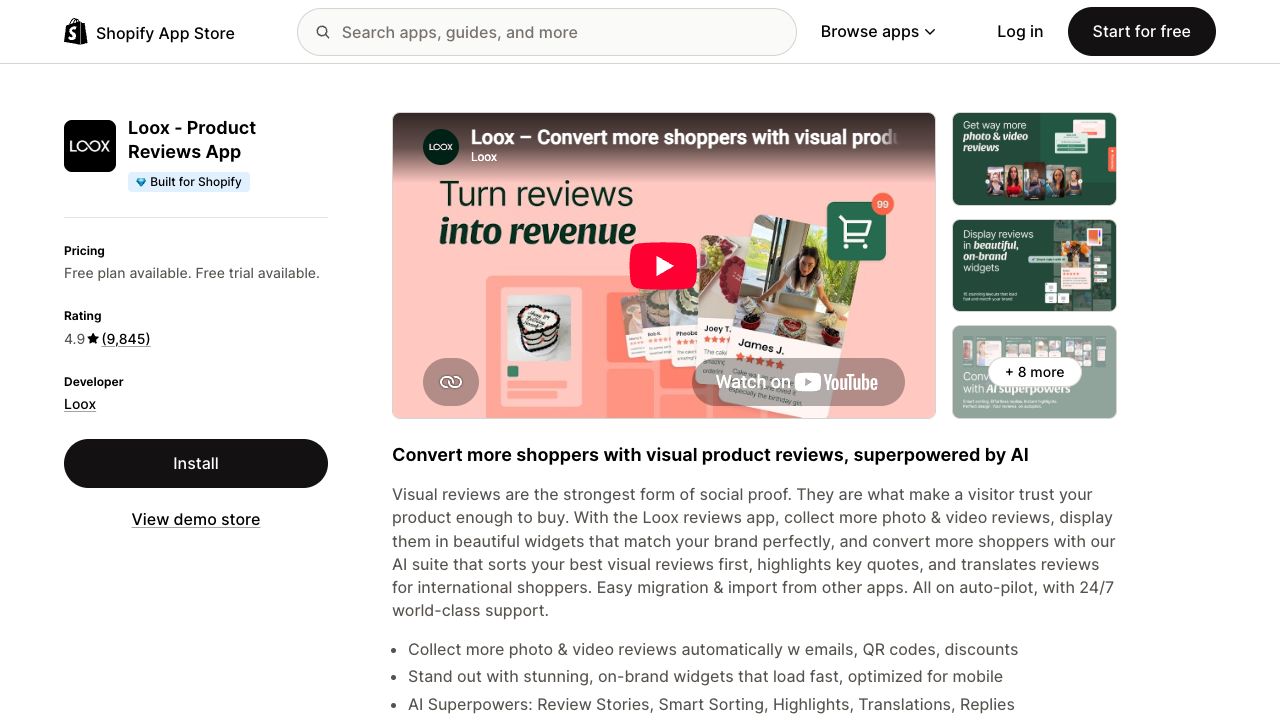
Investigate Loox for collecting and displaying feedback inside Shopify. Its public pages describe visual reviews, request emails, storefront widgets and plan-dependent referral features. The store-focused workflow differs from an independent public company-rating platform.
Loox’s pricing FAQ describes Shopify’s 30-day subscription cycle without an annual commitment. Confirm the selected plan, usage allowance and additional charges before installing. The inspected Shopify listing describes Beginner as free with up to 500 orders. Convert lists $49.99 monthly with 300 orders included and $50 per additional 300 orders. Unlimited lists $299.99 monthly. Charges are listed in USD. Confirm the applicable order allowance and merchant terms rather than assuming permanent free access.
Loox also describes photo and video incentives. A feature existing does not make every use appropriate. Platform rules, disclosure, customer consent and the conditions attached to the reward still matter. Never make a discount depend on a positive rating.
I would evaluate the actual product-page display and collection process before paying for extra presentation features. A good-looking widget is useful only when the reviews are genuine, relevant and connected to the right product.
2. Trustpilot for public company feedback
Trustpilot supplies a public company-review profile with business tools for invitations, replies and feedback management. Review this direction when shoppers need information about the seller’s service and buying experience beyond one product.
The inspected English pricing page listed 50 monthly invitations on Free, with different allowances on paid plans. Starter was restricted to eligible new small-business customers. Verify eligibility before budgeting around the advertised entry offer.
Paid starting prices were described per domain with an annual commitment. The FAQ described the initial term as prepaid, while another section discussed billing cycles. Ask for the actual term, invoicing arrangement, domains and add-ons in writing. A monthly equivalent is not proof of a cancellable month-to-month contract.
Trustpilot prohibits incentivized reviews. Its reviewer guidelines explain paying businesses do not control removal. Evaluate honest collection and response processes rather than promises to erase criticism. The catalog’s destination is a consumer-review profile, not a verified software referral, so the provider name stays unlinked.
Choose the feedback layer before buying the feature list
Write down where buyers will read the feedback: a product page, company profile, service listing or location page. Specify the decision those buyers need to make. A visually similar widget does not establish the right workflow for every destination.
Match the information to the destination. Product feedback should address the product, while service feedback explains the buying experience. Praise for fast email replies does not prove a complicated product performs well.
A business with both product and service questions needs a coordinated collection process. Map the customer’s experience before adding reminders. Multiple tools should not send overlapping requests without an agreed purpose and sending schedule.
Put a named person in charge of the queue and define the escalation route. A managed setup is more useful than several unattended tools. Software organizes feedback, while your team remains responsible for investigating and fixing the problem.
Collect feedback after a real experience
Schedule collection around a meaningful experience. A shipped item needs delivery and a reasonable opportunity for use before detailed product feedback. A service needs an identifiable milestone the customer has experienced. Order placement alone does not establish either condition.
High-ticket orders often involve an appointment, assembly or handover. Account for those steps before requesting feedback about the purchase. Do not copy a low-cost consumable store’s timing without reviewing the delivery and use process.
Define an objective invitation rule independent of the predicted rating. Apply the rule consistently. Do not use a private satisfaction question to direct happy buyers toward public reviews while withholding the invitation from unhappy buyers.
The request itself should be straightforward. Ask for the person’s honest experience. Avoid telling them what rating to choose, implying a reward requires praise or presenting a sample testimonial for them to copy.
Also check the actual sending rules. Consent, opt-outs and applicable requirements are not solved simply by naming a message transactional. Loox’s help distinguishes its own sending options from external integrations. Verify the workflow you will use rather than assuming every connector has identical behavior.
Keep product reviews separate from service problems
A customer who likes the product but dislikes delivery communication needs a different response from a buyer reporting a product defect. Preserve both concerns. Classification should help investigation rather than reshape the comment into more favorable sales copy.
Classify feedback under practical categories such as product information, condition, delivery, communication or returns. Assign the next action from the issue. Avoid turning a simple queue into a reporting project nobody maintains.
Repeated questions point toward product-page or pre-sale improvements. Clarify an ambiguous shipping promise before the next order. Unreliable supplier information requires work with the supplier rather than a rewritten request for reviews.
For the broader model, my high-ticket dropshipping guide explains why operations matter. Selling an expensive product online requires more than attracting a click. The handover and follow-through are part of what the customer is buying.
Respond helpfully without publishing private details
A public response should acknowledge the concern and explain the next step. Keep the customer’s order history, address, phone number, payment information and private correspondence out of the reply. Detailed investigation belongs in an appropriate private channel.
Start with the reported concern rather than an argument about stars. Use the platform’s appropriate private process when the order is unidentified. Do not ask customers to post identifying information publicly.
A practical response might acknowledge the delivery concern and explain how to contact the support team privately. Only promise an action the business is authorized and able to take. Do not invent a refund, replacement or deadline to make the response sound reassuring.
Keep the internal support record separate from the public reply. Assign an owner, record the issue and follow up through the appropriate channel. Posting a polite sentence does not finish the customer-service work.
AI-assisted replies need human review of facts and tone. Reject drafts denying an uninvestigated problem, exposing private information or claiming an unresolved issue was fixed. An automated response does not establish a completed support action.
Moderation is not permission to rewrite the customer
Base moderation on legitimate rules covering privacy, irrelevant material and suspected fabrication. Truthful criticism should not disappear solely because sales might suffer. Preserve the customer’s experience instead of polishing the comment into sales copy.
Loox’s public integrity policy requires authentic reviews from real customers and rejects fabricated or misleading manipulation. An import function does not create permission to import unrelated people, change the meaning of feedback or present somebody else’s buyers as your customers.
Preserve provenance and the correct product association when moving genuine reviews. Inspect the destination’s labels and their meaning. Historical imports do not automatically establish verified purchases, even when the import feature accepts the file.
For a public platform, use its reporting process when you have a legitimate reason. A report is a request for review, not a guarantee of removal. Never threaten a customer or offer a reward to make accurate criticism disappear.
Keep any legal dispute with a qualified professional. This guide explains general workflow considerations, not whether a particular statement is unlawful or what action your business should take against a specific reviewer.
Understand incentives and platform rules separately
The Federal Trade Commission’s general U.S. guidance distinguishes incentives from rewards conditioned on a particular sentiment. Rewards must not expressly or implicitly require praise or criticism. Disclosure and other consumer-protection concerns still require attention. This is general information, not campaign-specific legal clearance.
Platform rules also matter. Trustpilot prohibits incentivized reviews, so a reward feature in a Shopify app does not belong in a Trustpilot collection campaign. Review the requirements of the destination before copying a workflow.
Before offering rewards, identify the platform rules and required disclosure. Neither a small coupon nor an added badge establishes compliance by itself. Obtain qualified advice for the proposed campaign and relevant jurisdiction.
I would avoid making a review campaign complicated with rewards before the honest collection process works. You need useful feedback, not a discount program whose real conditions the customer does not understand.
Also distinguish a referral reward from a review reward. Recommending your business to a friend and writing a product review are different actions. Keep the terms clear and never make the reward depend on someone publishing a particular rating.
Verify the integration before connecting customer data
List the information needed for the workflow, such as an order reference, product association, delivery timing or contact details. Review requested permissions and retention terms before connecting customer data. A familiar brand name does not justify approving every permission.
Assign request sending and suppression to an identified system. Uncoordinated applications risk duplicate reminders. Customers should not need repeated unsubscribe actions because two applications disagree about the owner of the message.
For an outside email integration, verify the available request types and the actual opt-out behavior. Loox’s support material notes differences for externally sent messages. Do not assume a setting in one application controls every message in the stack.
Assign access for publishing replies, changing collection rules and exporting reviews according to each person’s role. Document responsibility alongside permissions. This comparison does not certify any store’s privacy practices or email compliance.
Retain implementation instructions and the approved workflow. When a feature or tool changes, compare the new behavior with the documented process. Troubleshooting starts with an agreed expectation, not memory of a past configuration.
Compare the full cost of managing reviews
The subscription is one part of the cost. Include the number of domains or stores, the invitation allowance, required features, staff access and any add-ons. Then include the time to respond and act on what customers say.
Separate contract length from the displayed monthly amount. An annual commitment often has a monthly equivalent, while Shopify billing uses a different arrangement. Compare the actual terms and invoicing schedule rather than marketing-card numbers alone.
Ask how exceeding the allowance affects requests, pricing and access. Identify the resource covered by any unlimited claim and the limits still applying. Obtain the selected plan’s terms before relying on an upgrade assumption.
Check retention and export options before leaving a platform. Public company profiles and store-hosted widgets have different dependencies. Preserve genuine feedback and applicable permissions without assuming every provider offers identical portability.
Fix supplier communication failures before buying a tier to conceal them. Extra analytics do not establish a reliable delivery process. Direct the spending decision toward the identified operational problem.
Use feedback to improve the offer and supplier process
Use repeated expectation gaps to review positioning, product information and buying advice. Investigate whether the offer describes the product accurately for the intended audience. Do not dismiss the feedback by immediately blaming the customer.
My high-ticket niches list supplies categories for investigation. Category selection does not guarantee satisfied buyers or profit. Evaluate the specific product and service promise before promoting the offer.
If the complaint involves a supplier, collect enough information to investigate through the proper private channel. Identify whether the problem is preparation, packaging, transit, parts or a misunderstanding of the product. Those require different next steps.
The supplier research guide supports commercial verification. Supplier Paradise supplies research leads. A directory entry does not establish quality, approval or a working relationship. Verify commercial terms and responsibilities directly.
Keep the business foundation separate from software as well. The business-formation checklist outlines the broader administrative work. A review app does not establish the correct entity, replace consumer obligations or certify compliance.
Measure feedback and follow-through separately
Track whether the collection process is reaching the intended customers, whether they are choosing to respond and whether the team follows through. Separate invitations sent, reviews received and issues resolved. They are different measures.
A higher average rating does not prove an improved process. Invitation selection, product mix and display rules affect the comparison. Record those differences before interpreting a change as an operational improvement.
Dashboard-attributed sales do not establish causation. A suitable evaluation is needed before crediting the tool with every purchase. No causal sales evaluation was performed for this article.
Choose a small number of operational questions: Are repeated delivery complaints decreasing? Is somebody responding appropriately? Are recurring product questions reflected in better information? Those are useful even before you build an advanced report.
A quiet queue has several possible explanations, including satisfied customers and failed collection. Check sending, receipt and response activity before treating silence as success. Keep the interpretation tied to observable evidence.
How I would choose the best review management software
I would first choose the feedback layer. Investigate Loox for a Shopify product-review workflow and Trustpilot for public company feedback. Then check the current plan, rules, sending process and total commitment against what the business needs.
For your own evaluation, confirm a legitimate implementation before you use live customer data. Review the display, correct product association, message timing, permission boundaries and suppression process. These are checks for you and your team, not tests I am claiming to have performed.
Assign an owner and a clear escalation route before launching collection. If nobody will deal with a real complaint, adding an automated request system is not the first task.
Choose a process your team will maintain. Genuine feedback needs a route from the customer’s comment to investigation, correction and follow-up. Software selection should support those responsibilities rather than replace them.
Frequently asked questions
Are product-review apps and company-review platforms the same? No. Their collection, display and moderation rules differ. Choose the feedback layer before comparing plans.
Is a discount for a five-star review appropriate? Do not condition rewards on a positive rating. General U.S. FTC guidance and platform rules both matter. Some platforms prohibit review incentives entirely. Obtain qualified advice for your campaign and jurisdiction.
Does paying allow removal of negative reviews? Payment does not override public-platform moderation rules. Truthful criticism should not be suppressed solely because the business dislikes the comment.
What needs checking before importing reviews? Verify the feature, rights, authenticity, product mapping and labels. Import access does not authorize fabricated reviews or the presentation of another merchant’s buyers as yours.
Will review software guarantee more sales? No. The useful purpose is a consistent, honest feedback process and better operations. Provider attribution or marketing claims are not a conversion test I performed.
Related posts
- Best CRM software for ecommerce
- Best free Shopify apps
- Best fulfillment companies for Shopify
- Best business email providers
- Best social media management tools

Trevor Fenner is the founder of Ecommerce Paradise. His main projects are Ecommerce Paradise, Supplier Paradise, and Review Paradise, which is currently in development. TrevorFenner.com publishes research-based reviews and practical guides to online business tools and remote-work services, with clear affiliate disclosures.