
Looking for the best Etsy tools? Here’s the honest answer. The right tool answers one specific question about your product, listing or shop. Start with Etsy’s own search data, and only add a paid research tool once you know exactly what information or workflow you’re missing.
My shortlist is Marketplace Insights for recent first-party searches, Marmalead for keyword comparisons, EverBee for estimated product research and Alura for a broader research-to-listing workflow. You do not need all 4 subscriptions. Most sellers need 1 or 2, max.
Quick context on me. At Ecommerce Paradise, I teach an independent high-ticket retail model, and my team builds client stores on Shopify. Etsy has different product requirements. Nothing linked here is permission to list ordinary third-party retail products on Etsy, so keep that in mind as you read.
Research date: October 13, 2026. This guide uses public product, pricing and help information. I have not connected a seller account, installed extensions, sent customer messages or run a sales experiment for this comparison.
Disclosure: I own Ecommerce Paradise and Supplier Paradise. The Etsy tool providers in this guide are unlinked because the current catalog does not document verified affiliate destinations for them, and a redirect to a merchant homepage does not establish affiliate attribution. Some other tools I mention, like Shopify, are affiliate links, and I may earn a commission at no extra cost to you if you buy through them.
Best Etsy tools by research job
| Tool | Review for | Information type | Important limit |
|---|---|---|---|
| Etsy Marketplace Insights | Recent search demand | First-party search and listing data | Time window and free weekly searches |
| Marmalead | Keyword comparison and seasonality | Research metrics and forecasts | Provider grades do not establish ranking |
| EverBee | Product and shop research | Estimated sales and revenue metrics | Estimates do not establish private transactions or profit |
| Alura | Research and listing operations | Research with plan-dependent editing features | Search, listing, shop and automation allowances |
Decide what you’re trying to figure out before you compare scores. A popular phrase, estimated product revenue and a listing grade are 3 totally different kinds of information. Keep the source and time period attached to every number.
Marketplace Insights
Etsy’s Marketplace Insights help article describes search and listing data from the last 30 days. Sellers get up to 15 free keyword searches per week, and free-search results stay available for 7 days. Etsy Plus subscribers get unlimited searches.
The tool works on desktop and mobile web, not the native seller app. The help page also says Marketplace Insights won’t edit your listings for you.
Use this one first for recent Etsy search data. It’s free, it’s first-party, and it comes straight from the marketplace. A searched term still needs a check against your product and the marketplace rules, because search interest doesn’t decide eligibility or profit.
Marmalead
Marmalead covers related phrases, keyword comparisons, seasonality and listing grades. Some of its search and engagement descriptions refer to expected future activity. Keep those forecasts separate from measured results.
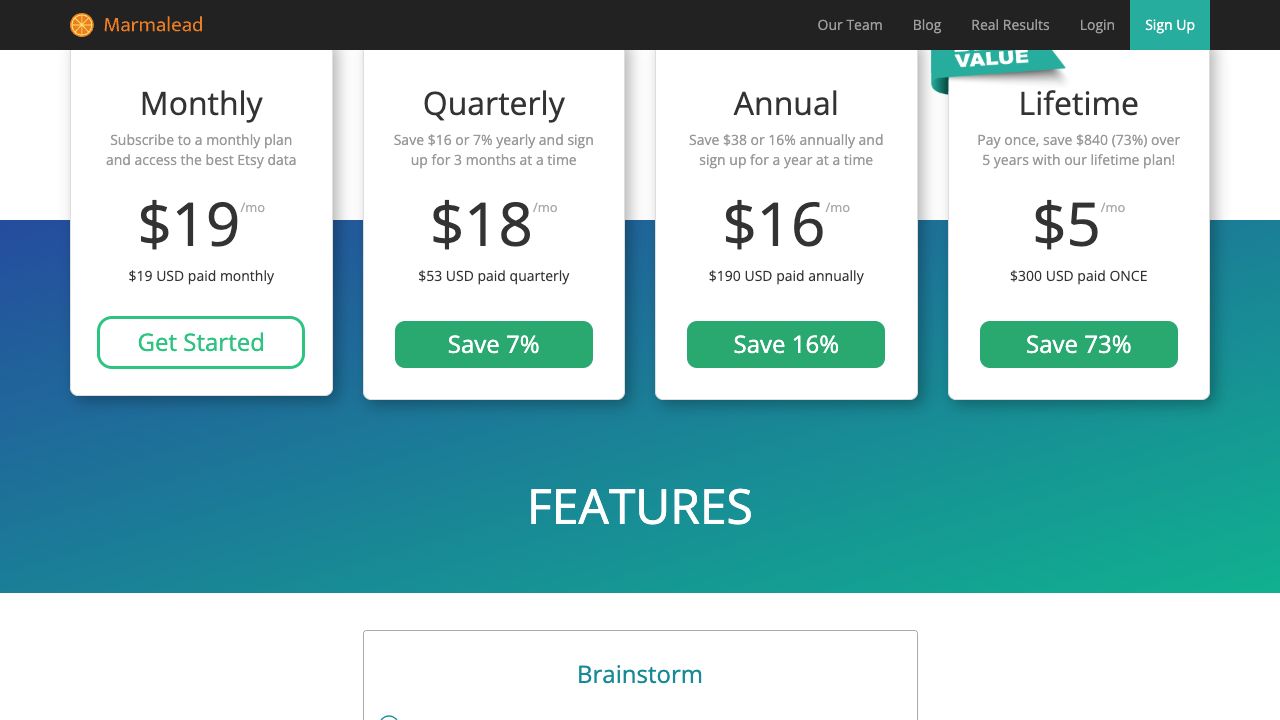
The pricing I inspected showed $19 USD paid monthly or $190 annually. The annual monthly-equivalent headline is not monthly billing. Compare the full commitment and the terms you actually select.
A displayed lifetime offer also used a monthly-equivalent headline. Don’t read it as a cheap recurring monthly plan, and don’t assume every future feature comes with it.
Here’s how I’d use it. Let the score sort your research candidates, then check each phrase against the real item. A high grade is not an official Etsy rank or a guarantee of sales.
EverBee
EverBee’s help describes its sales and revenue metrics as estimates or approximations. Hold onto that definition, even when a marketing headline uses stronger language about seeing sales.
The Hobby plan I inspected had limited keyword access and basic research. Growth showed $299 USD under annual billing. Its monthly-equivalent headline isn’t a month-to-month quote, and the free tier doesn’t include every paid data field.
Use product research to build a shortlist. Estimated units and revenue don’t reveal another seller’s production costs or contribution margin. No private merchant transactions were accessed for this guide.
The provider describes MCP access on paid research plans. I did not install or use an EverBee connector for this comparison.
Alura
Alura combines research with listing and shop-operation features. Its Free plan lists limited daily searches and a 10-listing optimization allowance.
Basic, Growth and Professional each have different resource limits. Review searches, listing work, connected shops and automation separately. Billing variants weren’t independently selected here, so this guide doesn’t give a universal paid monthly quote.
Pick the workflow you need before buying a bigger package. An email-marketing add-on showing up on the product page doesn’t mean every plan includes it.
Review generated descriptions and replies before you publish anything. Provider scores and AI suggestions are not verified product facts or tests of your shop’s performance.
Describe the product before researching phrases
Write a plain description of the item and who it’s for. Include the material, dimensions, options and use. For a personalized product, note which details the buyer supplies and which parts stay fixed.
Build a short list of accurate phrases from that description. Cut any term that points to a different product, material or audience. High search volume never justifies misleading language.
Take a fictional personalized stationery listing. It needs to explain the final item, the available options and the information the buyer has to provide. That’s a planning exercise, not a product I researched or sold for this guide.
Keep a broad category separate from a precise description. Compare phrases against the same proposed item instead of reshaping the product to chase every attractive number.
Write unresolved product questions right next to the research. A phrase shouldn’t go into the final title until the business verifies the claim behind it.
The software helps you organize evidence. You still own the decision about an original, accurately described offer.
Read definitions and periods beside the figures
Record the source, time period and definition with every number. Recent searches, expected engagement and estimated monthly sales are not interchangeable.
Check whether a figure is reported, estimated or forecast. A precise-looking decimal doesn’t fix uncertainty in the method behind it.
When tools disagree, check dates and scope first. Two reports using different windows are answering different questions.
Estimated revenue is not profit. Production, materials, shipping, advertising and service costs all need their own review. A public dashboard can’t show you those costs for another merchant.
Use the research to find your next question, not to declare a product validated. Keep assumptions visible until real evidence backs them up.
No competitor’s private transactions, financial statements or profit were verified for this comparison.
Plan for seasonality and production time
Check the date range before treating a spike as steady demand. Interest around an event or holiday is different from demand across a full year.
Leave time for preparation and delivery. Research that shows up after your production window closes doesn’t solve the problem. Confirm the schedule the business can actually offer.
Keep a dated shortlist instead of changing the catalog every time a new suggestion pops up. Review each idea against your capacity, product requirements and the evidence you’ve collected.
Write down why you advanced or rejected an idea. Your notes should explain the decision without relying on your memory of a chart.
A forecast helps with planning, but it doesn’t guarantee a result. Treat the uncertainty as part of the research record.
This guide did not test a seasonal launch, order production or verify future demand.
Improve the listing with accurate information
Explain exactly what the buyer receives. Include the important options and the steps for personalization. Make basic details easy to find so buyers don’t have to message you for routine stuff.
Check AI-generated wording against verified facts. Remove invented materials, certifications, features or delivery promises. Smooth copy doesn’t create evidence.
Use relevant language naturally. Don’t stuff the title with unrelated phrases just because a tool scores them highly. The listing still has to make sense to the buyer you’re targeting.
Check your visuals against the final product and the image requirements. A concept mockup shouldn’t suggest an included accessory or a finished result the buyer won’t get.
Look at another seller’s presentation for context, not as permission to copy their design, images or text. Having the right to use something is a separate requirement.
For your own evaluation, compare the approved listing with the product information before publishing. No listing was edited or submitted through these tools for this guide.
Check Etsy’s product requirements
Etsy’s current Creativity Standards separate products made, designed, handpicked or sourced by sellers. Each category has conditions. Search demand does not make an item eligible to list.
Original designs produced through a production partner need the right disclosure and accurate shipping-origin information. Seller-prompted AI creations also have disclosure requirements under the stated standards.
The standards exclude another person’s work and AI prompt bundles from the seller-designed category. Review your actual item and arrangement instead of using a popular listing as a shortcut.
These are general marketplace distinctions, not a legal ruling on a specific item or intellectual-property question. Get proper advice when rights or eligibility are unclear.
Keep the reviewed product classification with your listing notes. If production or personalization changes later, check it against the requirements again.
An independent multibrand retail model does not automatically fit Etsy’s creative marketplace. That’s a big reason I keep these 2 paths separate.
Best Etsy tools: compare fees and resource limits
Read the plan you’re considering resource by resource. Daily searches, saved items, listings, connected shops, AI actions and marketing features each have separate allowances.
Compare prepaid annual totals with month-to-month billing. A lower monthly equivalent doesn’t make it the better commitment for a workflow you haven’t tested.
Check the service and terms each feature requires. A broad “optimization” label doesn’t mean unlimited editing or access to every data field.
Review the Etsy fees and payments policy for your selling arrangement. Listing, transaction, payment, advertising and regional costs each have different conditions. Don’t assume a calculator’s default covers every seller.
In a hypothetical example, a $40 order with $24 of direct costs leaves $16 before omitted expenses. If marketplace charges or production time are left out, that $16 is not final profit. The example is neither a fee quote nor a sales forecast.
Include packaging, delivery, customization, software and support work in your own cost review. Use proper accounting and tax help for your situation.
For your own cost record, note the currency and whether the selling price includes shipping. Record production and packaging separately, then list the marketplace charges that apply. Keep advertising assumptions visible instead of hiding an unexplained allowance in the total. A readable cost record helps you catch a missing expense before you approve a product.
Look at what a calculator asks for before trusting the output. A filled-in result doesn’t prove the inputs match your setup. Save the source of each cost and the date you checked it, and update the record when a supplier changes a price or your delivery method changes.
If you want bookkeeping that keeps up with this, I like Finaloop for ecommerce bookkeeping because it’s built around online store sales and costs. It’s not a substitute for an accountant, but it makes your cost records a lot less of a pain in the butt.
Use one research record the team understands
Pick one place for the shortlist, evidence and next action. Running the same search across several subscriptions adds work without necessarily adding a new kind of information.
A useful record shows the product idea, intended buyer, accurate phrases, relevant dates and open questions. Keep research notes separate from claims approved for publication.
A shared spreadsheet is usually enough. I like Google Workspace for shared research sheets because the whole team can edit one file instead of passing copies around. A free Google account works fine if it’s just you.
When you add a second tool, write down the missing input it fills. A different estimate or score isn’t automatically a useful second opinion.
For a fictional candidate, record the proposed product, the source window and the question that still needs verification. Name the person responsible for the next check. Don’t mark it approved just because several tools show favorable numbers.
Tie your research budget to the work. A subscription should answer a question or support a specific task, not replace actually creating or improving the offer.
Save the approved product information and the reason for each listing change.
Review access and customer communication
Check requested permissions and data-handling terms before you connect a seller account or extension. Give the app only the access it needs for the authorized task.
Keep customer records out of unnecessary AI demos. Use fictional information when you’re testing writing or an interface.
A tool’s follow-up or email feature doesn’t give you permission to add every buyer to a promotional list. Review the consent, opt-out and marketplace requirements that apply.
For your own independent store, email marketing is a different story because those are your customers. I like Omnisend for ecommerce email because it’s built for online stores and includes signup forms and unsubscribe handling. You still need proper consent before you send anything.
Check suggested customer replies against the order details. Never invent a refund, a finished production step or a shipping date because generated wording sounds reassuring.
Assign someone to own message review and follow-up. The customer needs an accurate answer and a clear next step.
No extension, seller connection, private data upload, permission change or customer message was completed for this comparison.
Evaluate changes without claiming a guaranteed ranking
Record the current listing and the reason for each proposed change. Clearer product information is a worthy goal on its own, without promising an instant search boost.
Don’t change the title, photos, price and shipping terms all at once and then credit every result to a keyword. Use an evaluation method that fits your shop’s activity level and the uncertainty involved.
Separate what you observed from why you think it happened. Changes in visits, orders or conversion have several possible causes. A provider’s letter grade doesn’t prove the reason for a later result.
Make sure you’re comparing a similar period, audience and offer. Seasonal swings or changes in product availability affect how you read the numbers.
Keep unsupported performance claims out of the final listing and your reporting. A quiet stretch doesn’t prove failure, and a few orders don’t prove a repeatable improvement.
This guide includes no controlled experiment or verified seller revenue increase.
Confirm production and delivery before promising them
Agree on the product specs, packaging and handoff with any legitimate production partner. Review personalization requirements before you publish the buying instructions.
Keep your delivery explanation in line with what the business actually supports. A template’s sample shipping statement is not evidence for your product.
A supplier candidate needs verification. My supplier research guide covers a different retail context, but the difference between a lead and confirmed commercial terms matters for any operating business.
Supplier Paradise is another research resource I own. The directory does not certify Etsy eligibility or an approved relationship.
For a fictional partner handoff, document the approved specs, the information needed for personalization and the responsible contact. Review any changes before you pass a revised promise to the buyer.
No supplier appointment, production order or delivery test was completed for this guide.
Keep the independent-store path separate
Etsy serves eligible creative offers within its marketplace rules. An independent store comes with a different set of responsibilities.
My high-ticket dropshipping guide explains the independent retail model I teach. It is not an Etsy reselling strategy.
If you go the independent route, you need your own storefront. I like Shopify for an independent online store because it’s what my team builds client stores on and it handles checkout, apps and payments in one place. I’ve built 20+ websites over the years, and many closed down, so I’d rather you start on a platform you won’t outgrow.
For keyword research outside Etsy, I like Mangools for Google keyword research because its KWFinder tool is simple enough for beginners. That’s for your own site’s content, not for Etsy listings.
The high-ticket niches list gives you categories to investigate in this separate model. A category doesn’t prove profit or marketplace eligibility.
The business foundation checklist covers admin and professional review. A research subscription doesn’t set up your entity or resolve intellectual-property questions.
When it’s time to form that entity, I like Northwest Registered Agent for LLC formation because registered agent service is their core business. I run my own business through a Wyoming LLC. This isn’t legal advice, so check your own situation.
Choose the channel around your product and the buying experience you’re ready to deliver. Don’t assume every marketplace accepts the same product arrangement.
Frequently asked questions
Does Etsy provide keyword research?
Yes. Marketplace Insights supplies recent first-party search information with a limited free weekly allowance and a separate Etsy Plus arrangement.
Are estimated sales verified profit?
No. Estimated units or revenue don’t establish private transactions, costs or margin.
Does a keyword score guarantee ranking?
No. Provider scores and forecasts are research inputs, not official Etsy results.
Does a popular supplier product qualify for Etsy?
Demand doesn’t decide eligibility. Review the item and arrangement against the current marketplace rules.
Do I need every tool in this guide?
No. Start with the research job, and add a subscription only for a specific missing input or workflow.
My take on the best Etsy tools
All right, here’s where I land. Start with Marketplace Insights because it’s free and it’s Etsy’s own data. Add Marmalead, EverBee or Alura only when you can name the exact gap it fills.
Keep every number tied to its source, period and definition. Remember that estimates are not profit and scores are not rankings. Check Etsy’s Creativity Standards before you fall in love with a product idea.
My first store failed before my second one worked. That’s normal, and it’s why I’d rather you build one solid offer than chase every number. Go deep before you go wide. One accurate, well-described product beats 50 listings stuffed with keywords.
If you’re more interested in an independent store than Etsy, grab my free list of 1,000+ niches to start brainstorming. It pairs well with the guides above. Go check that out.
Related guides
- Print-on-demand companies
- AI content tools
- High-ticket dropshipping niches
- Small-business software
- Ecommerce platforms

Trevor Fenner is the founder of Ecommerce Paradise. His main projects are Ecommerce Paradise, Supplier Paradise, and Review Paradise, which is currently in development. TrevorFenner.com publishes research-based reviews and practical guides to online business tools and remote-work services, with clear affiliate disclosures.