
The best ecommerce platforms are the ones that support the business you actually want to run. That sounds obvious, but it is easy to spend a week comparing themes while ignoring the difficult part: getting a real order paid, fulfilled, and supported.
I would choose the business before the software. What are you selling? Who is buying it? Are you shipping from your own stock, working with authorized suppliers, or arranging local pickup? Those answers narrow the shortlist much faster than another feature chart.
At Ecommerce Paradise, I teach a focused approach to building an online business. Start with one market and a clear operating process. The store should help you execute that plan, not distract you from making it.
This comparison covers Shopify, WordPress.com, BigCommerce, Square Online, and Shift4Shop. I am treating them as options to evaluate, not pretending that one platform is automatically right for every seller. The useful differences are payments, maintenance, fulfillment, and what happens to the bill as the business changes.
Affiliate disclosure: I may earn a commission through the affiliate links in this article at no extra cost to you. Published pricing and feature information was reviewed October 10, 2026. This is a research-based comparison, not a claim that I personally tested every platform or verified its sales claims.
Best ecommerce platforms: the practical shortlist
| Platform | Where I would compare it | Reviewed cost context | Important question |
|---|---|---|---|
| Shopify | A focused retail store on a hosted commerce platform | Basic $39 monthly or $29 monthly equivalent billed yearly | Do your payments, shipping, team access, and required apps fit the plan? |
| WordPress.com | A managed WordPress website with publishing and commerce | Commerce $70 monthly or $45 monthly equivalent billed yearly | Which selling features and extensions does the complete setup need? |
| BigCommerce | A hosted store evaluated against catalog and growth requirements | Core $39 monthly or $29 monthly equivalent billed yearly | What are the current GMV thresholds and payment-provider fees? |
| Square Online | Online selling connected with a local or in-person business | Square Free $0; Plus $49 and Premium $149 monthly per location | Which online-store features and processing rate apply? |
| Shift4Shop | A hosted store, subject to business-location availability | Reviewed end-to-end page displayed $41 monthly | Is the service available to your business, and what payment conditions apply? |
These are selected published prices, not complete operating budgets. The Shopify, WordPress.com, BigCommerce, and Square figures come from their reviewed US pricing views. Shift4Shop served a region-specific offer; confirm the currency, eligibility, and account terms directly. Processing, taxes, domains, hardware, extensions, and services can add to the total.
Understand the operating model first. Read my high-ticket dropshipping guide before building a store around a software subscription →
The five platforms I would compare
1. Shopify: start here for a focused retail-store comparison
Shopify would be my starting point for comparing a hosted retail store. The reviewed US monthly prices were $39 for Basic, $105 for Grow, and $399 for Advanced. Their yearly-billed monthly equivalents were $29, $79, and $299.
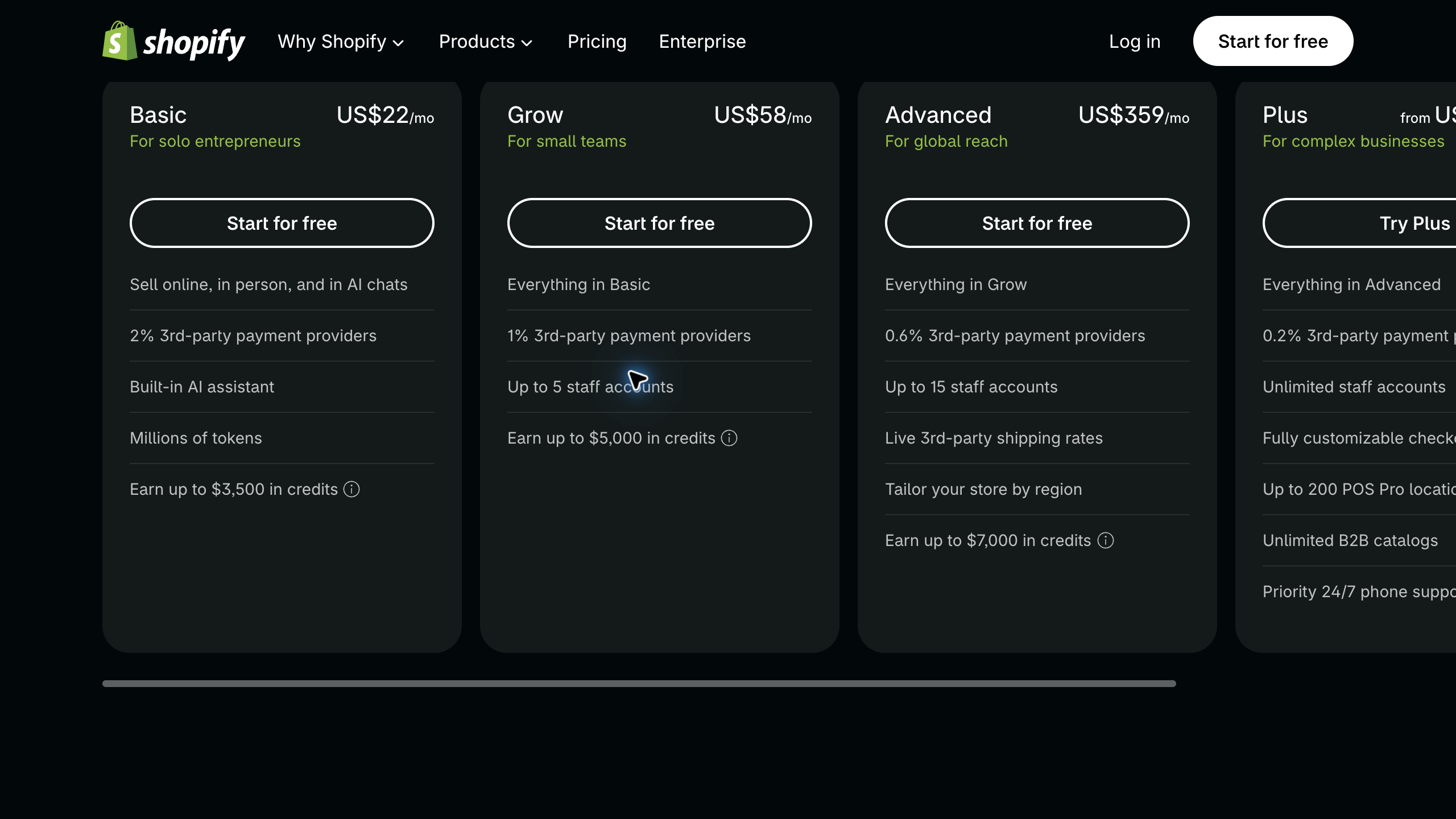
Hosting is included, but that does not mean every part of the business is included. Check staff access, shipping calculations, payment options, and the applications your specific catalog needs. A subscription does not take responsibility for supplier relationships or customer support.
I would build three sample listings: a simple product, a product with several variants, and the most awkward product in the proposed catalog. If the awkward item requires freight, an installation option, or a quote, test that process early. Do not use a simple T-shirt checkout as proof that your difficult order works.
Then keep the launch setup small. Start with clear product information and a practical theme. You can spend a lot of money on extra applications before you know which customer problem they are supposed to solve.
My caution is adding a tool for every possible future need. Record what each application does, its recurring charge, and who maintains it. The store should still be understandable when another person needs to manage an order.
2. WordPress.com: compare publishing and commerce together
WordPress.com is a managed service, not simply another name for every self-hosted WordPress website. Its Commerce plan combines WordPress with a WooCommerce selling setup and included ecommerce extensions.
The reviewed US Commerce price was $70 month-to-month, or $45 per month billed for twelve months. Longer commitments showed other monthly equivalents. Plugin installation is available on paid plans, so do not repeat the outdated claim that all plugins require the Business tier.
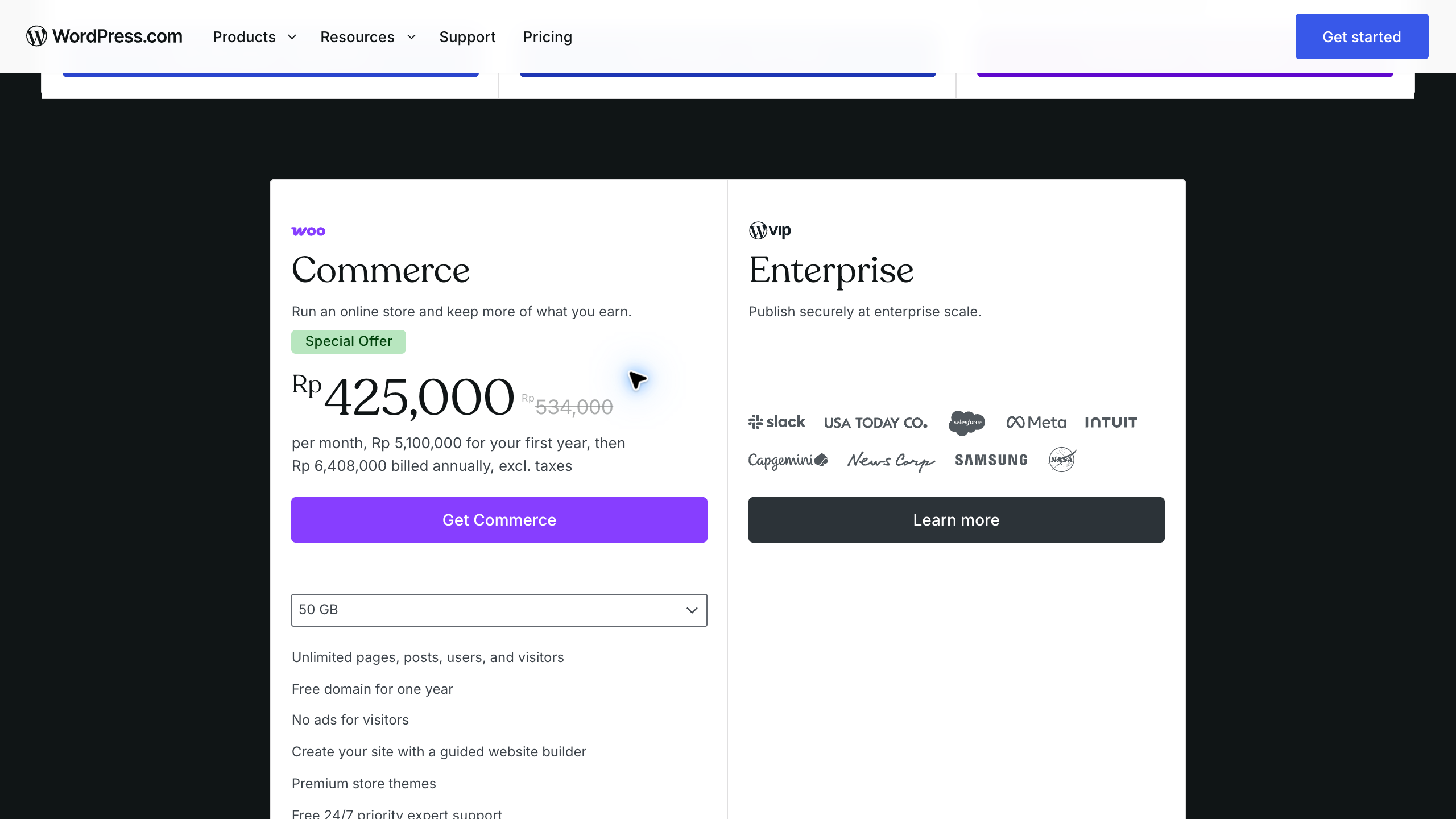
I would compare this route for a business where publishing and selling need to work together. Map the editorial process, the product catalog, the checkout, and who maintains the extensions. A blog with a few products has different requirements from a large retail operation.
The important distinction is the complete package. A managed WordPress.com plan and a separately hosted WooCommerce site do not automatically include the same services, extensions, backups, or support. If somebody quotes you a build, ask exactly which arrangement they are proposing.
My caution is making a decision from the word WordPress alone. Identify the host, the plan, the payment tools, the needed extensions, and the maintenance owner. You want an operating setup you can explain, not a collection of familiar brand names.
3. BigCommerce: pay attention to current growth and payment rules
BigCommerce is another hosted-commerce candidate. Its current reviewed plans were Core, Growth, Scale, and Performance. Core was $39 monthly or $29 per month billed annually; Growth was $105 or $79, and Scale was $399 or $299.
The pricing page uses its own GMV calculation for thresholds. Core lists $30,000 trailing-twelve-month GMV, Growth $100,000, and Scale a monthly allowance with an overage rate. Automatic upgrades and the current calculation deserve a place in your budget.
Also avoid the blanket claim that every payment-provider choice has zero platform fees. The page lists an Open Payment Provider fee of 2% on Core, 1% on Growth, and 0.6% on Scale for eligible orders. Embedded Payment Providers are treated differently, and processing charges are separate.
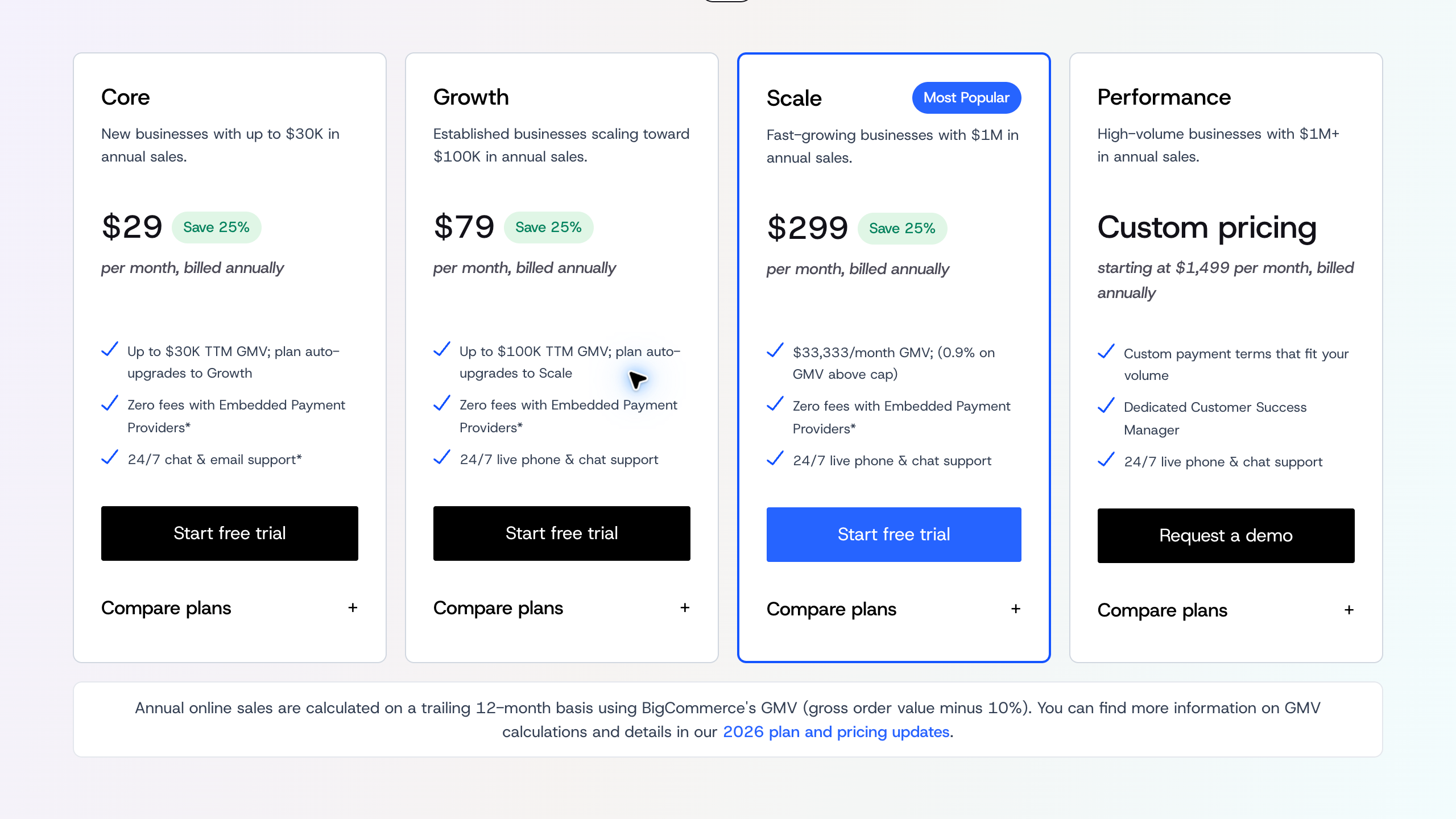
I would ask how the proposed catalog, payment provider, and expected sales affect the complete bill. Have the provider explain any ambiguous threshold before you sign up. Keep that answer with the decision notes.
My caution is relying on an old comparison. Plan names and terms can change. Compare the current offer against the store you intend to run, especially if a higher order value means you could cross a sales threshold with relatively few orders.
4. Square Online: compare the online and local operation together
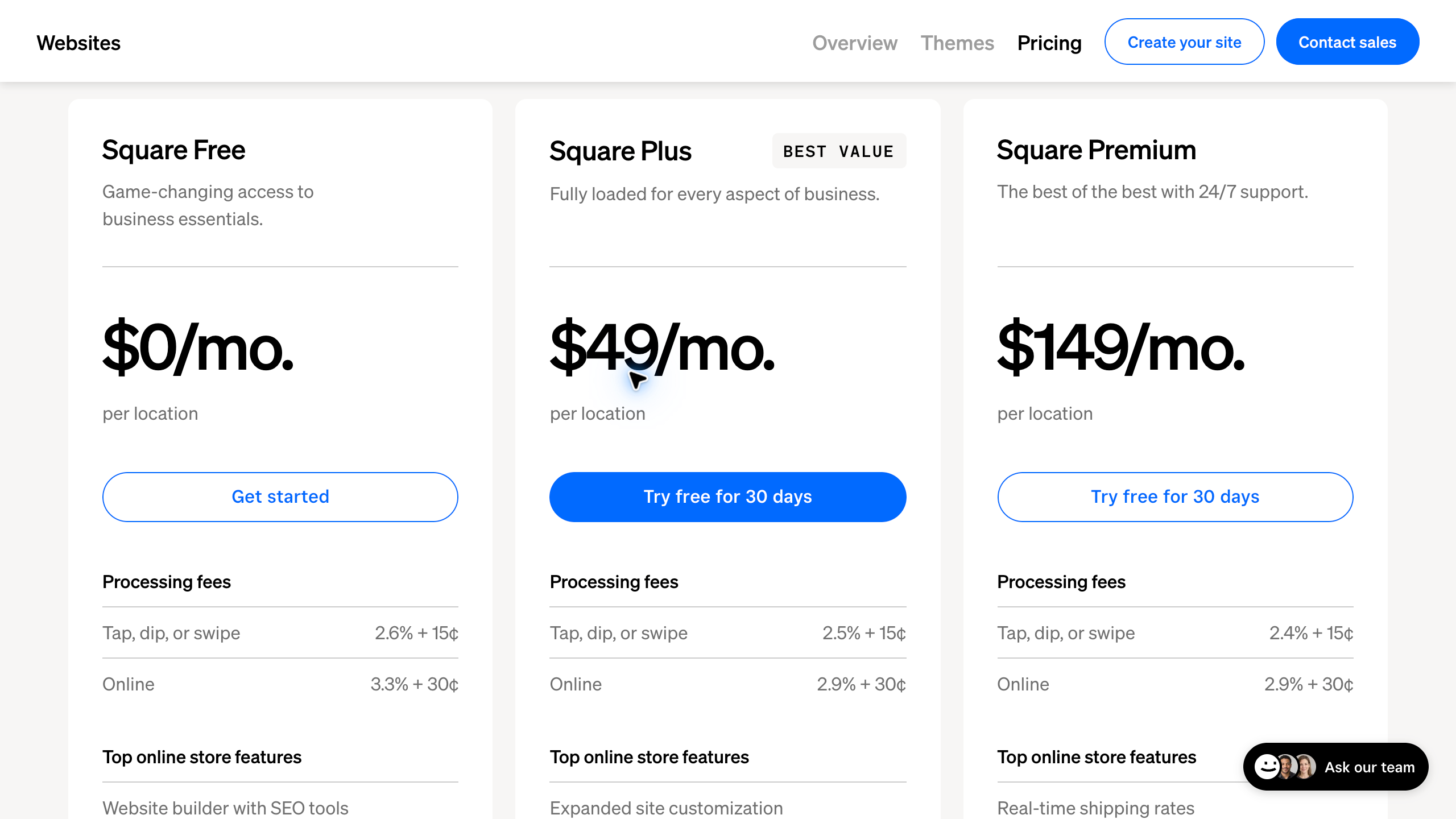
Square Online is worth comparing when online selling needs to connect with a local or in-person operation. The reviewed US page puts online-store features inside Square Free, Plus, and Premium, with different feature access.
Those plans displayed $0, $49, and $149 monthly per location. Online processing rates on the reviewed comparison were 3.3% plus 30 cents for Free, and 2.9% plus 30 cents for Plus and Premium. Other payment types, services, and conditions have different fees.
I would test the actual pickup or delivery process. Can the customer choose the right location? Does the order reach the person preparing it? What happens when an item sells in person while somebody else is shopping online?
For a retailer, the operational connection can matter more than a slightly different page layout. Compare the order record, inventory handling, staff workflow, and customer messages as one process.
My caution is assuming that a free subscription includes every website capability. Check the selected tier for custom-domain connection, shipping tools, and the features your business requires. Free does not mean payments or the whole operation have no cost.
5. Shift4Shop: confirm availability before spending time on the build
Shift4Shop presents a hosted end-to-end ecommerce offer with catalog, order, and marketing tools. The reviewed page displayed a $41 monthly platform offer and payment-processing conditions that need account-specific confirmation.
The pricing route also served a country-specific page with a notice that the service was not available in the detected country or region. That is an important limitation, not something to ignore because the feature list looks useful.

I would start by asking whether your actual business can use the service. Confirm the business location, products, payment requirements, currency, platform charge, and any processing-related conditions. Do that before importing a catalog or paying a developer.
If the offer is available and fits your business, test the same difficult products and fulfillment cases you use for the other candidates. A large list of included features still needs to be matched to a real process.
My caution is describing an account as universally free or available everywhere. Use the offer that applies to your business, not a headline from a different country or an old article. If eligibility is unclear, choose another candidate while you get a direct answer.
Keep the catalog focused. Use my high-ticket niches list to narrow the market before comparing hundreds of store features →
Write the requirements before testing the software
A useful requirement describes something you can observe. “Customers can choose the correct size and see the delivery charge before paying” gives you a test. “The site should look premium” leaves everybody guessing.
Start with the product and customer. Write down the variants, specifications, compatibility questions, delivery constraints, and information somebody needs before placing an order. Put the difficult questions in the brief, not just the attractive parts of the product.
Separate mandatory requirements from preferences. A working payment method is mandatory. A particular animation is usually a preference. Eliminate a platform that cannot support the mandatory process before comparing the decorative details.
I would keep the first comparison to two or three serious candidates. Testing five complete stores can become its own project. Use the shortlist to identify likely fits, then spend your time on the real order process.
Confirm payments and fulfillment early
Check payment eligibility against your actual business, products, and location. Do not assume that forming a company or buying a store plan guarantees acceptance by a payment provider. Get the requirements from the proposed provider.
Then map the order from payment to delivery. Who checks the details, pays the supplier, confirms stock, provides tracking, and answers the customer? The platform supports that workflow, but somebody still needs to own it.
For dropshipping, work through my supplier sourcing guide alongside the store plan. A polished checkout cannot fix a supplier relationship that was never confirmed.
Supplier Paradise can provide a research starting point. Verify the company, dealer requirements, fulfillment terms, and permission to sell directly. A directory lead is not a guaranteed account approval.
Compare the full first-year and later-year budget
Separate fixed subscriptions, processing, applicable platform fees, applications, domain costs, technical help, and customer-support work. Use the same catalog and sales assumptions for every candidate so the comparison means something.
Here is a hypothetical example, not a provider quote: a $40 platform subscription plus $80 of necessary monthly tools creates a $120 monthly software bill before payment charges and labor. The first headline price is only one line of that budget.
Check the growth triggers too. Extra locations, team members, sales thresholds, or a required shipping feature can change the needed plan. Write down the trigger and the next cost instead of assuming that the opening plan will fit forever.
Annual billing can lower a monthly equivalent, but it creates a larger upfront commitment. Keep the payment schedule, renewal date, promotion period, and cancellation terms separate. Compare the money you actually pay, not just the number printed beside “per month.”
Organize the business behind the checkout. Work through my business formation checklist and confirm the requirements for your own situation →
Use a representative catalog and test the exceptions
Build a small catalog that includes the awkward cases. Use a variant-heavy item, an item with special delivery needs, and a normal product. Accurate sample information will tell you more than importing a thousand unfinished listings.
Test a mixed cart, an unsupported delivery address, a stock shortage, and a customer who changes an order. Use the platform’s supported test process and make sure no test order can trigger a real supplier shipment.
Review the customer messages and the staff view. A checkout can look fine while the person handling the order is missing essential details. Confirm the handoff, not just the payment confirmation page.
Check a phone as well as a computer. Product options, shipping information, contact routes, and the final total should remain usable. If a complex purchase requires a conversation, make that route clear instead of forcing the buyer through an unsuitable cart.
Plan SEO and ownership without expecting software to do the work
For SEO, test whether you can manage useful product content, page titles, descriptions, redirects, and navigation. These are practical requirements. A platform having SEO settings does not guarantee rankings.
If you are moving an existing store, identify valuable URLs before changing them. Plan redirects and check the new pages before launch. A migration should preserve useful content and customer routes, not simply produce a new theme.
Keep the domain, billing, recovery information, and main administrative access under the business’s control. Give contractors appropriate individual access and require a clear handover. The site should not depend on one person remembering how it was built.
Ask what data can be exported and how it would be used in a future move. Products, orders, customers, files, and content may require different processes. One exported spreadsheet is not automatically a complete backup of the business.
Want help deciding what matters for your store? Review my private coaching options and bring the actual requirements →
Best ecommerce platforms FAQs
Which platform would I compare first for a niche retail store?
I would start with Shopify as a hosted-store candidate, then test the required payments, product options, fulfillment, and budget. It is a starting point for evaluation, not a guarantee that every business fits.
Is WordPress.com the same as self-hosted WooCommerce?
No. WordPress.com is a managed service with its own plans and included features. A separate hosting account with WooCommerce can have different maintenance responsibilities, extensions, and support.
Does BigCommerce have zero fees with every payment provider?
Do not assume that. The reviewed pricing distinguishes Embedded and Open Payment Providers and lists plan-specific fees for eligible Open-provider orders. Payment processing is separate. Check the current terms for the provider you intend to use.
Is the lowest subscription the cheapest overall store?
Not necessarily. Include the applications, payment charges, domain, hardware where relevant, support, and maintenance. Compare the complete process with the same assumptions for every candidate.
Should I migrate an existing store immediately?
First compare improving the current setup with moving it. Include data transfer, URL changes, staff training, testing, and parallel subscriptions. A real operating limitation is a better reason to migrate than wanting a different-looking homepage.
My recommendation: choose a store you can operate
Start with Shopify for a focused hosted-retail comparison. Consider the other candidates when their operating model fits your requirements. Do not choose a tool first and invent a business to justify it.
Write the requirements, test the difficult order, and compare the full budget. You will make a better decision from a small working catalog than from another week of feature rankings.
Research reviewed October 10, 2026 using the official pricing and product pages for the five providers. Offers and account eligibility can change. Prices are not complete quotes, and this article does not promise store revenue, ranking, or independent performance results.
Want help putting the store and business process together? Review the Ecommerce Paradise done-for-you store service →
Related guides
Start with the high-ticket dropshipping overview. Then use the niches list to focus the market.
Keep the supplier sourcing guide beside your catalog research. Use the business formation checklist to organize the next business decisions.

Trevor Fenner is the founder of Ecommerce Paradise. His main projects are Ecommerce Paradise, Supplier Paradise, and Review Paradise, which is currently in development. TrevorFenner.com publishes research-based reviews and practical guides to online business tools and remote-work services, with clear affiliate disclosures.