

The best business bank account is the one that fits how money actually moves through your business. So before you compare dashboards or signup offers, look at your supplier payments, store payouts and recordkeeping. A low monthly fee doesn’t matter much if the account can’t make the kind of payment your manufacturer accepts.
This guide compares Chase Business Complete checking, Mercury’s partner-bank service and Airwallex’s cross-border payment platform. They serve different purposes. Airwallex is here as a possible payment add-on, not a third interchangeable bank.
At Ecommerce Paradise, I always start with the business model and what it needs to operate. I’ve been running my business since October 2010, today through a Wyoming LLC, and the lesson is simple. Your account should support your operations without piling on fees or reconciliation work, so keep the first setup understandable before you add more financial tools.
If you’re building a store that sells expensive products, read my guide to what high-ticket dropshipping is first. The supplier-direct model shapes almost every banking decision in this article.
Keep that in mind: public pricing, eligibility and deposit-protection sources were reviewed on October 14, 2026. The existing provider screenshots were captured October 12. I did not open accounts, submit applications or test payments for this comparison.
This is general research, not personalized financial, legal or tax advice. Approval, fees and protection depend on your entity and the applicable account terms. Review those details with the provider and your advisers before you make any financial commitment.
Affiliate disclosure: some links earn me compensation at no extra cost to you. I own Ecommerce Paradise and Supplier Paradise. A partner link does not mean account approval, deposit coverage or financing.
Compare the account structure first
A direct bank account, a fintech service using partner banks and a regional payment platform each need different checks. Figure out who provides the service, where eligible funds are held and which agreement governs your account.
| Option | Structure | Selected cost | Requirement to review |
|---|---|---|---|
| Chase Business Complete | Bank business checking | $15 monthly service fee unless a qualifying waiver applies | Statement-period activity, cash deposits and transaction allowances |
| Mercury | Fintech service with partner-bank accounts | No required core monthly fee, other services carry charges | Company eligibility, address and payment requirements |
| Airwallex | Business payment platform, not itself a bank | US Explore includes up to 10 free Spend users, transaction fees separate | Regional account terms, currency charges and funds arrangement |
Compare the same month of activity across the shortlist. Include incoming payouts, outgoing supplier payments and everyone who needs access. A basic account and an advanced payment workflow are different purchases.
Chase Business Complete
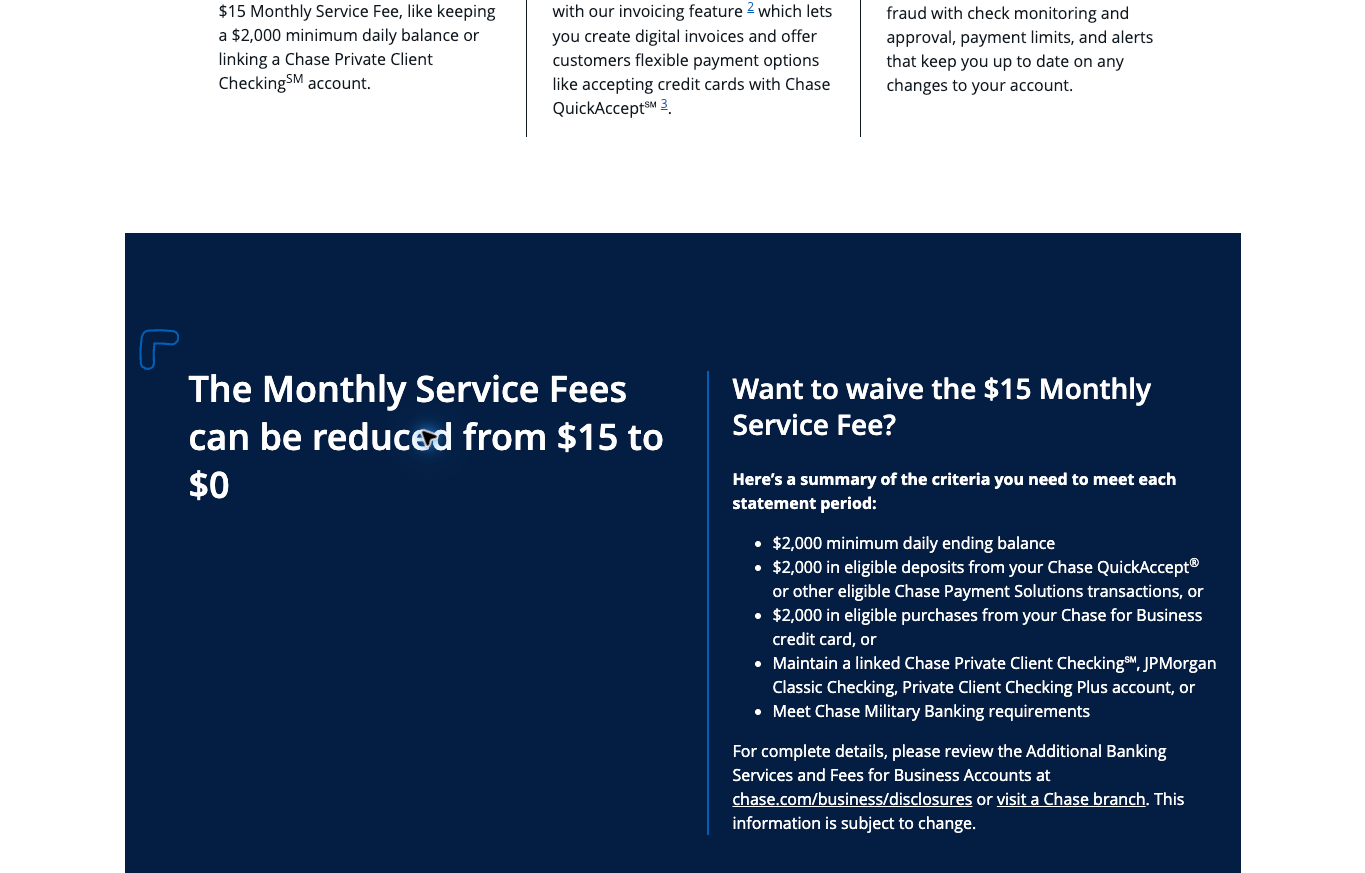
Chase Business Complete is a direct business checking option. I’d look at it when branch access, physical deposits or a traditional bank relationship serve a specific need. Online features alone don’t tell you whether branch services deserve a place in your budget.
The current monthly service fee is $15. One waiver route requires a $2,000 minimum daily ending balance. Other routes involve eligible Chase payment-processing deposits, eligible business-card purchases, specified linked accounts or military-banking requirements.
Read the conditions for each statement period carefully. An average balance is not the same as a minimum daily ending balance. Ordinary store payouts don’t automatically meet the eligible Chase processing-deposit requirement.
The page includes $5,000 in in-branch cash deposits and specified transaction allowances per statement cycle, with fees for extra activity. Review the full fee schedule for your expected use. Twelve unwaived monthly service fees total $180, before any other charges.
Compare the services you’ll actually use instead of making unnecessary purchases just to hit a waiver. If your business has no physical-deposit needs, put a real value on branch access in your comparison. Don’t assume a familiar bank is automatically the best fit.
Mercury
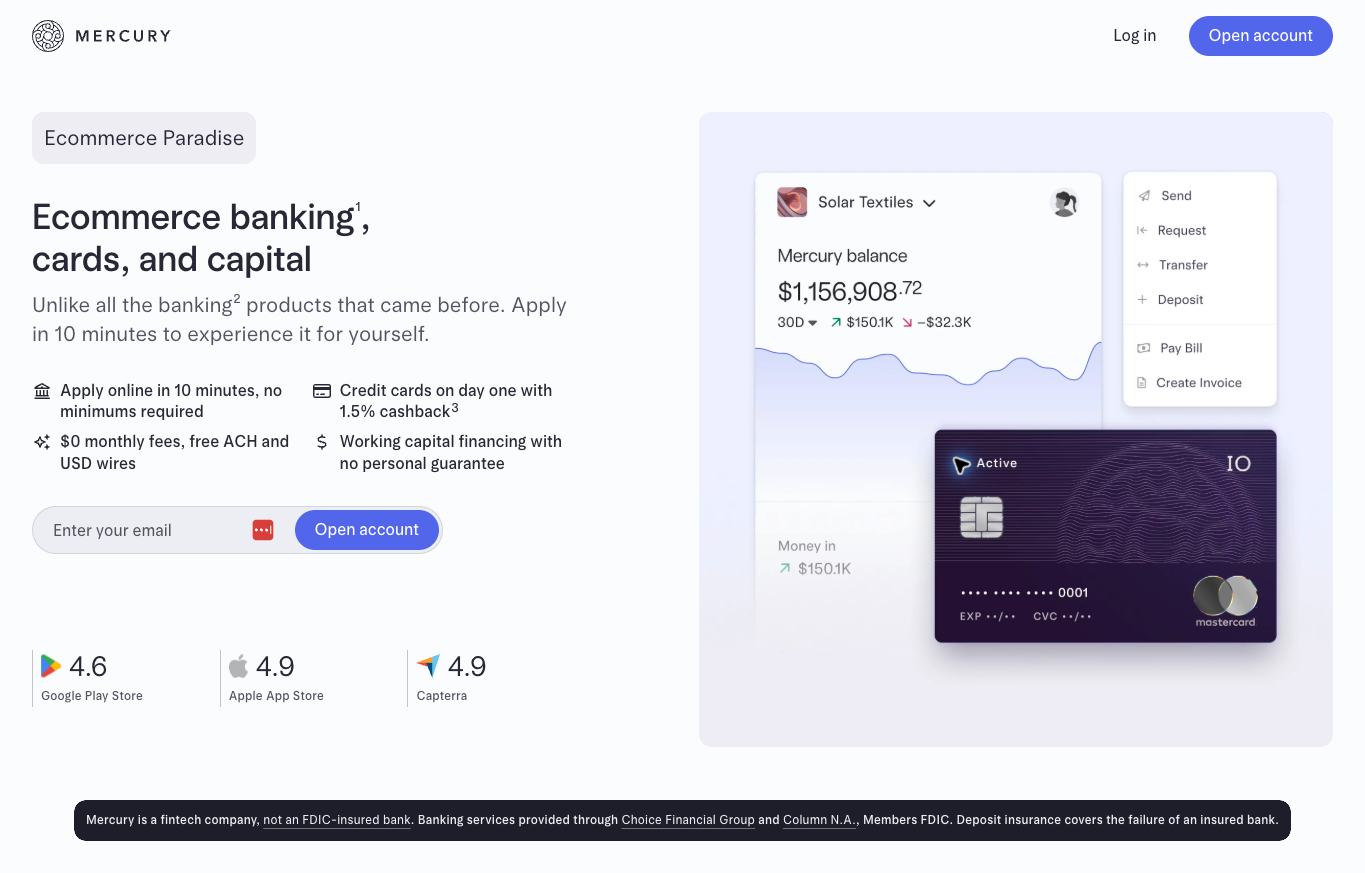
Mercury is the one I recommend for a digital operating workflow, because it’s built for online businesses and has no required core monthly fee. Its current disclosure describes a fintech company, not an FDIC-insured bank. Banking services are provided through Choice Financial Group and Column N.A., Members FDIC.
Core banking has no required monthly fee or minimum balance. Its pricing table lists free ACH, domestic wires and ordinary international USD wires, with a 1% exchange fee for non-USD international wires. Optional services and premium processing deserve a separate review.
Eligibility includes a company formed and registered in the US or a US territory, existing or planned US operations and an acceptable principal business address. Registered-agent, PO-box and UPS-box addresses are excluded for this principal address. Country restrictions and onboarding review apply.
That address rule matters if you formed an LLC with a registered agent, like many founders do. A US company and EIN do not guarantee approval. Keep your information accurate, ask the provider about anything unresolved and review the Mercury partner offering against your actual payment methods and bookkeeping needs.
I’ve been a digital nomad based in Bali since about 2019, so I get why founders abroad want location independent banking. But a founder outside the US needs a real eligibility review, not a general promise. Lending, cards and investments are also separate decisions from ordinary checking and savings.
Airwallex
Airwallex belongs in the comparison when cross-border collections or supplier payments justify a separate platform. The regional entity and account terms that apply to you matter. Don’t treat a US pricing page as a worldwide offer.
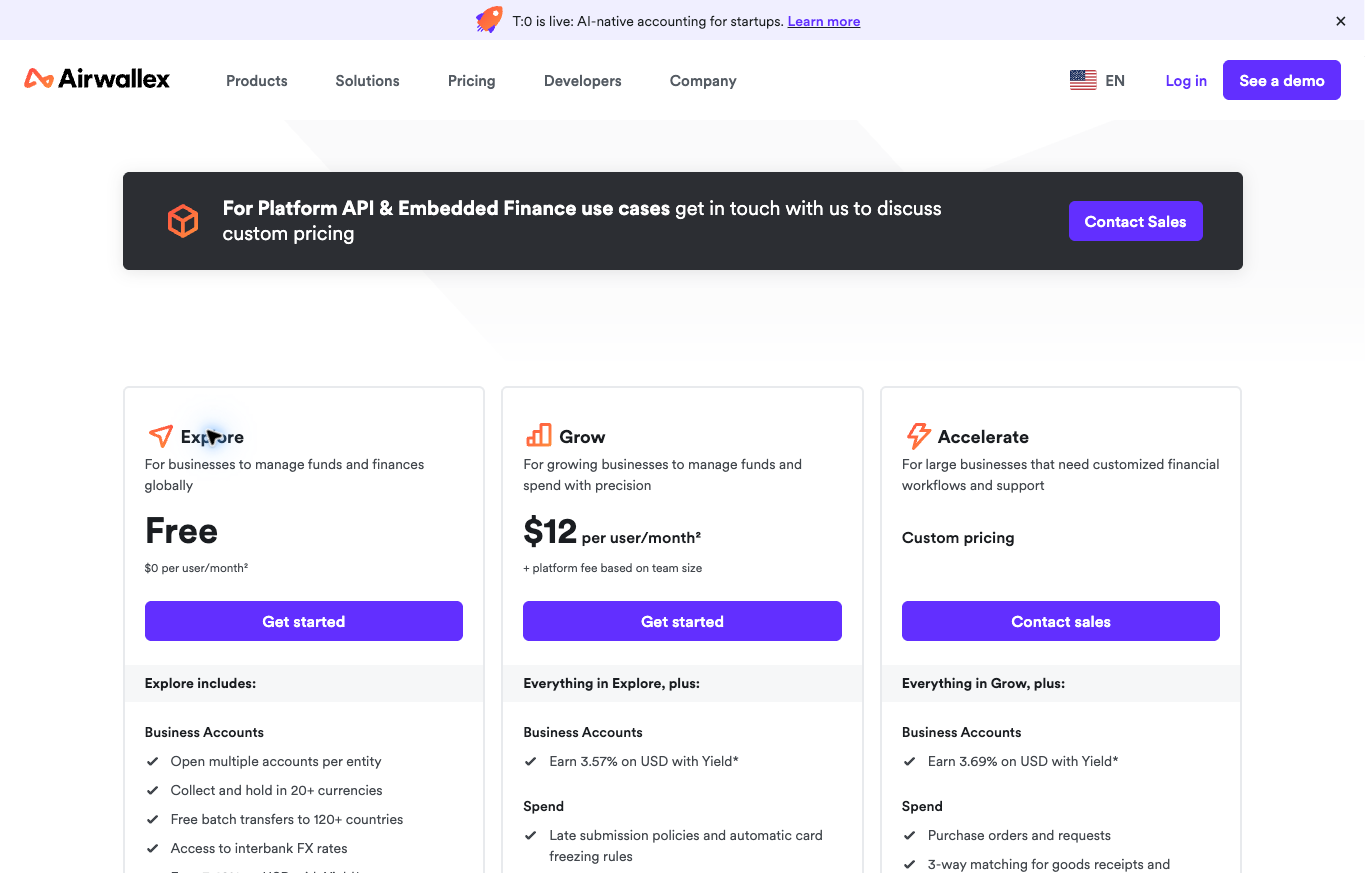
US Explore includes up to 10 free Spend users. Grow lists $12 per active Spend user monthly plus a platform fee based on team size, and Accelerate uses custom pricing. So the $12 figure is not the whole Grow bill.
The US table lists FX charges of 0.5% above interbank rates for major currencies and 1% for others. Selected SWIFT transfers show $15 to $25. Review the route, plan and recipient-side charges when you estimate a payment.
Airwallex is not itself a bank. Its US funds-safety explanation describes eligible partner-bank arrangements for certain customers. Other jurisdictions use different arrangements, so don’t carry US coverage statements over to every regional wallet.
Evaluate the Airwallex offering for a specific currency or payment need. Adding another account without a defined purpose creates more records and access decisions without solving an operating problem.
Map incoming payouts and supplier deadlines
Write down where customer payments enter the business. Your payment processor collects an order payment before the funds arrive in your operating account. Record the expected payout timing, currency and any conditions that affect availability.
Then list outgoing payments by method and due date. Manufacturers, ad platforms and software subscriptions often use different payment methods. The account needs to support your actual obligations, not an impressive feature list.
For a high-ticket store, compare the supplier’s payment deadline with your payout timing. A paid customer order doesn’t mean the money is available right away. Solve the timing requirement before you assume a new account fixes the gap.
The supplier-direct model I mentioned at the top only works with clear supplier terms and an understandable order workflow. Build your payment process around those. Don’t confuse a deposit account with financing.
Picture an illustrative order that needs a $2,400 supplier payment before shipment. If the customer payout hasn’t arrived, that invoice still needs a funding plan. This hypothetical example describes a timing problem, not a lending recommendation or a predicted store result.
So here’s the move. Document this flow before you apply for another financial product. A simple diagram or written sequence helps your bookkeeper understand each transaction, including who approves the payment and where the invoice is stored.
Compare one realistic month of fees
Use the same activity assumptions for each account. Count outgoing payments, currencies, cash deposits and the people who need access. Separate the fixed subscription from transaction charges and optional products.
A hypothetical account with a $15 monthly fee costs $180 across 12 unwaived months. Another account with no monthly fee still costs money if your required payments carry charges. Calculate the full month instead of ranking accounts by their subscription labels.
Here’s an arithmetic example. A 1% charge on a $5,000 conversion equals $50, and 4 such conversions total $200 before other costs. These assumed conversions only illustrate the math, not a promised quote or a recommendation to send money.
The exchange-rate benchmark needs review too. A percentage above a named rate is different from a flat transfer charge. Ask for an estimate using the actual currency, payment route and recipient requirements.
For currency conversion, I point people to Wise because it’s built specifically for sending and converting money across borders. According to its Wise Business pricing page, it uses the mid-market exchange rate without a markup and shows its prices upfront. Compare its fee for your exact currency pair against your bank’s before you send.
Include optional processing and third-party costs where they apply. A supplier who needs to receive a fixed invoice amount creates a different comparison from sending a fixed amount out of your account. Record both sides of the payment.
Review the Airwallex payment options, or any other cross-border option, around a defined requirement. Do the cost comparison before you add another platform and another set of records.
Keep deposit protection separate from app access
The FDIC’s standard deposit-insurance amount is $250,000 per depositor, per insured bank, per ownership category. The FDIC’s guide to understanding deposit insurance also notes it does not cover the default or bankruptcy of a non-FDIC-insured institution. A new app or named subaccount doesn’t automatically create another allowance, so ask about the actual deposit structure.
For a nonbank arrangement, identify the insured bank holding eligible deposits. Pass-through coverage requires conditions, including proper ownership records. Sending money to a nonbank is not by itself proof of an eligible insured deposit.
Deposit insurance protects against the failure of an insured bank. The nonbank company’s insolvency and an app outage are different risks. Understand the support and record-access process even when eligible funds have deposit coverage.
Mercury advertises access to up to $5 million through partner-bank sweep networks, subject to conditions. Review the participating banks, account records and your other deposits at those banks. The headline does not certify full coverage of your particular balance.
Airwallex’s US safety explanation covers qualified customers and the applicable partner-bank arrangements. Other regions follow different rules. Identify the entity and arrangement holding your funds instead of assuming the US description applies to every wallet.
Keep investments separate from deposit accounts. Mercury Treasury and Airwallex Yield are different products from ordinary checking funds. An investment-return figure is not a guaranteed FDIC-insured savings rate.
Check eligibility before comparing signup forms
Read the requirements for your entity, business activity and owners. A roundup like this can’t predict onboarding approval. The provider needs accurate information and decides whether your application meets its rules.
Keep the business name consistent across formation records and provider applications. The SBA’s guide to opening a business bank account lists common requests like an EIN, formation documents, ownership agreements and a business license, and notes some banks ask for more. Don’t submit unnecessary private information through an unfamiliar page or an unverified contact.
Address requirements deserve their own check. A registered-agent address, mailing address, residence and principal operating location all serve different purposes. Provide the address type the institution asks for instead of treating one purchased address as a substitute for everything.
A founder living abroad should review country and residency restrictions with the provider. US company formation answers only part of the eligibility question. Keep tax, legal and account requirements with the right professionals.
The business foundation checklist helps you organize the wider setup. Formation is a separate process from account approval, financing and supplier onboarding.
For Mercury’s digital direction, review the current partner page alongside the actual eligibility information. A partner offer does not waive the provider’s verification process.
Assign payment access without sharing every login
Decide who prepares payments and who authorizes them. A bookkeeper usually needs transaction records, while payment approval belongs to the responsible owner or an authorized role. Document those responsibilities before you invite users.
Use supported permissions and approval controls for the work each person does. Keep separate user access where it’s available. Shared credentials make it harder to remove access and see who did what.
Review the process whenever a contractor joins or leaves. Remove access through the provider’s supported procedure when the relationship ends. Keep an internal record of approvals and changes instead of relying on memory.
Changes to a supplier’s payment instructions need independent verification through an established contact channel. The FBI’s IC3 business email compromise alert recommends confirming any change to account details through a separate channel, such as a phone call. An unexpected email should never be the only basis for replacing recipient details.
Record who is responsible for account administration and support. Include an approved recovery process without handing out sensitive credentials. A backup administrator needs authorized access, not a copied password in a shared document.
Make reconciliation part of the account decision
A statement records money movement, while invoices and receipts explain the transactions. Keep supporting records attached or organized through an agreed workflow. A bank feed doesn’t set the correct accounting treatment by itself.
Talk through exports and integrations with your accounting professional. Check which transactions appear, how fees show up and how transfers between your own accounts are handled. Don’t assume an integration removes the need for review.
My accounting software comparison covers the recordkeeping layer separately. Choose an account that supports your agreed routine instead of rebuilding your whole accounting process around a dashboard.
Set a recurring review for unmatched receipts, failed payments and unexplained charges. Investigate discrepancies while the records are still easy to find. Waiting until year-end just adds avoidable reconstruction work, and honestly that’s a pain in the butt.
If several platforms hold funds, document the transfers between them. Otherwise the same money shows up as an unexplained deposit in one system and an unexplained withdrawal in another. Your account list should help the bookkeeper follow the complete flow.
Choose the business model before adding financial tools
A focused catalog and clear supplier relationships make payment requirements easier to understand. Start with the category you plan to serve. The high-ticket niches list helps you organize research without promising demand or profit.
Then confirm the manufacturer’s accepted payment methods, order process and dealer requirements. My supplier research guide covers the relationship-building work. A convenient account doesn’t create dealer approval or favorable invoice terms.
Supplier Paradise is another starting point for discovery, and I own the directory. Review the actual supplier requirements before you commit to a product line.
For help organizing the model and operating plan, look at Ecommerce Paradise coaching. Coaching is a separate paid business service, not account opening or personalized financial advice.
The Ecommerce Paradise Academy on Skool has classroom and membership information for learning the business, with a 7 day free trial and then a paid membership. Review the current enrollment terms. Membership does not include a banking approval or financing promise.
Prepare an account change without disrupting payments
Inventory the processor payouts, supplier instructions and recurring charges tied to your existing account. Include infrequent payments as well as monthly subscriptions. A forgotten charge creates extra work during a transition.
Review the new account’s approved details and supported payment methods before you change any instructions. A marketing page doesn’t prove your account is open, funded or ready. Resolve provider questions through the right support channel.
Plan the transition with your accountant and the providers involved. Keep records of every change and reconcile both sides. Don’t close an existing account just because the first payout landed successfully.
Account for outstanding checks, expected refunds and pending payments in the transition plan. Follow each institution’s procedures instead of assuming every transaction moves automatically. This guide did not transfer funds or close any account.
After the transition, check whether the new arrangement still serves the business. New currencies, supplier terms or staff roles create different requirements. Update the documented process before you add more products.
My take on choosing a business bank account
So with that said, here’s how I’d approach it. Map your incoming payouts and supplier deadlines first. Then compare one realistic month of fees across the same activity, and keep deposit protection, eligibility and access control as separate checks.
For most online businesses that qualify, I’d start with Mercury as the main operating account, since it’s designed for digital workflows and has no required monthly fee. Add a currency tool like Wise only when you actually pay suppliers in other currencies. Look at a branch bank like Chase if you handle cash or physical deposits.
Whatever you pick, confirm eligibility, read the fee schedule and verify payment instruction changes by phone. Keep the setup simple enough that your bookkeeper can follow every dollar. You can always add tools later once a real need shows up.
If you want help setting up the whole business, not just the bank account, my free high-ticket dropshipping mini course walks you through the model step by step. Go check that out before you open any new accounts.
Questions before choosing an operating account
Is the lowest monthly fee always the cheapest setup?
No. Include transaction, conversion, platform and optional-service charges for your actual activity. Compare the same payment flow across providers.
Does a US company guarantee account approval?
No. Ownership, business activity, address and country restrictions also need review. The provider makes the onboarding decision.
Does every fintech balance receive deposit insurance?
No. Identify the insured bank and the applicable deposit and recordkeeping conditions. Insurance against bank failure does not insure the nonbank company itself.
Does a virtual mailbox satisfy every business-address requirement?
No. Mailing and principal operating addresses serve different purposes. Follow the institution’s requirements and provide accurate information.
Should I add a cross-border platform for domestic payments alone?
Define the need first. Extra accounts add records, fees and access responsibilities. Evaluate a separate payment platform when a specific currency or workflow requirement supports the decision.
Related guides
Review the accounting software guide for the records behind your bank statement.
My business credit card comparison separates purchase rewards from repayment obligations.
The business formation checklist covers preparation before provider applications.
Read my wholesale supplier guide before discussing payment arrangements with manufacturers.
The ecommerce platform comparison covers the separate technology decision behind the store.

Trevor Fenner is the founder of Ecommerce Paradise. His main projects are Ecommerce Paradise, Supplier Paradise, and Review Paradise, which is currently in development. TrevorFenner.com publishes research-based reviews and practical guides to online business tools and remote-work services, with clear affiliate disclosures.