

Want the best hotel booking site? Here’s the thing. The best site is the one that helps you compare the exact stay you need. Match the room, dates, guests, total cost and cancellation rules before you choose, because a low nightly headline doesn’t prove you found the best deal.
If you run an online business and move between locations, the room also has to work as a workspace. Check the desk, the arrival setup and the connectivity info. A photo or an amenity icon is not a measured WiFi result.
I’ve been a digital nomad since about 2019, mostly based in Bali, and I’ve lived in Chiang Mai, Bangkok, Los Angeles and Seattle. At Ecommerce Paradise, I teach business operations that give you more flexibility and location independence. Travel still means planning for customer questions, supplier communication and everything else on your plate.
This shortlist compares Expedia, Hotels.com and Booking.com, plus an equivalent direct hotel quote. Expedia and Hotels.com are related Expedia Group brands, so comparing both is not an independent review of the whole market. Keep that in mind.
Public interfaces and policy information were checked October 13, 2026. No reservation, hotel stay, refund request or WiFi test was performed. Confirm the actual property and rate conditions instead of assuming every offer follows the same rules.
Disclosure: if you buy through affiliate links here, I may earn a commission at no extra cost to you. I own Ecommerce Paradise and Supplier Paradise. The real provider screenshots show public interfaces, not personal bookings or tested savings.
Compare the stay requirements
| Site | Useful comparison direction | What to check | Important limit |
|---|---|---|---|
| Expedia | Compare a stay alongside other trip arrangements | Room conditions, total price, payment timing and the actual booking rules | A package or promotional headline does not prove a particular hotel rate is best |
| Hotels.com | Evaluate a hotel-focused search and the applicable regional rewards | Room type, cancellation deadline, local currency and reward eligibility | Related to Expedia. Reward programs are not identical worldwide |
| Booking.com | Add another platform to the comparison | Property-specific payment and cancellation policies, room details and total cost | Payment at the property does not automatically mean free cancellation |
So what you should do is lock in your requirements first. Then run the same search on each site and compare like with like.
Expedia for comparing the stay alongside the trip
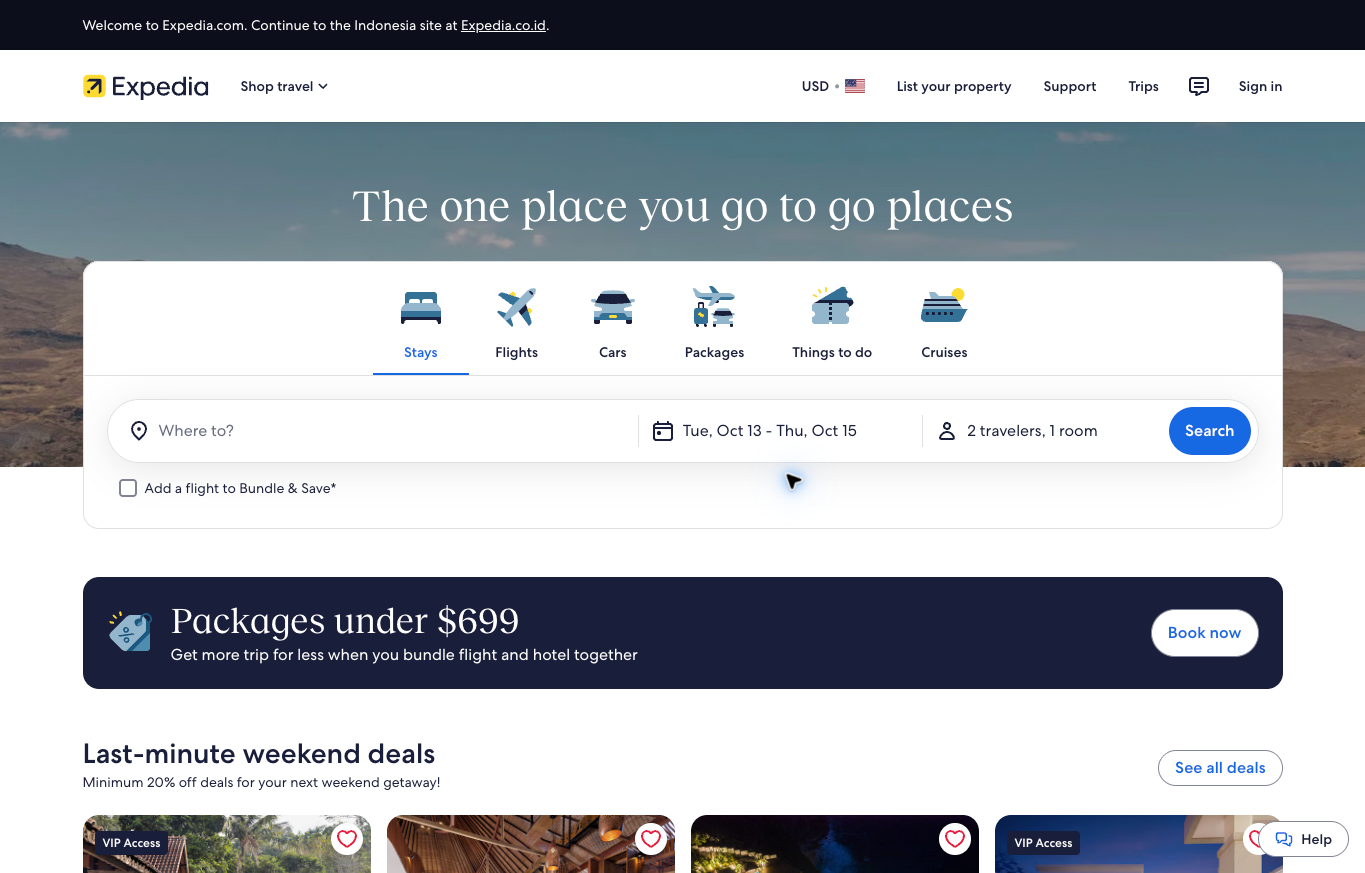
Expedia gives you a public accommodation search alongside flights, cars and other travel categories. I like it when you’re planning the stay as part of a bigger trip. Still, I’d check the exact room setup before putting any value on a bundle or promotion.
A package and a hotel-only reservation are different comparisons. Write down what each offer includes and which conditions apply if your plans change. A convenient booking screen doesn’t prove you got the lowest equivalent price.
Current public terms pull in the property’s own rules for payment, cancellation and refundability. Pay Later doesn’t mean free cancellation, and it doesn’t wipe out no-show charges. Review the selected rate instead of guessing the conditions from the payment label.
The preserved screenshot shows the United States and USD interface, with dated default fields and promotional wording. No property search, reservation or savings experiment was performed. Confirm the current offer for your real room and dates.
Hotels.com for the room and applicable regional program
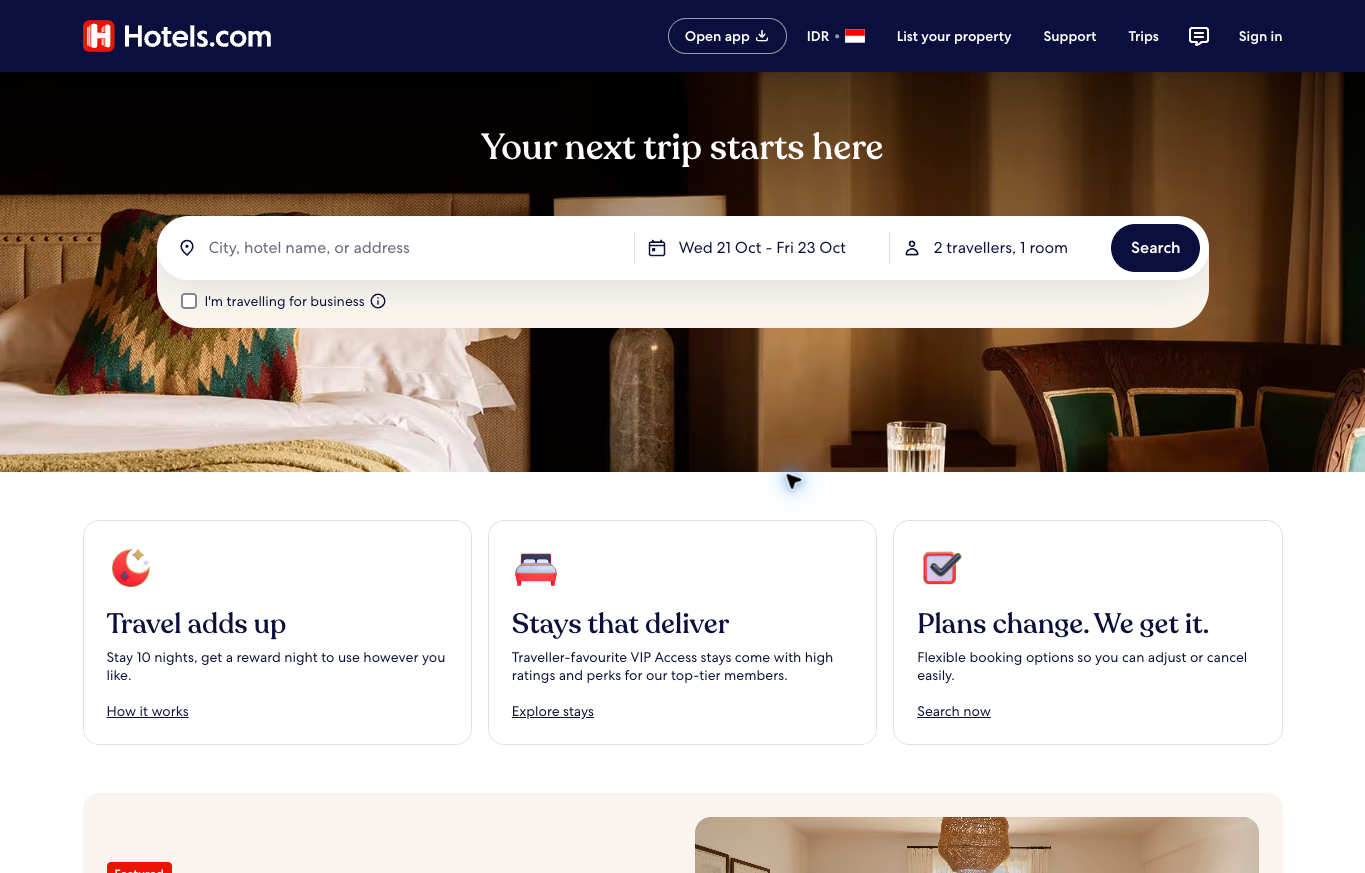
Hotels.com is another accommodation search option. I like it as a hotel-focused second look once you know the room you want. Compare the room, total charge and conditions before you put any value on member benefits.
The preserved interface is the Indonesia and IDR view. Its regional program messaging doesn’t mean rewards are the same worldwide. Confirm the program available to your account and which bookings qualify.
Regional public terms also tie cancellation and no-show charges to the property’s rules. Payment timing is still separate from refundability. Save the rate’s specific conditions before you decide.
Hotels.com and Expedia are related brands. Comparing both is useful, but it doesn’t prove an independent whole-market review. A future promotional credit is also different from a discount already applied to what you pay today.
Booking.com as another platform comparison
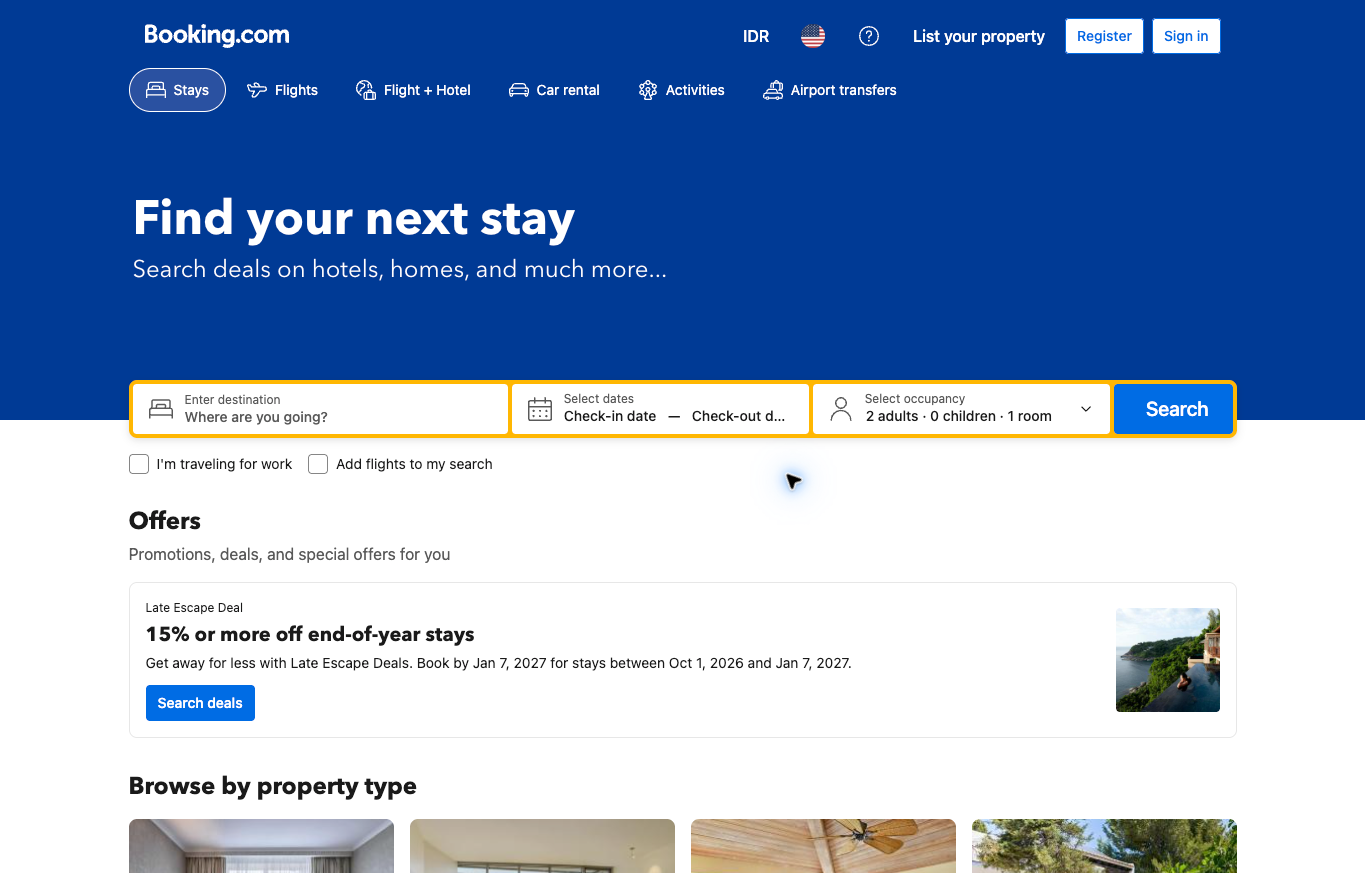
Booking.com gives you a separate public interface for accommodation research. The brand name alone doesn’t tell you the selected property’s payment, cancellation or preauthorization rules.
The Booking.com customer terms separate upfront payment from property-specific cancellation conditions, and they note an upfront payment may be taken or pre-authorized at booking. Some offers include a free-cancellation deadline, while others don’t. Inspect the actual rate you pick and when you’ll be charged.
A promotional percentage only counts if its qualifying room, dates and conditions match your stay. A result for a different room category is not an equivalent price comparison. Keep your requirements fixed while you look at alternatives.
The preserved screenshot shows a public interface without a submitted booking. Booking.com has no affiliate link in this guide because no verified affiliate destination was established. This comparison doesn’t include a stay, refund or support-performance test.
Match the room before comparing the price
Start with the same dates, guests and room category everywhere. A different bed setup or occupancy arrangement is a different offer. Keep the requirements fixed before deciding one platform has a better price.
Write down the inclusions that matter for your trip. Breakfast, parking and kitchen access have different value for different stays. Don’t count a saving on an amenity you won’t use.
Review guest supplements and restrictions. A stated room capacity doesn’t mean every guest is included in the displayed amount. Ask the property about any unclear occupancy detail before relying on the rate.
Match cancellation conditions too. A non-refundable room and a flexible room are different deals. Describe the difference instead of calling the smaller number an equivalent saving.
Compare the entire stay cost
Record the total payable for the stay and flag any charges collected separately. Keep refundable deposits separate from the accommodation cost. Optional expenses belong in the budget if you expect to use them.
In the U.S., the FTC’s rule on unfair or deceptive fees covers hotel stays and says the total price has to include mandatory fees the business knows about upfront. Taxes and optional add-ons can be shown separately before payment. So still read the full breakdown, especially outside the U.S.
Here’s a hypothetical example. Two nights at $95 plus $25 per night in extra charges total $240. Two otherwise equivalent nights at $110 with no extra charges total $220, and these numbers just show the math, not live property prices.
The example only works with comparable rooms and conditions. A cheaper room in a bad location adds transport time and cost. Review the trip you’ll actually take, not a stripped-down offer you’d never pick.
Save the offer details while you compare. Include the quote date, currency, room and full charge. Availability and prices change, so an older screen doesn’t prove the current bookable amount.
Read the cancellation deadline
Review the rate’s deadline, time zone and the charge after that point. Keep the specific conditions instead of relying on the property’s general description. A “flexible” label still needs its actual limits spelled out.
Decide how much flexibility the trip needs before you pay. A meeting that might move or an uncertain next destination calls for a different setup than fixed plans. Don’t assume you can negotiate your way out of a non-refundable booking later.
If a delayed arrival affects the first night, confirm the required notification process. Missing the first night doesn’t automatically protect the rest of the reservation. Get the booking party’s answer in writing for your actual stay.
A request to change dates is not an approved change. Keep the confirmation and the revised conditions. The original booking still applies until the responsible party confirms otherwise.
Separate payment timing from refundability
Pay Now and Pay Later are about when you get charged. Neither label alone means free cancellation. Review the rate’s rules and any no-show charge alongside the payment option.
Check the currency you’ll actually be charged in, not just the displayed conversion. Bank or card conversion fees are separate from the property’s price. Confirm those with your payment provider instead of treating a website estimate as a final bank quote.
My business credit card guide separates rewards from fees and repayment responsibilities. Keep the hotel choice and the payment-method choice as 2 separate decisions.
Identify who’s taking the payment and keep the record. A booking platform and the property play different roles in some arrangements. Your confirmation should show where a payment or refund question goes.
Cancellation and a completed refund are separate events. Keep the cancellation confirmation and review the actual refund process. No refund request or processing-time test was performed for this guide.
Keep rewards separate from today’s payment
A reward only matters under the program and booking conditions that apply to your account. The preserved Hotels.com screenshot uses Indonesia and IDR. Its message doesn’t mean the same arrangement applies in every region.
The current One Key terms and conditions separate pending rewards from available credit and require eligible bookings. OneKeyCash is promotional credit that can’t be redeemed for cash. Don’t treat a possible future reward as money already taken off today’s bill.
Compare the amount you pay today first. Then give a separate, realistic value to any reward you expect to use. Counting an included discount and a future credit as instant cash savings overstates the benefit.
Review direct hotel loyalty rules separately. A third-party booking doesn’t automatically qualify for every hotel perk. Confirm the booking channel and eligible rate before counting points or status benefits.
Compare an equivalent direct hotel quote
Ask the hotel about the same room, dates, guests and inclusions you used on the platforms. Keep cancellation and payment conditions equivalent too. A quote for a different category doesn’t prove a better price for your stay.
Booking direct is not automatically cheaper or better. The support relationship and any hotel-program benefits need their actual terms checked. A platform offer still deserves a look when it fits the trip.
Read any price-match requirements before relying on a claim. Matching dates and room conditions, submission timing and verification all affect eligibility. A “best rate” headline doesn’t mean your request will be approved.
Don’t make duplicate non-refundable bookings just to test prices. Do your research before you create another payment obligation. Keep the final purchase deliberate and tied to one arrangement you understand.
Check the practical working conditions
For a working trip, figure out what affects your normal tasks. Review the desk, seating, noise expectations and location. A room photo introduces the space, but it doesn’t prove you’ll be comfortable working there for hours.
WiFi listed as an amenity doesn’t prove tested speed or reliability. Ask the property for details and keep a backup for important calls. No hotel network was tested for this article.
Read recent reviews for the concerns that matter to your stay. Construction noise, workspace limits and arrival instructions deserve more attention than a general rating. Reviews describe other people’s visits and don’t guarantee the same experience.
Clarify unusual arrival times before you commit. Staffing and access arrangements differ by property. Get specific instructions instead of assuming every front desk runs around the clock.
Check the room against the work you plan to do. A quiet call needs different conditions than checking email for 10 minutes. Keep those needs in your comparison instead of hoping a discount makes up for a bad workspace.
Plan business responsibilities during the trip
My high-ticket dropshipping guide explains the retail model I teach. Supplier-direct fulfillment doesn’t remove customer questions, payment review or order responsibilities while you travel.
The niches list gives you categories to investigate. A focused operation is easier to plan around when the team understands the products and responsibilities. Go deep before you go wide.
Use the supplier sourcing guide to verify commercial relationships. Confirm who handles supplier questions and exceptions during the trip instead of assuming the business runs itself.
Supplier Paradise is a research resource I own. Directory leads support your research, not automatic supplier approval or a travel-ready business setup.
Write a simple coverage plan before you leave. Name the person answering customers, the escalation route and the decisions that need your approval. Your hotel choice should support the responsibilities still on your schedule.
Retain the booking and support records
Save the confirmation, payment record and rate conditions somewhere you can reach while traveling. Check guest names, dates and room details right away. An early correction is much easier when you have the booking info handy.
Know who’s responsible for each question. The property handles some accommodation details, while the booking platform or payment party handles others. Keep the support route next to the confirmation so you’re not piecing it together at the front desk.
Keep written confirmation of approved changes. A request, a canceled reservation and a completed refund are 3 different states. Record what the responsible party confirmed, and don’t assume the rest happened automatically.
Keep business records separate from assumptions about taxes. Working during a trip doesn’t make it deductible by itself. My business foundation checklist covers broader admin, not personalized tax advice.
Keep an offline copy of your confirmation and arrival instructions when connectivity is uncertain. Note the property’s contact method and the booking reference. Having the app doesn’t help much when the network goes down.
Keep business offers separate from travel services
For help with the bigger store decisions, check out my private coaching. It covers your ecommerce business, not hotel reservations or promised travel savings.
The Ecommerce Paradise Academy is my classroom and membership community. Membership is separate from any accommodation purchase, and it doesn’t create a business that needs no supervision.
Judge any educational or service offer against its own scope and current terms. A room comparison can’t tell you whether a business program fits you. Keep the learning decision separate from the travel budget.
Make a short comparison record
Write down the property, room category, dates, guest count and total payable. Add the payment currency, deadline and cancellation conditions. That gives you a consistent way to compare offers without 40 open tabs.
Separate confirmed facts from open questions. An unresolved late-arrival arrangement needs an answer, not an assumption logged as a benefit. Your comparison should show what still needs property confirmation.
Include the quote date and the provider view. An Indonesia reward message and a United States payment offer belong to their own regional contexts. Don’t combine benefits from different accounts into a fictional package.
Keep old screenshots as dated records when they’re useful. The selected price and terms still need a review before you buy. A captured offer from another search date doesn’t prove current availability.
Choose the actual stay
I’d compare Expedia’s current accommodation options against your defined room requirements. Review the full price and the property’s conditions before you put any value on a bundle.
Use Hotels.com’s current offer as another room comparison. Keep the regional reward arrangement separate from what you pay today.
Add Booking.com and an equivalent direct hotel quote when it’s useful. Pick the room, flexibility and support setup the evidence actually supports. This shortlist doesn’t crown one universally cheapest site.
Frequently asked questions
Is one booking site always cheapest?
No. Compare equivalent rooms, dates, guests and conditions. No universal price winner is established here.
Does Pay Later mean free cancellation?
No. Payment timing and refundability are separate questions, so read the selected rate’s rules.
Are Expedia and Hotels.com independent market checks?
No. They’re related Expedia Group brands, not a complete independent market comparison.
Is OneKeyCash withdrawable cash?
No. Current terms describe promotional credit with eligibility and redemption conditions, not a cash-withdrawal benefit.
Does this guide prove reliable hotel WiFi?
No. No stay or network test was performed, so ask the actual property about your working requirements.
My take on picking a hotel booking site
All right, here’s how I’d do it. Fix your room, dates, guests and flexibility first. Run the same search on Expedia, Hotels.com and Booking.com, then get one direct hotel quote for the same setup.
Compare the total you pay today, the cancellation deadline and who handles refunds. Treat rewards like OneKeyCash as a separate, future value. A low nightly headline is not the same thing as the best stay.
Being location independent is pretty cool, but it doesn’t run itself. Plan your workspace, your backup connection and your business coverage before you book. That’s what keeps a working trip from turning into a pain in the butt.
If you want to build a business that fits this kind of lifestyle, start with my free high-ticket dropshipping mini course. It walks through the model I teach, with no promises of easy money. Go check that out.
Related guides
My business credit card comparison separates rewards from fees and repayment obligations.
The business bank account guide covers payment workflows.
Read the VoIP comparison for business communications while traveling.
My accounting software guide covers recordkeeping separately from booking decisions.
The business foundation checklist introduces broader operating responsibilities.

Trevor Fenner is the founder of Ecommerce Paradise. His main projects are Ecommerce Paradise, Supplier Paradise, and Review Paradise, which is currently in development. TrevorFenner.com publishes research-based reviews and practical guides to online business tools and remote-work services, with clear affiliate disclosures.