

The best wholesale suppliers are the ones that fit your product category, your customer market and your sales channel. A company name is just a research lead. Your store still needs an approved commercial relationship and a fulfillment process that actually works.
Here’s what I’d do. Start with one category and define the customer you want to serve. Then research the manufacturers, distributors and dealer programs that serve that market, because product access belongs near the very beginning of your store plan.
At Ecommerce Paradise, I connect supplier research with the store’s customer responsibilities. Accurate product information and clear delivery expectations matter before the first order ever comes in. Through Ecommerce Paradise I also do supplier recruiting for client stores, and I sold a multi-store portfolio doing about $7M a year in 2022, so this part of the business is close to my heart.
This shortlist compares Newair, Petra Industries, Almo, CWR Wholesale Distribution and S&S across different product categories. Supplier Paradise shows up separately as my research directory, not a wholesale supplier. Public program information was checked on October 15, 2026, and if you’re new to the model, my high-ticket dropshipping guide explains how it all fits together.
Keep that in mind as you read. I’d separate confirmed information from a directory’s reported details and from open questions, and keep the source and research date beside each material fact. An attractive company profile doesn’t replace the supplier’s current answer.
Ownership and affiliate disclosure: I own Supplier Paradise and Ecommerce Paradise. Links include my directory, paid support, educational resources and some affiliate links to tools, and qualifying purchases through those earn me compensation at no extra cost to you. No supplier account, commercial agreement, fulfillment test or order was completed for this article.
Compare five wholesale suppliers by category
| Company | Category to investigate | Published program detail | Important limitation |
|---|---|---|---|
| Newair | Wine fridges, beverage cooling and compact appliances | Wholesale program includes dropship websites | Minimums depend on the business |
| Petra Industries | Electronics, accessories and home products | Independent-retailer page advertises no minimum order | Confirm brand and sales-channel access |
| Almo | Appliances and hospitality equipment | Separate dealer, ecommerce and hospitality channels | Division-specific requirements apply |
| CWR Wholesale Distribution | Marine electronics and boating equipment | Blind shipping described in its FAQ | COD excludes blind dropshipping |
| S&S, formerly S&S Activewear | Blank apparel and branded merchandise | Business wholesale pricing without minimum pieces | Retail accounts receive retail pricing |
These companies serve very different businesses. I’d start with Newair for a focused cooling category, CWR for a marine niche or S&S for apparel decoration. Petra and Almo are worth a look when several product lines or a specialized distribution channel matter, and this is a category-based shortlist, not a tested quality ranking.
1. Newair for wine fridges and compact appliances
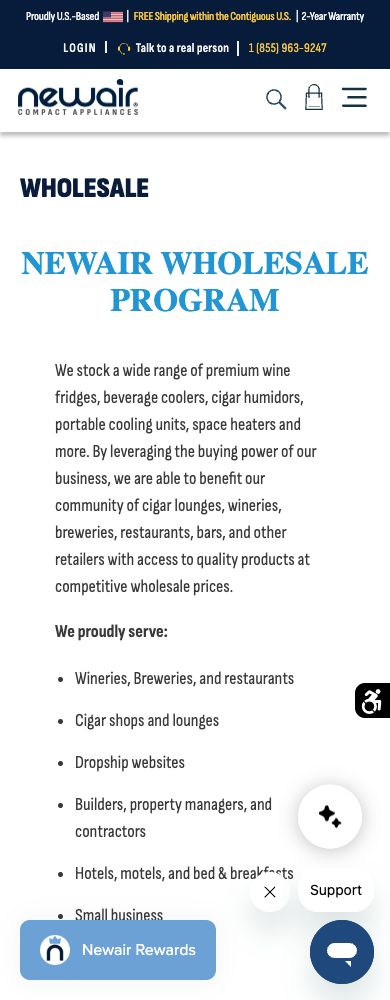
Newair’s official Wholesale Program lists wine fridges, beverage coolers, cigar humidors, portable cooling units and space heaters. Its stated audiences include dropship websites along with hospitality businesses and contractors. For a wine storage or home bar store, that’s a much more specific starting point than a general marketplace.
The program advertises low to no minimums depending on the business, plus an online wholesale ordering portal. Keep that qualifier attached to the minimums. The public page doesn’t promise identical terms for every applicant.
I’d ask which models your store is allowed to sell, how inventory gets communicated and whether an order ships directly to the customer. For cooling products, get installation clearances and delivery arrangements before you write the product page. A wholesale program description doesn’t give you your dealer price, margin or approval.
2. Petra Industries for electronics and related product lines
Petra’s independent-retailer page describes consumer electronics, accessories, home appliances, fitness technology and other categories. The company presents itself as a wholesale distributor for resellers. That makes Petra worth a look for a specialist store that needs several related brands instead of one manufacturer’s range.
Its public independent-retailer offer advertises no minimum order and online ordering. Neither detail proves access to every brand or permission for every marketplace. Ask which products and sales channels your approved account would cover.
My preference would be a narrow product family with a clear buying reason, like outdoor communication equipment or home power protection. Don’t import an entire catalog just because the feed exists. Confirm product data rights, individual-order fulfillment, shipping charges and the warranty contact before you pick your first items.
3. Almo for appliances and specialized distribution
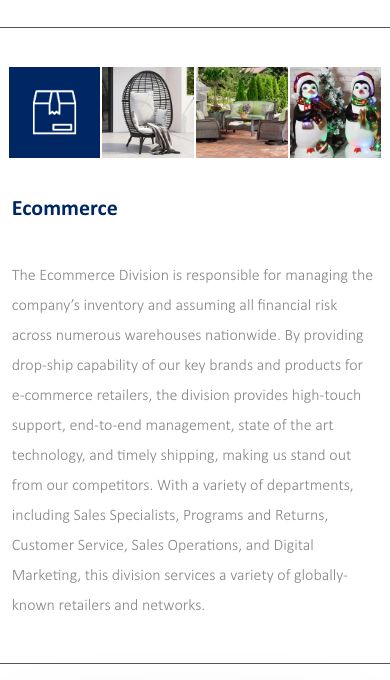
Almo describes separate dealer, ecommerce, premium appliance and professional audiovisual businesses. Its corporate overview specifically describes dropship capability within the ecommerce division. A retail appliance account and a hospitality project relationship still need separate investigation.
The Almo Hospitality dealer page says applications require approval and qualified resellers need resale documentation. Its advertised no-fee and no-minimum-order terms belong to the hospitality offer. Don’t stretch those statements to every Almo division or product line.
Pick the division before you ask for pricing. A hotel television project, a luxury kitchen sale and a consumer ecommerce order all raise different support questions. I’d describe your buyer, delivery region and sales channel in the first contact, then ask for the right application route and confirm the actual freight, installation and warranty responsibilities.
4. CWR Wholesale Distribution for marine products
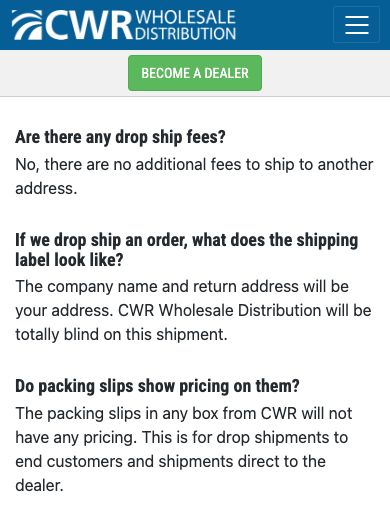
CWR’s public catalog focuses on marine equipment, including navigation, boating hardware and related outdoor categories. Its FAQ describes blind shipments using the dealer’s company and return address, with no pricing on packing slips. That gives a marine store owner a concrete fulfillment process to dig into.
The same FAQ excludes blind dropshipping from COD accounts. CWR also lists business documentation, sales venue information and a personal guarantee form among its account requirements. Read the current application carefully before you make any financial commitment, and to be clear, this comparison does not recommend signing a guarantee.
Manufacturer restrictions still matter even when the distributor accepts your sales channel. Ask about the exact brand and marketplace instead of treating general account access as universal permission. For technical products, confirm compatibility information and installer requirements before you take customer orders, because marine buyers need accurate answers, not an imported description with an unsupported fit claim.
5. S&S for blank apparel and branded merchandise
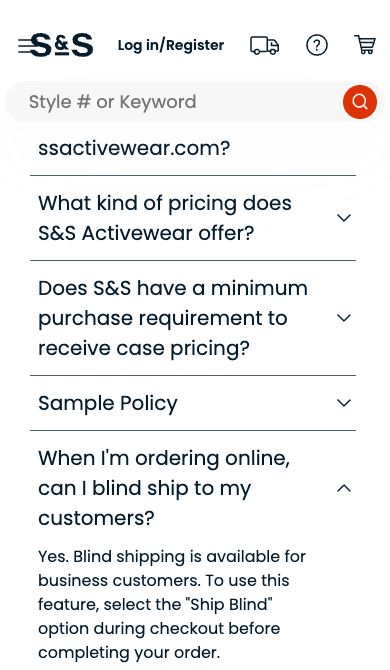
S&S, formerly S&S Activewear, supplies apparel and accessories for businesses that decorate and resell merchandise. This route fits a screen printing, embroidery or branded merchandise operation. Buying blanks is a different business from selling high-ticket appliances, and the work after sourcing belongs in your decision.
The US FAQ separates business wholesale pricing from personal retail pricing. Business registration asks for business information and a resale certificate where applicable. The page states no minimum piece requirements and describes blind shipping for business customers through its checkout option.
Start with a few styles, sizes and colors for one buyer group. Plan who decorates the goods, who checks the finished work and who handles the customer’s return. Blind shipping doesn’t mean printing, embroidery or a complete print-on-demand service, so confirm the brand’s resale conditions and your decoration workflow before promising finished merchandise.
Use a directory to organize leads
Supplier Paradise is my own high-ticket supplier research resource. Its directory and scripts help with shortlisting. Each company still decides account approval and commercial terms.
The dedicated membership page, checked October 15, 2026, lists $9 monthly, $49 annually and $97 one-time directory access. Monthly and annual plans renew under their billing terms. Lifetime access covers the directory and standard updates while Supplier Paradise operates the directory.
Coaching and done-for-you recruiting are separate support options. They’re not required upgrades for using the directory. Compare the current scope before buying help instead of assuming a directory subscription includes a managed supplier application.
Start with a category and write down why each company deserves a look. Reported territory or supplier type needs confirmation from the company. A paid listing database is not an approved commercial relationship.
Check Supplier Paradise’s access options if an organized workspace fits your research. No membership checkout or private directory test was completed for this comparison.
Separate confirmed facts from research observations
Give every material sourcing detail a status. Confirmed information has a current supporting source. Reported information comes from a directory or another indirect record, and unknown information stays an open question.
Keep the source, date and account context beside each answer. A supplier’s general website describes the public offer, not necessarily the terms your store will get. Note that distinction before you compare companies.
For example, a directory mentioning a country doesn’t mean you have permission for your proposed territory. Ask the company to confirm the intended market and channel. Don’t fill the empty field with a guess.
I’d use one record for the whole research and application process, because several disconnected spreadsheets produce messy notes. I like Google Workspace for this because a shared Sheet gives you one current shortlist, and you also get a professional business email address for supplier inquiries. The next reviewer can see the evidence behind every decision.
Qualify category and account fit first
Identify the product category and customer before you ask for detailed commercial terms. Ask whether the company carries the relevant line and accepts your proposed sales channel. A bad account fit ends the investigation early, and that’s a good thing.
Write down requirements for facilities, business documents and territory. Different programs need different evidence. A professional website doesn’t replace the application requirements the actual company gives you.
Describe a store under development honestly. Explain the intended niche and customer without invented sales or established-store claims. Ask which materials the supplier expects at the application stage.
Suppliers often want to see a real business behind the application. I like Quo for this because it gives you a dedicated business phone number for calls and texts, so suppliers aren’t calling your personal cell. Add it when you start making real contact.
My niches list supports category research. Go deep before you go wide. Use the list to narrow things down, then evaluate the products and customer responsibilities inside the category you pick.
Define product access and permitted content
An approved account still needs a clear product scope. Ask which brands, models and variants are included. Restricted lines sometimes need another approval or follow different territory rules.
Ask for current specs and the process for receiving changes. Product dimensions, compatibility and included accessories all affect customer decisions. Conflicting documents need an answer from the responsible source before you publish anything.
Confirm permission for images, manuals and descriptions. A file sitting online doesn’t give you reuse rights. Record the approved materials and any conditions on how your store presents them.
Ask who supplies discontinued product and replacement information. An outdated catalog creates unnecessary support work. Your store needs a reliable update route, not a one-time download treated as permanent truth.
Once you have approved product data, you need somewhere to put it. I like Shopify for this because it handles hosting, checkout and product management in one platform, which keeps a high-ticket catalog organized. It’s a monthly subscription, so set it up when supplier conversations are moving.
Clarify order submission and acknowledgement
Write down how an order reaches the supplier. Identify the required fields, the submission method and the acknowledgement process. A sent request is not the same as an accepted order or allocated stock.
Ask what happens when information is incomplete. Cover address corrections and who approves changes. Nobody should be guessing a customer’s delivery address or selected variant during fulfillment.
Confirm the operating schedule and time zone. A support channel that accepts messages around the clock doesn’t mean orders get processed around the clock. Your customer expectations need to match the confirmed procedure.
Keep a clear escalation contact for an unanswered acknowledgement. Don’t promise dispatch just because an order was transmitted. Note the next fact you need before you give a shipment estimate.
Understand stock and lead-time information
Ask what the stock signal means and how often it changes. A catalog listing, a feed quantity and an allocated unit are different kinds of evidence. Confirm the right source for your order before relying on availability.
Separate processing time from transport time. The first covers preparation and dispatch, and the second depends on the actual delivery arrangement. Mashing them together without context creates a misleading customer estimate.
Write down how backorders and discontinued items get handled. Find out whether a substitution needs customer approval and who supplies the revised information. A model that looks similar is not an automatic replacement.
No stock allocation, shipment or delivery time experiment was performed for this guide. These questions describe your own operating review. Public directory information doesn’t prove current inventory.
This matters legally too. The FTC’s Mail, Internet or Telephone Order Merchandise Rule guide says you need a reasonable basis for any shipping time you state, and if you can’t ship on time you have to offer the buyer a revised date or cancellation with a refund. That’s general information, not legal advice.
Confirm delivery responsibilities
High-ticket products sometimes need freight, appointments or extra handling. Ask which services the actual quote includes. Curbside delivery, placement and installation are different commitments.
Record geographic exclusions and access requirements. A standard delivery area doesn’t mean service to every address. Remote locations and difficult access need confirmation through the right shipping process.
Ask who sends tracking and appointment information. Find out what happens when a customer misses a delivery or needs a change. The supplier, carrier and store all need clearly assigned responsibilities.
Keep the approved delivery wording beside the product record. Your pages should describe the service you actually support, not a competitor’s promise. Confirm any material change before customer-facing copy repeats the old arrangement.
Get damage, return and warranty procedures
Separate transit damage from an ordinary return and from a warranty issue. Each one may follow a different process. Ask which evidence and deadlines apply instead of assuming one general policy covers every exception.
Identify who opens the claim and who tells the customer what happens next. Every report needs an owner. Bouncing a customer between several companies without an agreed process creates avoidable confusion, and honestly, it’s a pain in the butt for everyone involved.
Record authorization requirements before you promise a replacement or return. The supplier’s approval route matters alongside your store’s own obligations. Get proper professional guidance on legal requirements instead of guessing the right policy from a directory.
The FTC’s Businessperson’s Guide to Federal Warranty Law is worth reading here. It explains that sellers must make written warranties on products costing more than $15 available before the sale. Confirm with your supplier where the warranty text lives so you can show it.
Ask about parts and technical support for the product line. Some customer questions need specialist knowledge. Define the escalation route before you present the store as able to solve every installation or service issue.
Compare the complete commercial offer
The product price is only one input in the cost of serving the buyer. Shipping, handling, minimums and payment timing belong right beside the quote. Confirm the currency and included services before comparing suppliers.
Compare equivalent products and delivery arrangements. A quote that excludes freight is different from one that includes delivery. Write the differences down instead of ranking suppliers by the smallest number on the page.
Identify the sales channel and pricing conditions that apply. Ask for the current documents for your account. Don’t turn a vague reference to pricing policy into permission for every advertising or discount practice.
Here’s a hypothetical. On a $1,000 sale, subtract a $650 product cost, $120 freight, $15 handling and a $30 payment processing assumption. That leaves $185 before advertising, returns, taxes and overhead, and another $80 delivery charge drops it to $105.
Those are planning figures, not supplier quotes or expected margins. Compare the complete order cost before you rank a price list. To track real numbers once orders start, I like Finaloop for this because it’s bookkeeping built for ecommerce, so freight, fees and cost of goods land in one place.
Build a manageable shortlist
Pick a starting group you actually have time to investigate and follow up on. As a hypothetical planning example, research 10 companies and qualify the strongest 5. Those numbers show prioritization, not an approval formula.
Record the company, category, source and reason for including it. Add the current contact and the status of each important question. Another person should understand the decision without rebuilding your browsing history.
Give every lead a specific next action. Asking for application requirements is different from waiting on a delivery answer. Record the owner and date instead of adding more companies to dodge open questions.
Keep unsuitable leads with a short factual reason. A declined channel or the wrong territory sometimes tells you the search needs a new direction. It is what it is, and keeping the record stops you from investigating the same mismatch twice.
Prepare a clear first inquiry
Explain the business, the product category and the intended market briefly. Ask whether your proposed channel fits the current account program. The first contact should confirm a suitable route before you ask for every possible document.
Include an accurate contact method and a public business description. Don’t claim existing customers, dealer approval or sales volume without evidence. A serious plan deserves honest wording.
Ask who handles the next stage if the first person doesn’t have account authority. Keep their answer and role in your shortlist. A consumer service contact sometimes has to route your request to another team.
Supplier Paradise’s scripts give you a starting point, not an excuse for a generic mass message. Adapt each request to the company and the open question. No supplier messages or applications were sent for this comparison.
Prepare the store around verified arrangements
The high-ticket dropshipping guide I linked in the intro explains the operating model. Your store stays responsible for its customer promises even when another company ships the product.
The supplier sourcing guide explains the research process in more detail. Use it alongside current company responses, not as a substitute for account-specific terms.
My business foundation checklist supports admin prep. Confirm legal, tax and registration questions with the right professionals and authorities for your situation.
Many supplier applications ask for business documents, so form the company properly. I like Northwest Registered Agent for this because it handles LLC formation with a registered agent service. I run my own business through a Wyoming LLC.
Keep business money separate, too. The SBA’s page on opening a business bank account recommends one as soon as you start accepting or spending money for the business. I like Mercury for this because it’s an online business banking platform built for that separation.
Match product pages and support instructions to the approved information. Record who checks updates and resolves conflicts. A store built before access approval needs revisions when the real account scope differs from the original plan.
Review the relationship after approval
Approval starts an operating relationship. Keep the actual agreement and current procedures accessible to the people managing orders. A successful application doesn’t mean every future shipment will go through without exceptions.
Track factual problems and the responses you get. Missing acknowledgements, wrong stock and slow answers all deserve an evidence-based record. Don’t make a broad quality judgment from a polished website or one friendly conversation.
Assign an owner to recurring issues. Ask which process needs fixing and which customer commitments need review. Repeating an unresolved problem without changing the procedure leaves the same risk in place.
Keep changes to terms and contacts visible. A new account manager or a revised shipping process changes the working instructions. Confirm the revision before your team keeps using an outdated document.
Choose research support for the work you need
Look at Supplier Paradise’s membership options for directory access and separate support. Choose the scope based on the research or help you need, not an assumption that paid access guarantees suppliers.
My private coaching is an owned offer for broader store decisions. Bring a category, a shortlist and specific open questions. It doesn’t replace another company’s dealer approval.
The build and launch service is a separate owned option. Review its actual scope before you buy. A store building service doesn’t guarantee inventory, earnings or access to any brand.
Wholesale supplier questions
Does wholesale access include dropshipping? Confirm the actual fulfillment arrangement. Buying inventory and shipping individual customer orders are different operating models.
Does directory membership guarantee approval? No. Each supplier decides eligibility and commercial terms, and research access gives you leads, not an approved dealer agreement.
Is a public catalog enough to launch? No. Lock down product access, permitted content and fulfillment responsibilities before making customer promises, because an available product page is not an account offer.
How many companies belong on the first shortlist? Pick a group you have time to qualify and follow up on. Expand only when the open requirements give you a reason to try another research route.
My take on finding wholesale suppliers
So with that said, here are the key takeaways. Pick one category and one customer first. Use the five companies here as category-specific research leads, then confirm product access, sales channels, fulfillment, delivery and warranty handling directly with each one.
Track every material fact as confirmed, reported or unknown, and compare the complete order cost instead of the lowest price on a list. A wholesale account only matters once the supplier has confirmed, in writing, what you can sell, where and how it ships.
I teach USA-based authorized suppliers and high-ticket products because one approved relationship can support a focused store. If you want a free place to learn the full model, grab my free high-ticket dropshipping mini course and start building your shortlist the right way.
Related guides
The dropshipping overview explains customer and supplier responsibilities.
My niches list supports focused category research.
The supplier sourcing walkthrough covers commercial verification.
Use the business foundation checklist for administration.
Supplier Paradise’s public supplier guide gives you a research shortlist, not certified account approval.

Trevor Fenner is the founder of Ecommerce Paradise. His main projects are Ecommerce Paradise, Supplier Paradise, and Review Paradise, which is currently in development. TrevorFenner.com publishes research-based reviews and practical guides to online business tools and remote-work services, with clear affiliate disclosures.