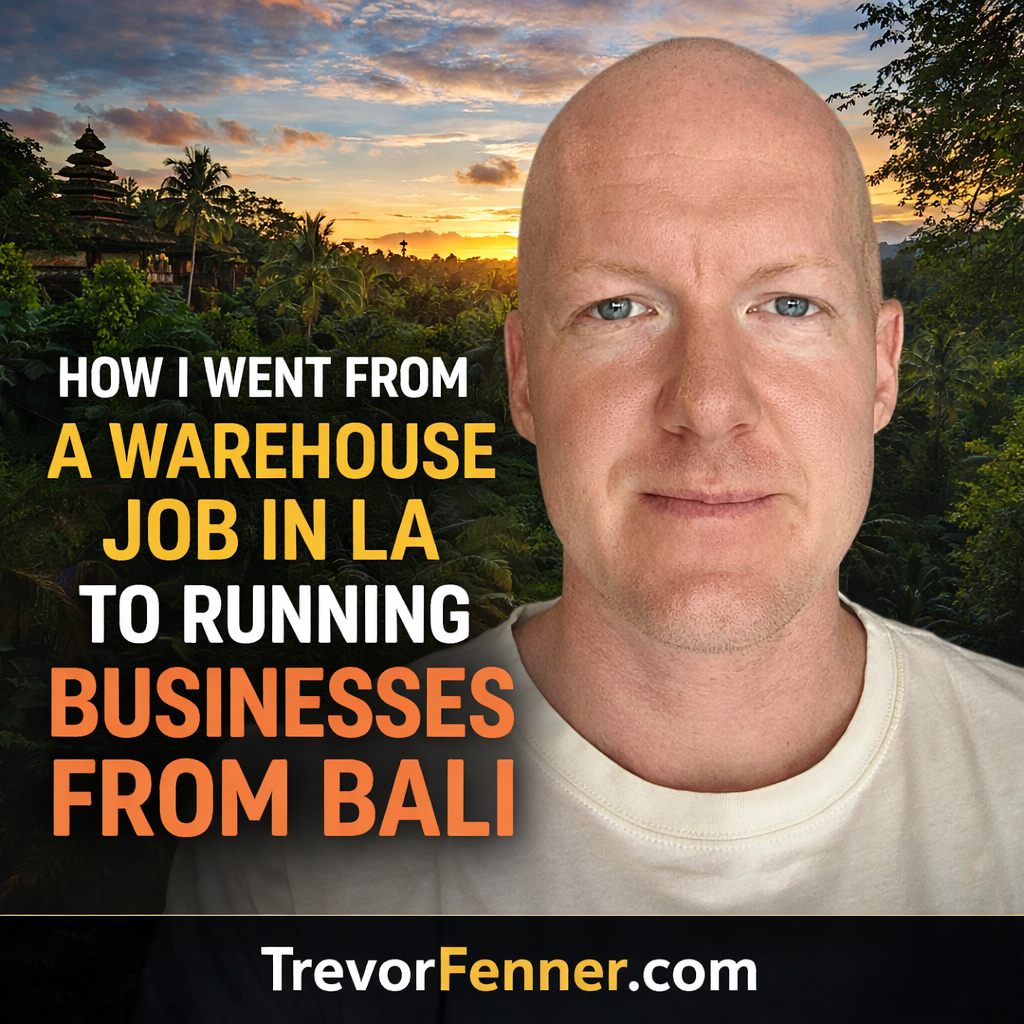

I currently run multiple businesses from a laptop in Bali.
Ecommerce Paradise is an education and services platform teaching high-ticket dropshipping. I also run an active ecommerce store selling electric bikes, scooters, and mobility equipment. Paradise Skate Mag is a skate media project covering culture, filming, and the community I’ve been part of my whole life. And Trevor and Widi is a couples travel vlog documenting expat life in Southeast Asia with my partner.
From the outside that might look like someone who has mastered the art of doing many things at once. The reality is more complicated and more honest than that. Running multiple businesses has not taught me that you can do everything simultaneously. It has taught me, repeatedly and sometimes painfully, that focus is the most important resource in any business, that it’s finite, and that how you allocate it determines almost everything about your results.
Here is what I’ve actually learned.
You Can Run Multiple Businesses, But Not Build Them All at Once
This is the most important distinction I’ve come to after years of running multiple operations simultaneously. There is a difference between running a business and building one.
Running a business that has systems, suppliers, trained team members, and documented processes requires a relatively small ongoing investment of attention. Checking in on performance, making occasional strategic decisions, handling exceptions that fall outside normal operations. A well-built business can largely run itself with periodic oversight.
Building a business is completely different. It requires concentrated, sustained, creative attention. You’re making consequential decisions constantly, many of them without enough information, in a domain you’re still learning. You’re creating systems that don’t exist yet, establishing relationships from scratch, troubleshooting problems that have no precedent in your operation. This work cannot be done in the margins of your attention. It demands the center of it.
The mistake I made repeatedly in my early years was trying to build multiple businesses at the same time. I thought that because I could context-switch quickly, I could effectively build several things in parallel. I was wrong. What actually happened was that every business I was trying to build got a fraction of the focus it needed, which meant all of them developed more slowly than they should have and some of them never developed at all.
The portfolio I run now exists because I built each piece sequentially, not simultaneously. I built one store, stabilized it, created systems around it, and then turned my building attention to the next thing. The businesses I run today are the result of that sequential focus, not of trying to do everything at once.
Attention Is the Real Constraint, Not Time
Most people think the challenge of running multiple businesses is time management. It isn’t. You can manufacture more effective time by waking up earlier, outsourcing more, delegating better, and eliminating low-value activities. Time is genuinely constrainable and expandable with the right systems.
Attention is different. Deep, focused, creative attention is a finite resource that depletes through the day and cannot simply be extended by adding more hours. The best work I do on any of my businesses happens in the first few hours of the morning when my attention is fresh and uncontested. By mid-afternoon, even if I have technically more time available, the quality of strategic thinking I can do drops significantly.
Understanding this changed how I structure my days completely. I protect my morning hours for the work that requires the most creative and strategic attention: building new systems, writing content, making consequential decisions about direction and investment. Administrative tasks, communication, routine operational oversight go in the afternoon when attention is naturally lower.
I also became ruthless about what actually deserves my deep attention versus what can be handled by someone else or by a documented process. For operational tools and team communication across my businesses I rely on Google Workspace, which keeps everything organized without requiring me to be the coordination point for every decision. That kind of infrastructure reduces the attention tax of running multiple operations significantly.
Every Business You Add Taxes the Ones You Already Have
This is something I wish someone had told me clearly before I started adding businesses to my portfolio.
Every new business you add creates ongoing overhead: decisions that need to be made, problems that need to be solved, relationships that need to be maintained, performance that needs to be monitored. That overhead doesn’t stay contained to the new business. It draws from the same finite pool of attention that your existing businesses depend on.
When I launched my ebike store there was a period where the attention it required in the early stages genuinely pulled resources away from Ecommerce Paradise. Not because I wasn’t managing my time well, but because building something new is inherently attention-intensive and that attention has to come from somewhere.
The lesson I took from that experience was to be much more deliberate about when I add a new business and to have a clear plan for how the existing businesses will be managed with less of my direct attention before I commit to building something new. That usually means building out the team, documentation, and systems in the existing business first, until it can genuinely run with minimal oversight, before shifting my building attention elsewhere.
Systems Are What Make Multiple Businesses Possible
If I had to identify the single thing that makes running multiple businesses sustainable, it would be systems. Documented, repeatable processes that allow work to be done consistently without requiring my direct involvement in every decision.
In Ecommerce Paradise this means documented processes for content production, student support, service delivery, and affiliate management. In my ebike store it means documented supplier communication protocols, order processing workflows, and customer service procedures. In Paradise Skate Mag it means a content calendar and editorial process that doesn’t depend on me making every creative decision in real time.
None of these systems existed at the start. They were built deliberately over time, usually because a problem occurred that made the absence of a system obvious. Every time something breaks in a business because a process wasn’t documented or a decision wasn’t delegated properly, I treat it as an instruction to build the system that would have prevented it.
The financial side of managing multiple businesses also requires systematic infrastructure. I track revenue, expenses, and profitability across all of my businesses through FreshBooks, which gives me a clear picture of how each operation is performing without requiring me to piece together data from multiple sources every time I want to understand the numbers. Clean financial visibility across multiple businesses is not optional. It’s how you make good decisions about where to invest and what to prioritize.
Focus Is Not About Doing Less, It’s About Doing the Right Thing Deeply
There’s a version of the focus conversation that concludes with: you should only ever do one thing. Pick one business, one product, one channel, and go all in forever.
I don’t think that’s right, or at least it’s not the whole picture.
The entrepreneurs I respect most are not people who picked one thing and never deviated. They’re people who focused intensely on one thing at a time, built it to a point of stability and self-sufficiency, and then applied that same intense focus to the next thing. They’re sequential focusers, not permanent single-taskers.
That’s the model I’ve tried to follow. Right now the thing that gets my deepest focus is Ecommerce Paradise, because it’s the business with the most active building happening: new content, new services, new students coming through the masterclass and coaching programs. My other businesses get attention too, but it’s maintenance and optimization attention, not building attention.
When I’m ready to build something new, I’ll shift my building focus there. The discipline is in being honest about which phase each business is in and allocating attention accordingly, not in pretending I can build everything simultaneously.
What I Tell Students Who Want to Run Multiple Stores
This comes up constantly in one-on-one coaching and in the Ecommerce Paradise Community. A student gets their first store to early traction and immediately wants to know when they can start building a second one.
My answer is always the same: when the first one doesn’t need you.
Not when it’s making money. Not when you’ve hit an arbitrary revenue milestone. When the first store has documented systems, reliable suppliers, a stable advertising operation, and can largely run without you making decisions about it every day. That’s when your building attention is genuinely free to deploy somewhere else.
Getting a high-ticket dropshipping store to that point typically takes twelve to eighteen months of focused effort. Students who try to shortcut that timeline by splitting focus earlier almost always end up with two stores that are both underperforming rather than one store that’s working well.
The free beginner’s guide lays out the full roadmap for building a first store properly. The right niche, the right suppliers, the right traffic strategy, the right operations. Doing that well for one store before expanding is not a limitation. It’s the foundation that makes everything else possible.
The Counterintuitive Truth About Productivity
Here is the thing that took me the longest to actually internalize, even though I understood it intellectually relatively early: doing less, better, produces more than doing more, worse.
In the years when I was trying to run the most businesses simultaneously, I was generating the least real progress. The years when I narrowed my focus aggressively and committed fully to one thing at a time were the years when I made the most meaningful forward movement.
According to research from the American Psychological Association on multitasking and cognitive performance, task-switching carries a significant cognitive cost that compounds with the complexity of the tasks being switched between. The more consequential the decisions involved, the more expensive the context-switching becomes in terms of both time and quality of output. Running multiple businesses means making a lot of consequential decisions. The cost of context-switching between them is real and it shows up in the quality of those decisions whether you notice it or not.
The most productive version of me is not the version managing the most things simultaneously. It’s the version that has protected deep focus for the most important work, delegated everything that can be delegated, automated everything that can be automated, and is building one thing with full intensity at any given time.
The Role of the Right Tools in Buying Back Focus
One thing that has made running multiple businesses genuinely more sustainable over the years is being deliberate about the tools I use to reduce operational overhead.
For financial management across multiple businesses FreshBooks has been essential. For team and document organization Google Workspace keeps everything in one place. For keyword research across my ecommerce and content properties KWFinder gives me fast, reliable data without requiring hours of analysis. For SEO tracking and site health across multiple domains Moz provides the visibility I need without having to manually audit each site constantly.
None of these tools add businesses to my portfolio. But they reduce the attention cost of running the ones I already have, which frees up more of my finite focus for the work that actually moves things forward.
What Multiple Businesses Have Actually Taught Me
After more than a decade of building, running, scaling, and occasionally selling online businesses, here is what I actually believe about focus and multiple businesses:
Focus is not about doing one thing forever. It’s about doing one thing fully at any given time and being honest about what that thing is. You can build a portfolio of businesses over time. You cannot build them all at once.
The businesses in your portfolio need to earn their place there. Each one should either be generating returns that justify its existence or be in an active building phase with a clear path to those returns. Businesses that do neither are not diversification. They’re distraction.
The goal is not to be busy. The goal is to build things that work, that compound, and that eventually require less and less of you to sustain. That’s what real leverage looks like and it’s what makes the kind of life I live in Bali genuinely possible, not just in theory but in practice every day.
If you’re building your first high-ticket dropshipping store and feeling the pull to add more before the first one is working, resist it. Check out the high-ticket niches list to confirm you’re in the right niche, get your supplier relationships solid, and focus on building one thing well. The portfolio comes later. The foundation comes first.
Trevor Fenner is the founder of Ecommerce Paradise, an education and services platform for high-ticket dropshipping entrepreneurs. He has been building location-independent ecommerce businesses since 2013 and currently lives in Bali, Indonesia.
About Trevor Fenner
Founder of Ecommerce Paradise and publisher of Paradise Skate Mag. I’ve been building location-independent ecommerce businesses since 2013 — and living the life they pay for in Bali, Indonesia with my wife Widi.
Want to Build Your Own Location-Independent Business?
Get unstuck with a private 1-on-1 consulting call — or keep reading the honest lessons I’ve picked up building businesses from Bali.
Trevor Fenner is a Seattle-born entrepreneur, skateboarder, and expat who left Los Angeles in 2016 to build a location-independent life in Southeast Asia. After living in Chiang Mai and Bangkok, he settled in Bali in 2019, where he has been based ever since. He is the founder of Ecommerce Paradise, an education and services platform helping entrepreneurs build high-ticket dropshipping businesses, and operates Electric Bikes Paradise, an ecommerce store specializing in electric bikes, scooters, and mobility equipment. He also runs Paradise Skate Mag, a skate media project documenting the Bali skate scene and broader skate culture, and is building Bali Cat Paradise, a blog centered on the nearly twenty cats he and his wife care for at their home in Bali. Trevor writes about ecommerce and entrepreneurship, expat life in Southeast Asia, and the lessons skateboarding has taught him about business and life.