

The best business brokers are not necessarily the ones with the biggest listing page. You need someone who understands the kind of business you own, the buyers who would actually want it, and the work required to get a deal across the finish line.
For an online business, that means looking past the headline valuation. Who checks the financial records? Who handles buyer questions? Which accounts and supplier relationships can transfer? And what will you actually receive at closing after fees and any deferred payments?
I would start with those questions before choosing a platform. Selling a business is not the same as putting a product on a marketplace. Buying one is not the same as buying yourself a paycheck. You are taking over a set of responsibilities, and you need to understand them before you commit.
This guide focuses on online businesses rather than every type of local business sale. It is a research-based comparison, not a claim that I have personally completed transactions through every service mentioned. Use independent legal, tax and accounting advisers for advice about your particular deal.
Affiliate disclosure: some links in this guide are affiliate links. I may earn a commission if you buy through them, at no additional cost to you. A referral relationship is not a guarantee that a service will accept your business, find a buyer or achieve a particular price.
Two online-business services to put on your shortlist
Have an established online business to evaluate? Review Empire Flippers’ current selling process.
| Service | Route to investigate | Main fit question | Cost question |
|---|---|---|---|
| Empire Flippers | Curated online-business marketplace | Does the business meet current eligibility rules? | What is the blended commission for your proposed deal? |
| Flippa | Self-service or broker-assisted selling | Which responsibilities does the selected package include? | What are the upfront, success and separate transaction fees? |
These are different routes into the sale process, not identical packages competing on one price. Choose the type of help you need first. Then check the current service terms against your business, budget and timeline.
1. Empire Flippers for a qualifying, established online business
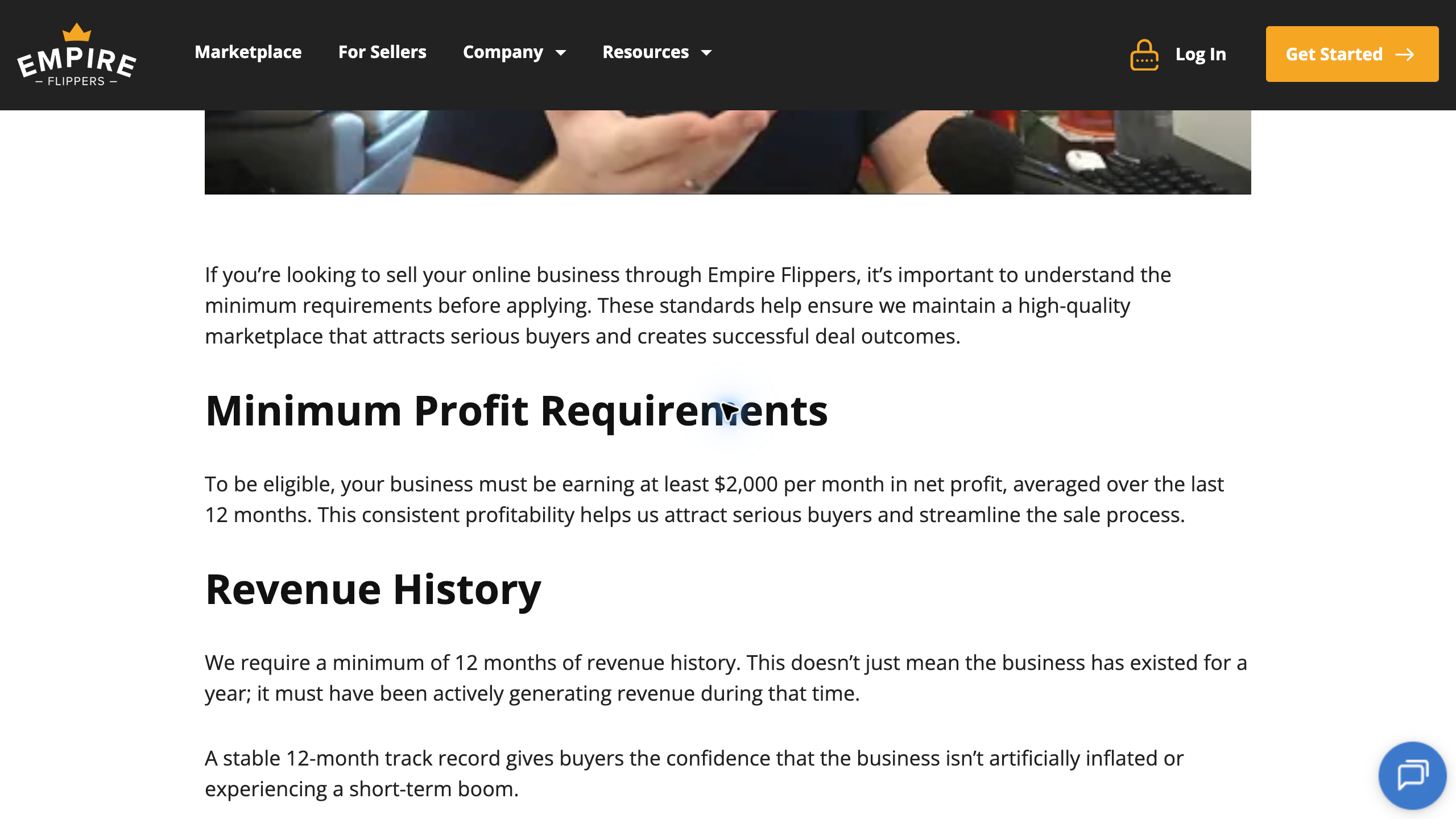
I would put Empire Flippers on the research shortlist when the business has an established revenue history and you want a curated online-business marketplace. Check its eligibility rules before spending time preparing an application.
The official requirements reviewed October 11, 2026 include at least $2,000 in average monthly net profit over the previous twelve months, twelve months of active revenue history, and at least three months of Google Analytics or Clicky data. Meeting minimum requirements does not guarantee that the business will be accepted.
The seller FAQ states that there is no listing fee and describes a blended selling commission. The schedule starts with a $10,000 minimum for sales through $66,666.66, then 15% through $700,000. Incremental value above $700,000 through $5 million is charged at 8%, with 2.5% on value above $5 million. Confirm the current written quote rather than applying the lowest percentage to the whole price.
The FAQ also describes a two-month exclusive listing period and migration support. Ask what your current agreement covers, including any exclusions and termination conditions. Those details should be settled before you sign, not after a buyer starts asking questions.
My main concern would be fit. A newly launched project with limited records is different from a business with consistent earnings and documented operations. If you do not qualify, that is useful information. It means you should work on the foundation or research a route designed for a different stage, not dress up a weak history to get through screening.
For a buyer, the useful next step is to understand how a listing’s numbers were assembled. Ask which expenses are included, what adjustments were made and what records support the figures. A curated marketplace can help organize the process, but you still need to decide whether the specific business makes sense for you.
Check Empire Flippers’ current marketplace and seller process if that established-business route matches your situation. Do not treat an asking price as a completed sale or a prediction of what you will receive.
2. Flippa when you want to compare listing and broker-assisted routes
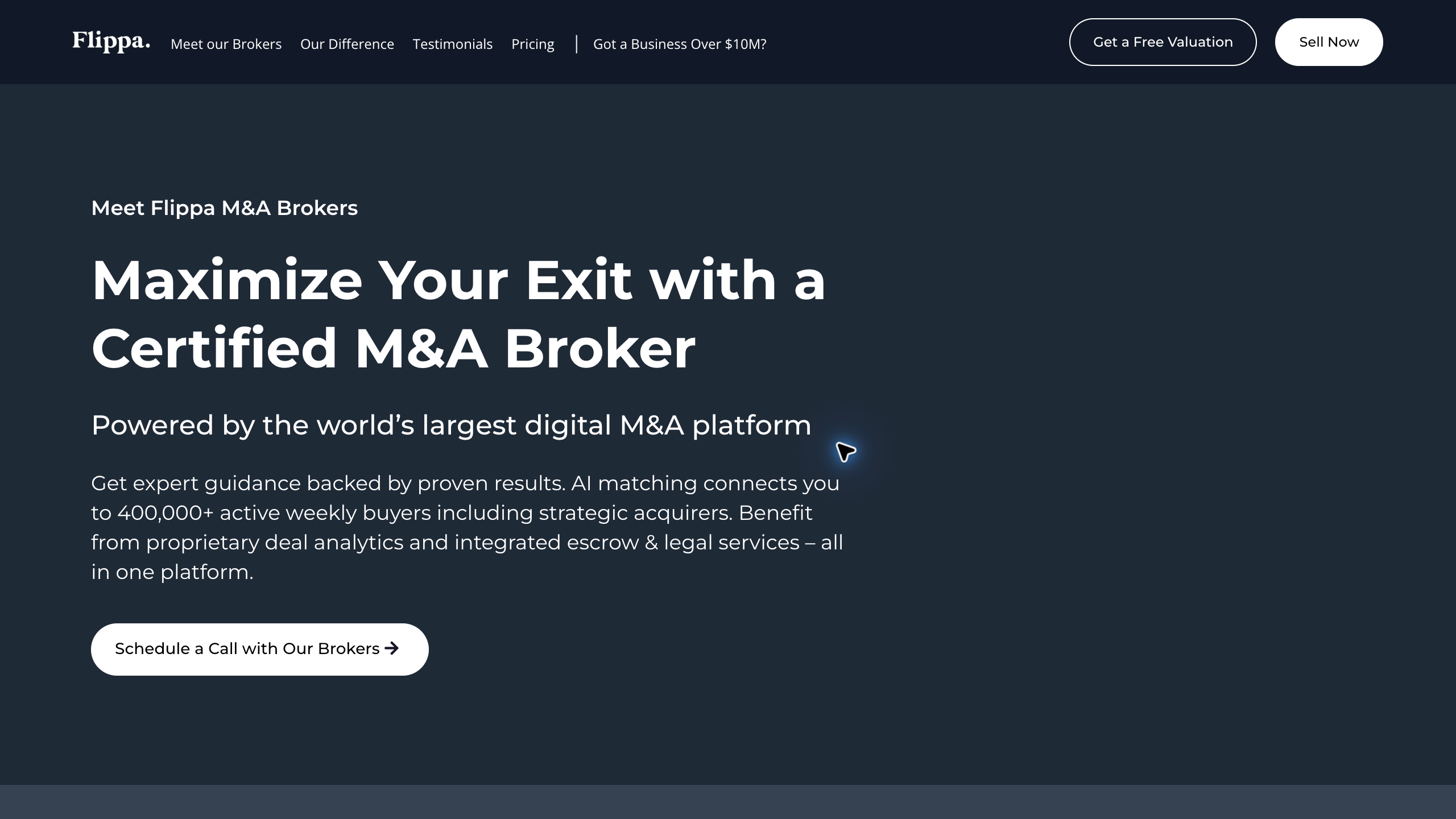
I would research Flippa when you want to compare a marketplace listing with a broker-assisted service. The important step is checking which route you are actually selecting. Advertising an asset yourself and hiring someone to manage the sale are not the same commitment.
Flippa’s official broker page describes support across digital-business categories including ecommerce, online publishing, software and apps. Its pricing is package- and value-dependent. The public pages reviewed for this guide do not support presenting one setup charge as the universal fee for every business.
Before paying, ask for the upfront amount, listing duration, success fee, optional upgrades and any separate payment or escrow costs. Have the provider explain how the fee changes if the final sale price differs from the asking price. Keep the selected package and quote together in your records.
I would also ask what happens when an inquiry arrives. Who qualifies the buyer? Who handles the first conversation? Who organizes the document request? If you choose self-service, assume you need to understand the responsibilities unless the written scope explicitly says someone else handles them.
For a buyer, a larger selection is only useful if you can sort it intelligently. Set your criteria before browsing. Decide which business models you understand, which risks you can manage and how much operating work you can take on. Otherwise, it is easy to get pulled toward whichever listing has the most exciting headline.
Compare Flippa’s current selling options with the help you actually need. I would rather see you choose a clearly defined scope than assume a low entry price includes a full brokerage engagement.
Understand what you are hiring before comparing prices
A marketplace helps buyers discover listings. A brokerage engagement can include additional work such as preparing the listing, screening inquiries, coordinating negotiations and supporting the transition. Do not assume that paying to advertise a business includes all of those services.
Ask for a written scope. If the website says you get support, find out what support means. Is there a named person managing your sale? Will that person organize buyer calls? Who reviews the documents, and who is responsible for resolving inconsistencies?
Also ask who the broker represents. A helpful conversation does not tell you whose interests the engagement protects. You want that relationship explained in the agreement, including any referral compensation or other conflicts that could affect the process.
The cheapest listing option might work for an experienced seller with clean records and time to manage inquiries. It might be a poor fit if you need substantial help preparing the business. Compare the work included, not just the first number on the pricing page.
Work out what you will keep, not just what you might sell for
Compare the service, not just the entry price. Review Flippa’s current listing and broker options.
A headline price is not the same as money available to you after the sale. Separate the expected purchase price, selling fees, professional costs, debt repayment, adjustments and any amounts that will be paid later. Have your advisers explain the tax implications separately.
For a simple hypothetical example, imagine an offer of $200,000 with $160,000 paid at closing and $40,000 contingent on future performance. That is not equivalent to receiving $200,000 at closing. The later payment depends on the actual agreement and whether its conditions are satisfied.
I would put those amounts into separate columns before comparing offers. One column is cash at closing. Another is money due later under a fixed schedule. A third is contingent money that may never be paid. You should understand the risks attached to each amount rather than combining everything into one reassuring total.
Ask how the broker’s fee is calculated for a deal with deferred or contingent consideration. Is a commission charged when the agreement is signed, when money is received, or on some other basis? Do not guess. A percentage is only useful once you understand the amount it applies to and when it becomes payable.
Check whether the business can actually transfer
An online store can look straightforward until you start listing everything it depends on. There is the domain, the website, customer records, payment processing, supplier relationships, advertising accounts, software subscriptions and any content or design rights. Each item needs its own transfer plan.
For a supplier-dependent business, ask about authorization before treating current revenue as something you can automatically continue. A seller’s existing relationship does not establish that the supplier will approve a new owner on the same terms. Get the required consent and responsibilities clarified during the deal process.
The same thinking applies to affiliate revenue. Do not assume that buying a website gives you the seller’s account, commission rates or approval status. Review the relevant program’s rules and make the transition conditions explicit. A website and its monetization arrangements are connected, but they are not necessarily transferred in one simple step.
Build a transfer checklist with an owner for each task. Record what needs approval, what evidence proves completion and what happens if approval is refused. That is much more useful than a vague promise that everything will be handed over after payment.
Evaluate the work you are buying
Understand supplier dependencies before making an offer. Follow the supplier qualification process.
Ask the seller to explain a normal week and an unusually difficult week. How many customer inquiries need attention? Who follows up on delivery problems? Which tasks depend on the owner’s judgment rather than a written process?
Then compare that description with actual records and operating documents. A claim of two hours per week means very little without context. It could exclude a contractor’s workload, seasonal problems, bookkeeping or the time needed to replace the owner’s relationships.
I would also separate maintenance from growth. Keeping current orders moving is one job. Recruiting suppliers, improving content and building new advertising campaigns are different jobs. Decide which responsibilities you are willing and able to handle before you decide that a business fits your lifestyle.
A location-independent business still needs someone responsible for the details. If a customer needs an answer while you are traveling, a process or a team member has to handle it. The goal is not to pretend the work disappears. It is to understand the work well enough to plan for it.
Prepare records before asking for a valuation
Start with a monthly record of revenue and expenses that an adviser can reconcile to the underlying evidence. Keep the explanations for unusual months alongside the numbers. A promotion, a stock shortage or a large refund can affect how someone interprets the trend.
Do not hide costs because they make the headline profit less attractive. If a buyer must replace your work with paid help, that matters. If an expense was genuinely unusual, document why rather than simply deleting it from the calculation. You want the discussion to be about evidence, not competing versions of the story.
Keep operational documents separate from sensitive personal records. Ask your advisers how to share the necessary material securely and at what stage. A buyer needs enough information to evaluate the business, but that does not mean you should put private customer or account information into a public listing.
Make a list of recurring software, contractors and essential relationships. Explain which arrangements can continue and which need new agreements. Clear records help you answer questions consistently and reveal issues you should resolve before marketing the business.
Buying an existing store versus building one
Buying a business and building a new one solve different problems. With an acquisition, you are investigating an existing history and negotiating which assets, obligations and relationships change hands. With a new build, you are creating the foundation without assuming there is already a proven revenue stream.
At Ecommerce Paradise, my approach is to understand the business before choosing the tools. Start by learning what the store actually does, who it serves and why customers would buy from it. A good-looking website does not answer those questions by itself.
If you are considering a supplier-dependent store, read my guide to what high-ticket dropshipping involves. Use it to understand the operational model, not as a prediction of what a particular acquisition will earn.
For niche selection, my high-ticket niches list is a starting point. Go deep before you go wide. You want to understand one category’s buyers and service requirements before trying to evaluate a store that sells everything to everyone.
My supplier qualification walkthrough gives you a practical research process. For an acquisition, extend that process to transfer approval: ask what changes with a new owner, which terms remain available and which permissions need to be renewed.
Supplier Paradise is my supplier research business. It can help you develop a lead shortlist, but a directory entry is not an authorized dealer agreement, guaranteed margin or approval to take over another owner’s relationship.
Before deciding on your business structure, use my business formation guide as a discussion starter with your advisers. The right structure for your situation depends on facts this article cannot determine for you.
Make a decision you can explain on one page
Still deciding which kind of store to pursue? Explore the high-ticket niche research guide.
There is also a timing decision. Selling while you are exhausted can make you eager to accept the first plausible offer. Buying because you are impatient to get started can make you overlook unresolved questions. Give yourself time to compare evidence and get advice before committing to terms.
Keep a separate question log for each service or listing. Record the question, the answer, who supplied it and the supporting document. If a verbal explanation conflicts with the written terms, ask for clarification rather than choosing whichever version sounds better. The point is to make uncertainty visible enough to address it.
For the transition, agree on what training actually includes. A short handover call is different from a written operating manual and scheduled support. Define how questions will be handled, who can approve changes and which unresolved items prevent completion. Those are practical details, but they matter when you become the person responsible for the business.
I would write a one-page decision note before engaging a broker. Start with the business model and your reason for buying or selling. Then list the records you have, the help you need, the total fee quote and the unresolved questions. If you cannot explain why a service fits those needs, keep researching.
For a seller, the next action is to organize the records and request a current eligibility and scope discussion. For a buyer, it is to define what you are looking for and what evidence you need before making an offer. Neither action requires pretending the uncertainty has disappeared.
Keep your walk-away conditions visible. Those might include missing financial evidence, a critical relationship that cannot transfer, responsibilities you cannot realistically handle or terms your advisers consider unsuitable. Decide those conditions before you become emotionally attached to a deal.
If your main question is whether to build a high-ticket store, my private coaching offer is an option to review. It is business-building guidance, not brokerage representation or individualized investment, legal or tax advice.
My done-for-you build and launch service is a separate option for creating a store from scratch. It is not the purchase of an existing operating business, and it does not promise existing cash flow or a future resale price.
Frequently asked questions
What are the best business brokers for an online business?
There is no universal winner. This shortlist covers an established-business marketplace route and a platform with different listing and broker-assisted options. Match the service scope and eligibility to your business before comparing fees.
Does a marketplace listing include a broker?
Not necessarily. Read the selected package and engagement terms. Ask who prepares documents, screens inquiries, negotiates and supports the transition, and which tasks remain your responsibility.
Does an estimated valuation mean my business will sell for that amount?
No. A valuation estimate is not an offer, a completed transaction or a guaranteed net payment. Compare the actual terms of any offer, including fees, adjustments, deferred payments and contingencies.
Can I automatically keep the seller’s suppliers and affiliate accounts?
Do not assume so. Confirm transfer requirements with each relevant provider and make necessary approvals part of the transaction plan. A working relationship under the current owner does not prove approval under a new owner.
Do I still need professional advisers if a broker helps with the sale?
I would use independent advisers appropriate to the deal. Brokerage support and marketplace screening do not replace advice about your contract, taxes, financial records or specific legal responsibilities.
Related Articles
Need guidance on the build-from-scratch route? Review my coaching scope and decide whether it fits.
These guides explain the business foundation behind the listing:
- What high-ticket dropshipping involves
- High-ticket niches list
- Finding and qualifying high-ticket suppliers
- Business formation for a high-ticket store
- Supplier Paradise’s supplier research guide

Trevor Fenner is the founder of Ecommerce Paradise. His main projects are Ecommerce Paradise, Supplier Paradise, and Review Paradise, which is currently in development. TrevorFenner.com publishes research-based reviews and practical guides to online business tools and remote-work services, with clear affiliate disclosures.