

The best virtual assistant websites help you find someone for a clear job. They do not decide what that job should be, write your procedures or make the person successful without management. I would get those pieces straight before paying for recruiting access.
A store owner can say, “I need a virtual assistant,” and mean several different things. Maybe you need help answering customer questions every weekday. Maybe you need a specialist to clean up a product catalog. Maybe you need someone to organize research while you keep the decision-making. Those are different roles, and they should not have the same hiring brief.
At Ecommerce Paradise, I focus on understanding the business before adding tools or people. For a supplier-dependent store, start with the high-ticket dropshipping model. You need to know which promises the store makes and who is responsible when something goes wrong.
This guide compares three research-based hiring routes: direct recruiting, a freelancer marketplace with estimated skill tiers, and a broader project marketplace. It is not a claim that I personally tested every service or hired through every route. Provider terms were reviewed October 11, 2026; confirm your actual fees and scope before committing.
Affiliate disclosure: some links in this article are affiliate links. I may earn a commission if you buy through them, at no additional cost to you. I also own Ecommerce Paradise and Supplier Paradise.
Looking for an ongoing role you can manage directly? Review OnlineJobs.ph’s recruiting process.
The best virtual assistant websites by hiring route
| Website | Route | Cost to investigate | Your responsibility |
|---|---|---|---|
| OnlineJobs.ph | Direct recruitment focused on workers in the Philippines | Paid recruiting access and separately agreed worker compensation | Selection, role definition, management and appropriate agreements |
| FreeUp | Freelancer marketplace | Actual hourly or fixed quote; published skill-tier estimates | Clear requirements, acceptance criteria and communication |
| Upwork | Broader project and ongoing-work marketplace | Freelancer price, applicable client fee and contract-initiation fee | Selection, milestones, review and account-access decisions |
None of these routes removes the need to evaluate the individual person and the actual arrangement. Choose the hiring process you can run well. A large profile database is not the same thing as a ready-to-use operating team.
1. OnlineJobs.ph for direct recruiting and an ongoing working relationship
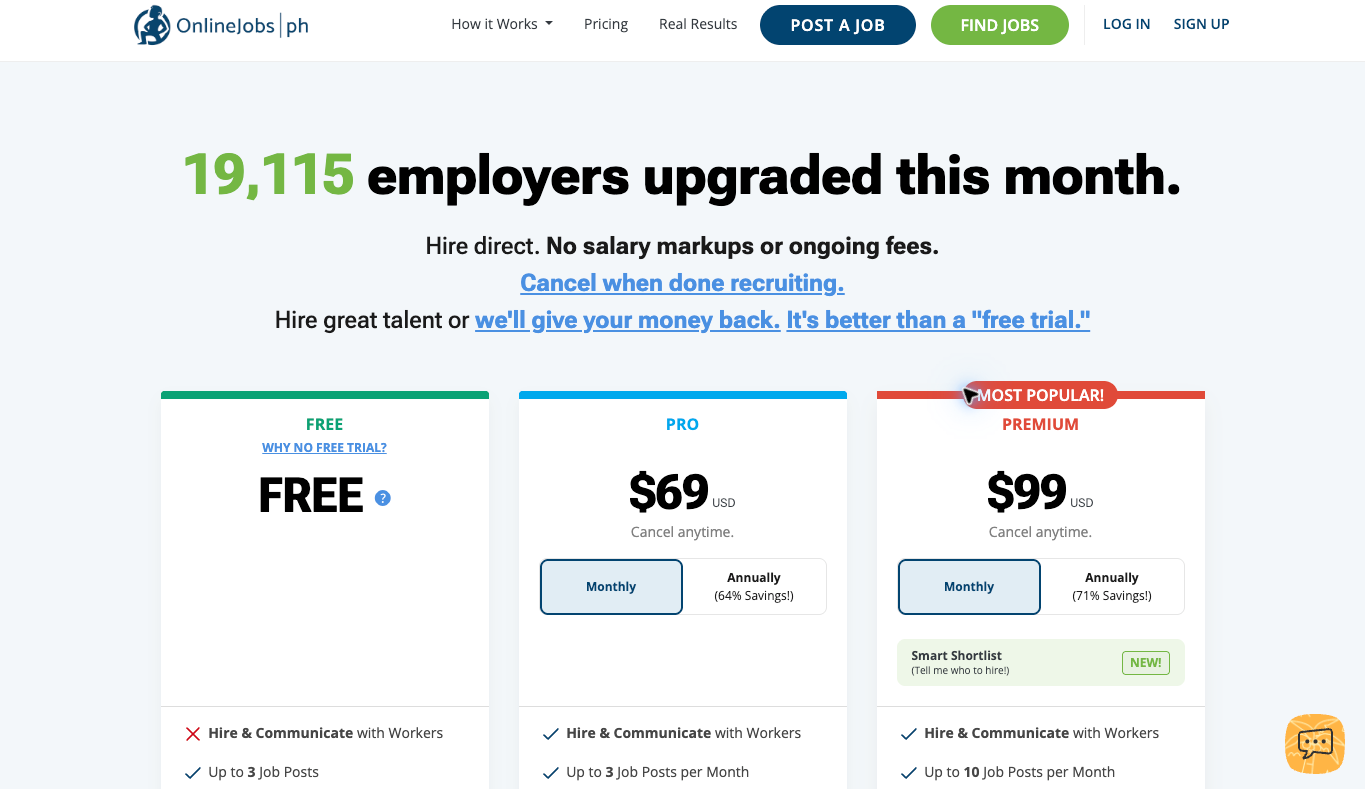
I would research OnlineJobs.ph when you want to recruit directly for a recurring role. The site focuses on workers in the Philippines. Its employer pricing page describes recruiting subscriptions rather than an ongoing salary markup for each person you hire.
The free account has an important limitation. The official FAQ says you can post a job and view applications, but you cannot communicate with applicants until you upgrade. I would treat that as an opportunity to inspect interest in the role, not as a complete free hiring service.
The same FAQ says you do not need to keep the recruiting subscription after you finish hiring. That is separate from your obligation to compensate the person you engage. Confirm the selected plan, renewal interval and cancellation terms before paying, and keep those records with your recruiting notes.
The monthly options displayed during this review were $69 for Pro and $99 for Premium. Those are recruiting subscription prices, not a worker’s salary. Annual options are a different commitment, so check the selected billing interval and renewal terms before purchasing.
The direct relationship can be a useful fit if you have a defined recurring workload and someone available to train and manage it. For example, you might need a person to prepare order updates using an approved process. That does not mean the new hire should independently decide refund exceptions or promise delivery dates they cannot verify.
I would evaluate each applicant’s relevant work, communication and availability rather than making assumptions based on location. Ask how they would handle a realistic situation. What would they check before answering a customer? What would they do when a supplier has not responded? Those questions show you how the person thinks.
Compare OnlineJobs.ph’s current employer options if direct recruiting matches your needs. The website is a starting point for finding candidates. Your job description and management process still determine what happens after the introduction.
2. FreeUp for comparing a defined task with a freelancer quote

FreeUp is another route to investigate for freelance help. Its official pricing page states that there are no startup or monthly marketplace fees and that work can be priced hourly or at a fixed rate. That does not mean the freelancer’s work is free.
The published estimated ranges are $5 to $15 per hour for entry-level work, $15 to $30 for mid-level work, and $30 to $75 or more for expert-level work. These are marketplace estimates, not a guaranteed quote for your task or a promise that a suitable person is available at the lowest rate.
I would use those tiers as a prompt to define the work more carefully. Following an existing catalog-entry procedure is different from designing the procedure. Handling a clearly documented support process is different from deciding how the business should respond to a difficult dispute.
For a fixed project, write down the deliverable and what makes it acceptable. “Clean up the catalog” is too loose. A better brief explains which records are included, which fields should change, what must remain untouched and how exceptions will be reported. The person can then quote a defined piece of work.
For ongoing hourly work, ask about the expected schedule and reporting process. You want to know what progress looks like before reviewing the first invoice. If the person discovers that the task needs more time or a different skill, agree on how that will be raised before the scope expands.
Request a current scope and quote through FreeUp if this marketplace route fits. I would compare the proposed work and responsibility, not choose someone solely because the advertised range starts at a low number.
Have a specific task ready to hand over? Compare a freelancer quote with your written scope.
3. Upwork for a scoped project or a broader candidate search

I would put Upwork on the shortlist when you want to compare candidates for a specific project or recurring work. Set your requirements before browsing. Otherwise, an impressive profile can pull you toward services that do not solve the original problem.
The freelancer’s price is not necessarily the full client cost. Upwork’s current support documentation states that the Basic client marketplace fee is up to 7.99% on covered payments. It describes a reduced 3% fee for eligible US clients using a qualifying bank payment method.
The current contract-initiation support page describes a one-time fee from $0.99 to $14.99 for new Marketplace or Project Catalog contracts. The amount can vary. Confirm the actual fee displayed for your contract rather than applying one number to every Upwork arrangement.
There is a reason I am emphasizing the actual quote. The official marketing material reviewed for this guide contains a legacy 5% example alongside newer fee language. Use the current support terms and the fees shown to your account. Do not budget around whichever example happens to look cheapest.
For a project, break the work into deliverables you can review. For an ongoing role, explain the hours, priorities and escalation process. Either way, retain enough understanding of the work to decide whether it is correct. A marketplace payment system does not make an unclear brief clear.
Review Upwork’s current client terms when comparing that route. Look at the individual candidate, the agreed scope and all applicable costs together before making a decision.
Write the job before choosing the website
Start with the outcome, then describe the tasks that produce it. If you need customers to receive accurate order updates, the role might involve checking supplier information, using approved response templates and escalating uncertain delivery estimates. That is much clearer than asking someone to “manage customer service.”
Separate routine decisions from exceptions. Routine work can follow a procedure. Exceptions need a named person with authority to decide. A new assistant should know which situations require approval, especially when money, customer promises or sensitive data are involved.
Also decide what the role is not responsible for. One person should not become the default owner of bookkeeping, advertising, design and support because those tasks all happen online. A broad title can conceal several distinct jobs with different skills and review requirements.
If you are still choosing a category, use my high-ticket niche research guide before designing the team. The operating needs of a store depend on what it sells, how orders are fulfilled and which questions buyers need answered.
Calculate the total cost, not just the hourly rate
A rate only becomes useful when you estimate the amount of work. A hypothetical ten-hour task at $15 per hour costs $150 before any applicable platform charges. A six-hour task at $25 also costs $150. Those examples do not tell you who is better; they show why the hourly number alone is not the whole comparison.
Add the time needed for training, review and coordination. If you spend several hours rewriting every handoff because the instructions are unclear, that is part of the operating cost. It is still your time even if it does not appear on the freelancer’s invoice.
For recurring work, estimate a normal week and a busy week separately. Product launches, seasonal demand and delivery issues can change the workload. Decide how extra hours are approved and what happens when the agreed capacity is reached.
Get appropriate professional advice about contracts, worker classification, tax and related responsibilities for your situation. My business formation guide can help you organize foundation questions, but it does not determine the correct arrangement for a particular person or jurisdiction.
Use a paid work sample with clear acceptance criteria
I would choose a small, representative paid task before handing over a critical workflow. The task should show how the person handles the kind of work you actually need. Do not ask for a large unpaid project and call it an interview exercise.
Give the same essential instructions you would provide during ordinary work. Include the expected output, deadline and a route for questions. If the task depends on information you forgot to supply, that is a problem with the test, not proof that the person cannot do the job.
Use fictional or sanitized material when possible. For a support role, a sample order scenario can show whether someone checks the facts and communicates clearly without exposing real customer records. For catalog work, a small set of non-sensitive example products can demonstrate accuracy.
Review the result against criteria you decided in advance. Did the person follow the instructions? Did they identify an uncertainty instead of guessing? Was the output usable? An attractive answer is not enough if it quietly changes details that were supposed to remain intact.
Give access in stages
Start with the minimum access needed for the agreed task. A person researching product information does not necessarily need payment access. A person drafting customer replies does not automatically need the authority to issue refunds. Match access to responsibility rather than granting everything because it is easier.
Use individual accounts and appropriate permissions where the platform supports them. Avoid passing around the owner’s login as the default training method. Keep a record of which systems each person can access and who approves changes to that access.
Plan the end of the relationship at the beginning. Know how you will remove access, recover working files and transfer any documented process. If an essential account or file only belongs to a contractor, resolve that ownership question before the work becomes critical.
For sensitive workflows, get advice appropriate to the data and the jurisdiction. This article is about choosing a hiring route, not granting permission to expose customer information or make financial decisions. Treat those responsibilities as separate decisions requiring their own safeguards.
Document the work and escalation rules
A useful procedure states what starts the task, what information to check, what output to produce and what counts as finished. Include a short example and the common exceptions. That gives someone enough context to work without having to ask you about every ordinary step.
For supplier-dependent orders, document who provides stock and shipping information and what to do when it is missing. My supplier qualification walkthrough explains the research foundation. Extend it into a clear operating handoff for the person who will communicate with the supplier.
Supplier Paradise is my supplier research business. A research lead can help build a shortlist, but it is not permission for an assistant to promise stock, margins or dealer approval. Those facts still need to be verified through the actual relationship.
When an exception appears, the procedure should say who decides and how quickly the issue needs attention. “Ask me if anything happens” is too vague. Define the difference between an ordinary question, a blocked order and an urgent customer problem.
Hiring someone to help with supplier-dependent orders? Build the supplier process first.
Build a realistic communication agreement
Agree on availability in an explicit time zone. A message sent during your afternoon might arrive outside someone else’s working hours. Decide when responses are expected and which channel is used for urgent work. Do not treat location independence as a promise of round-the-clock availability.
Keep ordinary progress updates short and useful. What was completed? What is next? What is blocked? Which decision needs your input? A consistent update makes it easier to spot a problem before it affects customers.
Set a review rhythm appropriate to the role. A new recurring workflow may need frequent feedback at first, then less supervision once the process is stable. Do not disappear during training and then judge a month of work against expectations you never explained.
Give feedback about the output, not vague personality judgments. Explain which detail was incorrect, what the correct version should be and why it matters. That turns a mistake into an actionable correction instead of an argument about whether someone was trying hard enough.
Review quality without making tracking the goal
Decide which measures show that the job is working. For support, that might include accurate answers and unresolved issues requiring follow-up. For catalog work, it might include completed records and the rate of corrections. Choose measures connected to the outcome, not just activity that is easy to count.
Time records can help explain workload, but time spent is not the same as useful work completed. A person can move quickly and introduce errors. Another can take longer because the task was poorly defined. Review the work and its context before drawing conclusions.
Keep the operating process open to improvement. If someone repeatedly encounters the same missing information, fix the handoff instead of treating every occurrence as a new individual failure. Good procedures should reduce recurring confusion.
Also make room for honest escalation. You want someone to tell you when a requirement cannot be verified or a task is beyond their scope. Rewarding confident guesses can create much bigger problems than receiving an early question.
When a managed service is a different decision
Recruiting an assistant and buying a managed service are different choices. With direct recruiting, you take on the responsibility for the role and its day-to-day operation. A managed service may include different supervision or deliverables, but only if its written scope actually says so.
I would compare those scopes before deciding which route saves time. Ask what is included, what remains your responsibility and who handles an exception. Do not assume a service includes every operational task just because the website uses the word management.
My private coaching offer is a separate option for working through high-ticket business decisions. It is not an employment placement service or a guarantee that a particular hire will work out.
Unsure which responsibilities you should hand over? Review the coaching scope.
Choosing the best virtual assistant websites for your role
Research OnlineJobs.ph if you want a direct recurring relationship and can manage the recruitment and role. Compare FreeUp when you want a current freelancer quote for defined work. Investigate Upwork when a broader marketplace and project-based agreement fit your needs.
Before contacting candidates, write a one-page role brief. Put the outcome at the top, followed by recurring tasks, exceptions, required availability, review criteria and access boundaries. If that page is unclear, improve it before buying recruiting access.
My done-for-you store build and launch service is another option to review when the store foundation itself is the unfinished work. It is separate from recruiting an employee or freelancer and does not promise sales or profitability.
The useful outcome is not simply saying you have hired a virtual assistant. It is having a clearly owned piece of work that gets completed reliably, with a way to handle questions and exceptions. Start there, then choose the website that helps you build that arrangement.
Need help creating the store foundation before expanding the team? Explore the build and launch service.
Frequently asked questions
What are the best virtual assistant websites for an online business?
Match the route to the job. This shortlist covers direct recruiting, a skill-tier freelancer marketplace and a broader project marketplace. Your role definition and ability to manage the work matter more than the length of a profile list.
Can I hire through OnlineJobs.ph’s free account?
The current employer FAQ says the free account lets you post and inspect applications, but communication with applicants requires an upgrade. Confirm the selected recruiting plan before relying on it.
Does FreeUp’s lack of a monthly marketplace fee mean the work is free?
No. You still pay the freelancer’s agreed hourly or fixed rate. Published estimates do not replace a quote for your actual scope.
Is an Upwork freelancer’s quoted rate the total client cost?
Not necessarily. Applicable client marketplace and contract-initiation fees can add to the cost. Check the current terms and the amount shown for your account and contract.
Should I give a new assistant full store access?
Not by default. Start with the permissions needed for the agreed task, document ownership and escalation rules, and plan how access will be removed when the relationship ends.
Related Articles
These guides help you define the business behind the role:
- What high-ticket dropshipping involves
- High-ticket niche research
- Finding and qualifying high-ticket suppliers
- Business formation for a high-ticket store
- Business phone tools for a small online business

Trevor Fenner is the founder of Ecommerce Paradise. His main projects are Ecommerce Paradise, Supplier Paradise, and Review Paradise, which is currently in development. TrevorFenner.com publishes research-based reviews and practical guides to online business tools and remote-work services, with clear affiliate disclosures.