
The best podcast hosting platforms fit the show you are prepared to publish. I would compare the format, schedule and number of feeds before choosing a subscription. A low starting price means little when your video files or shared-show workload exceed the selected allowance.
Podbean, Buzzsprout and Transistor use different hosting models. Podbean’s monthly upload limits need a file-size estimate. Buzzsprout measures upload hours over the selected billing period. Transistor combines resources across the shows in your account.
At Ecommerce Paradise, I focus on practical business systems. A podcast needs a useful subject and a repeatable production process before hosting matters. Paying for a feed does not supply an audience or sponsor revenue.
Public provider pricing and support documentation were reviewed on October 14, 2026. The retained Podbean screenshot was captured October 13. I did not create test accounts, upload episodes or measure these services for this comparison.
Use the shortlist to compare the same publishing workload. Keep uploads, archive storage, bandwidth and downloads in separate rows. An unlimited-show or storage label does not remove every other plan limit.
Affiliate disclosure: I receive compensation for qualifying purchases through the Podbean links, subject to program approval and terms, at no additional cost to you. Buzzsprout and Transistor are unlinked comparison options because their catalog entries have no verified affiliate attribution. I own Ecommerce Paradise and Supplier Paradise.
Compare the resource your show uses
The selected starting references below use monthly billing. Annual equivalents involve different commitments and, for Buzzsprout, a different upload-period model. Review taxes, optional production services and the actual plan terms separately.
| Host | Selected monthly reference | Resource to review | Starting question |
|---|---|---|---|
| Podbean | Unlimited Audio $17 | 1GB of monthly uploads | Does one audio show’s file volume fit? |
| Buzzsprout | Audio $18 | 6 upload hours per month | Does the publishing schedule fit the period? |
| Transistor | Starter $19 | 20,000 monthly downloads, 50 private subscribers and 250GB storage | Do all shows fit the shared limits? |
Write down the schedule for each proposed show, including trailers and bonus episodes. Estimate the finished files rather than raw recording time alone. This gives you a useful requirement to compare across providers.
Podbean
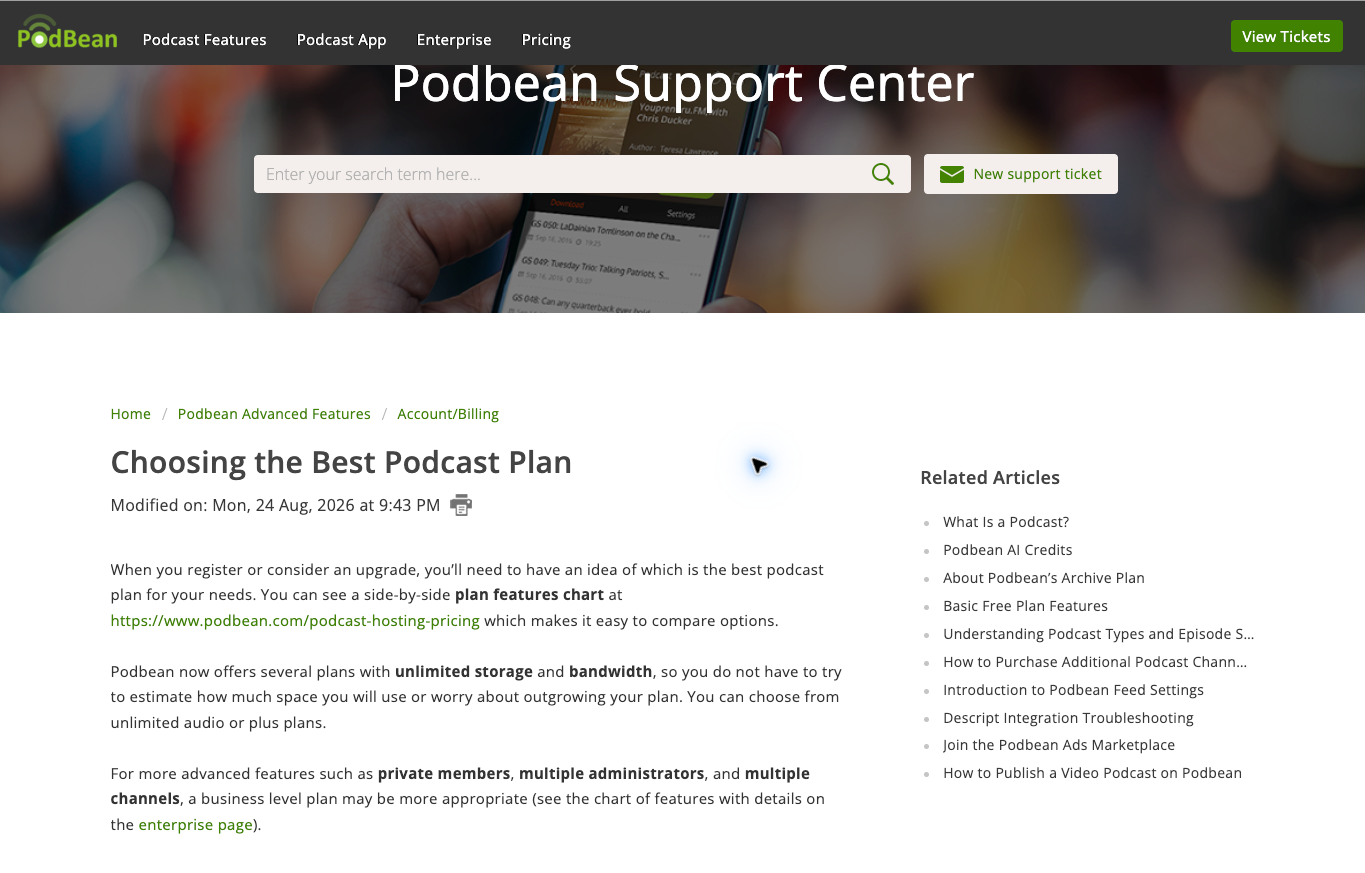
Podbean is worth comparing for an audio publishing setup with other tiers available for different formats. Review the exact plan instead of treating the Unlimited name as a complete capacity description.
Unlimited Audio lists $17 monthly or $144 billed annually, equivalent to $12 monthly. Its current upload allowance is 1GB each month. Unlimited Plus lists $39 monthly or $348 annually, with two audio or video podcasts and 10GB of monthly uploads.
Those tiers describe unlimited total storage and unmetered bandwidth, while monthly uploads remain limited. Network has a different bandwidth allowance. Do not carry one tier’s wording across every plan.
I would estimate the files you expect to publish and keep original media outside the host. Review the selected Podbean offer for the format and usage requirement. My Podbean review covers the narrower provider decision.
Buzzsprout
Buzzsprout is worth comparing when upload hours provide an understandable way to plan your schedule. Its current Audio and Audio + Video offers use a different period depending on the billing selection.
Monthly Audio is $18 and Audio + Video is $30, each with six upload hours per month. Annual selection shows $15 and $25 monthly equivalents with 72 upload hours per year. Keep the period visible beside the price.
The selected up-to-five-show Audio configuration shows $36 monthly with 15 upload hours per month. Its annual view shows a $30 monthly equivalent and 180 hours per year. Different show counts or media selections produce different comparisons.
Cohost AI and Magic Mastering appear as add-ons. Check the services you need before calculating a total. I would choose around the actual publishing pattern rather than assuming an annual pool and a monthly allowance behave identically.
Transistor
Transistor is worth comparing for several shows under a shared account. Its pricing offers unlimited podcasts, while current support guidance separately lists download, storage and private-subscriber allowances.
Starter lists $19 monthly with 20,000 monthly downloads, 50 private subscribers and 250GB storage. Professional lists $49 with 100,000 downloads, 500 private subscribers and 500GB storage. Usage adds across the shows you own.
The support guide explains storage limits introduced alongside video support. Older unlimited-storage wording still appears in the pricing FAQ, so confirm the selected plan’s current allowance instead of treating the older sentence as an override.
I would total each show’s requirements before choosing a tier. A larger video archive and a private audience use different resources from an ordinary audio schedule. Unlimited show count does not establish unlimited storage or subscribers.
Estimate finished media before choosing a plan
Begin with the publishing schedule for one show. Record the number of episodes, finished length and expected format. Include trailers, bonus recordings and any extra material you intend to host.
For an original arithmetic example, four 45-minute episodes produce three hours of finished audio. At a constant 128 kilobits per second, the audio alone is approximately 172.8MB in decimal units. This is a calculation, not a measured upload to any provider.
The calculation multiplies 128,000 bits by 10,800 seconds and divides by eight to convert bits into bytes. Artwork, metadata and additional files are outside the estimate. A different encoding rate changes the result.
Video needs a separate estimate from audio. Use the intended exported files and the provider’s supported format requirements. Do not treat an approximate hours-of-audio label as a guarantee for every video or lossless recording.
I would compare the Podbean upload allowance with those expected files before selecting a tier. Ask how replacements, imports and unpublished drafts count rather than assuming only a final episode uses resources.
A weekly schedule also needs room for a five-episode month. Five 45-minute episodes total 225 minutes, compared with 180 minutes for four episodes. Add a trailer or bonus release to the same forecast. These are original scheduling examples, not provider allowances. Estimate the busy period you intend to support instead of treating every calendar month as exactly four publishing weeks.
Separate uploads, storage and downloads
Uploads describe new media added during a period. Storage describes the archive retained on the service. Downloads and delivered data describe listener activity. Keep these resources separate in your comparison.
An account with ample archive space still needs a check of its monthly upload allowance. A host offering several shows adds their usage together where its terms specify shared resources. More feeds do not automatically create separate allowances.
Use one row for each resource and write down the relevant period. Compare a monthly limit with your busiest expected month. Compare an annual allowance with the full intended year instead of dividing by twelve and assuming the timing rules match.
Review what happens near a limit before relying on a plan. Ask about notifications, upgrade procedures and additional charges. A generous marketing label does not answer the operational question of what happens when your specific workload grows.
Keep hosting separate from production tools
A recording app captures the conversation, an editor prepares the finished media and a host publishes the files and feed. Transcription and show-note tools perform other jobs. A product supporting one step does not automatically replace the rest.
Map the work in order. Record, edit, review and approve the media before publishing. Prepare the title, description and artwork alongside the episode so missing information does not become a last-minute rush.
Choose a tool around the bottleneck you have identified. If useful interviews are not getting recorded, a second hosting subscription adds cost without fixing the production problem. A smaller process is easier to maintain.
Some providers bundle production features with hosting. Review the actual inclusion and additional charges before relying on them. Keep the original recording outside the publishing account rather than treating the host as your only archive.
Verify distribution at the listener destination
An audio feed and a video publishing workflow need separate checks. Review supported formats and directory requirements for the exact plan. A host’s upload confirmation does not prove every listener platform has the episode.
Decide who owns the directory accounts and who submits the show. Keep approval requirements and account verification in the process. Avoid promising immediate availability based only on a dashboard button.
For your own authorized publication, inspect the listing and play the episode through the intended destination. Review the title, artwork, description and media. Catch missing or incorrect details before promoting the episode widely.
This article did not submit a feed or perform playback tests. The process above describes checks for the publisher to complete. Keep distribution verification separate from the task of choosing a host.
Define ownership before inviting collaborators
The business should know who controls the host, feed, directory accounts and original files. A contractor helping with editing does not need to own the show’s accounts. Document the arrangement before production begins.
Assign supported permissions around each role. Preparing show notes differs from changing billing or feed settings. Keep access removal in the offboarding process and use the provider’s supported administration controls.
For private podcasts, review listener authentication and subscription limits. A hidden webpage is not equivalent to a controlled private feed. Confirm how access is granted and removed before promising private distribution.
Keep a process record without placing credentials or recovery details in a public content document. Store the account-owner information through your approved internal method. The next editor needs a clear handoff, not the owner’s password.
Build one repeatable publishing schedule
I would start with one useful show and a schedule you are prepared to maintain. Choose the audience and the reason someone returns for another episode. Adding several feeds before defining the editorial purpose spreads the work too thin.
Plan the recording and review time alongside the publication date. Give a reviewer space to check names, numbers and claims. A completed recording still needs approval before becoming a public episode.
Keep the status of each episode clear. Recorded, edited, approved, uploaded and verified at listener destinations are different stages. An internal checklist prevents an unfinished task from being counted as published work.
My Podbean launch checklist covers a narrower starting workflow. Use the process to organize production, not as a promise of audience growth.
Review permissions and factual claims
Get appropriate permission for guests, music and other material you include. An easy upload process does not establish rights to publish someone else’s recording. Keep relevant approvals with the production records.
AI transcripts and show notes need human review. Check names, figures and the meaning of important statements against the source recording. A fluent summary still needs factual approval.
For a business interview, describe the speaker’s experience accurately and disclose relevant commercial relationships. Do not manufacture a success story to make a service look stronger. Keep promotional claims within the evidence provided.
Retain the approved media and supporting source recording under your agreed process. If someone raises a question later, the team should know which version was published and who approved the episode. Hosting supports distribution, while editorial responsibility stays with the publisher.
Evaluate monetization without predicting income
A provider offering advertising or paid-content features does not guarantee sponsors, subscribers or a profitable show. Compare the actual eligibility requirements, fees and payout terms separately from the base hosting plan.
For direct sponsorships, define the episode, placement, approval process and publication commitment. Promise only audience numbers you have measured and are authorized to report. Paid recommendations need an appropriate disclosure.
My Podbean monetization guide covers the narrower feature decision. Keep a hosting subscription separate from the business case for selling advertising.
Budget for production and promotion before assuming future revenue covers the bill. An original hypothetical budget of $20 for hosting plus two $5 add-ons totals $30 monthly, or $360 across twelve months. These assumed figures are not provider quotes or an earnings forecast.
Keep migration and exit terms in the comparison
Before choosing annual billing, review renewal, cancellation and refund conditions. A monthly equivalent still describes an upfront commitment under an annual offer. Check the money committed rather than the smallest displayed number.
Keep original media and review the supported export process. Ask what happens to episode metadata, statistics and private listeners when you leave. A feed redirect is one part of migration, not proof every related record transfers.
Buzzsprout’s official transfer guidance describes moving episodes before placing a 301 redirect on the old feed. The guidance recommends keeping the old account active for at least three weeks after redirection. Follow the applicable host procedures and verify the actual destination listings.
This comparison did not import episodes, change a feed or close an account. My Podbean migration guide covers the separate workflow. An established show needs a transition plan rather than a rushed cancellation.
Connect the show to a defined business purpose
A business podcast should answer questions the audience cares about. Choose interviews and episodes around useful decisions rather than filling an empty calendar slot. Hosting is the delivery arrangement, not the entire marketing strategy.
For the store model, read the high-ticket dropshipping guide. Understand the operating work before treating content production as a replacement for supplier relationships or customer service.
The high-ticket niches list helps organize category research. A focused audience makes choosing useful questions and interview subjects easier.
My supplier research guide covers relationship development. Verify the actual relationship before presenting a manufacturer as a business partner.
Supplier Paradise offers another discovery starting point I own. The directory is separate from podcast hosting and does not establish dealer approval or a partnership.
The business foundation checklist covers broader ownership and responsibilities. Keep contracts and operating decisions organized alongside the content process.
For help organizing the business model, review Ecommerce Paradise coaching. Coaching is a separate paid service, not testing or migration of these hosting products.
The Ecommerce Paradise Academy provides classroom and membership information. Review current enrollment terms separately from your hosting decision.
Questions before choosing podcast hosting
Does unlimited storage mean unlimited monthly uploads?
No. Review the selected plan’s separate upload and bandwidth conditions. Podbean’s listed monthly upload allowances remain distinct from total archive storage.
Are annual upload pools identical to monthly allowances?
No. Keep the billing and usage periods visible. Compare your publishing schedule with the selected period rather than assuming an even monthly division.
Does Transistor’s unlimited-show count remove storage limits?
No. Current support guidance lists storage allowances across the account. Confirm the selected plan instead of relying on older unlimited-storage FAQ wording.
Does hosting guarantee distribution or sponsor revenue?
No. Directory requirements and actual playback need verification. Advertiser eligibility and income require a separate business case.
Were accounts or uploads tested for this comparison?
No. The recommendations use public provider sources. The retained screenshot documents public Podbean guidance, not an installed show or uploaded episode.
Related guides
Read my Podbean review for the narrower provider decision.
The Podbean pricing guide separates plan costs and allowances.
My Podbean launch guide organizes the starting workflow.
The migration guide covers a change of host.
Read the monetization guide before comparing paid-content or advertising features.

Trevor Fenner is the founder of Ecommerce Paradise. His main projects are Ecommerce Paradise, Supplier Paradise, and Review Paradise, which is currently in development. TrevorFenner.com publishes research-based reviews and practical guides to online business tools and remote-work services, with clear affiliate disclosures.