
My starting point for comparing CBD brands is the paperwork, not the star rating. Find the exact product label, match the batch report and check which tests the document covers. A familiar name or polished website gives you none of those answers by itself.
This is a limited documentary comparison of CBD For Life and cbdMD, two names in my research catalog. I am examining transparency rather than ranking clinical benefits. Neither brand is presented as a treatment recommendation or a universal winner.
The FDA warns about CBD safety risks, including liver injury, drug interactions and sedation. Retail CBD products are not equivalent to the approved prescription CBD drug. Discuss CBD with a qualified healthcare professional rather than using this article to choose treatment or change medication. FDA guidance advises avoiding CBD during pregnancy or breastfeeding.
Research reviewed October 14, 2026. Public labels, testing information and regulator guidance informed this guide. I have not used these products, purchased a sample, commissioned laboratory tests or measured health outcomes. A received-item batch match and current affiliate attribution have not been verified.
Ownership disclosure: I own Ecommerce Paradise and Supplier Paradise. Their business resources are separate from healthcare advice. Provider names remain unlinked because current affiliate approval and attribution have not been fully verified.
Best CBD brands: compare the evidence before the promotion
| Brand | Research direction | Evidence inspected | Unresolved check |
|---|---|---|---|
| CBD For Life | Exact topical variant and batch transparency | Rub labels, testing index and one sample-specific potency report | Applicable current batch, full test scope and lawful sales access |
| cbdMD | Product-to-batch report matching | Public COA lookup instructions | Specific current product report and actual referral access |
The table records research scope, not a safety score. A testing page is useful when the relevant document is readable and matches the product. Missing evidence deserves an unanswered question rather than a favorable assumption.
CBD For Life: review the selected variant
The inspected rub page listed regular 500mg and extra-strength 3000mg options with several scents. Its ingredient lists differed across variants. Original and Lemongrass listed ingredients including menthol, camphor, lanolin and beeswax, while Lavender and Vanilla used a different oil-and-wax arrangement.
Those details describe labels, not effects. Do not copy one variant’s ingredients onto another or interpret the product’s total CBD amount as a use instruction. Promotional relief statements were not independently tested for this guide.
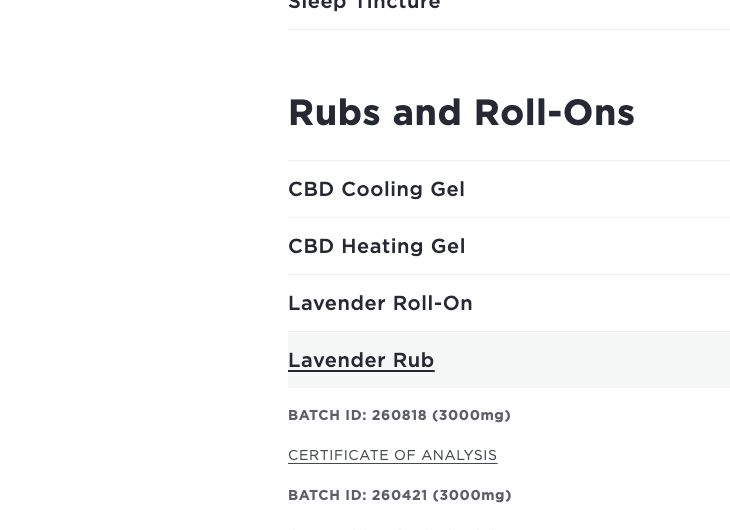
The testing index supplies batch-report links. A previously inspected Lavender 3000mg report for batch 260818 covered cannabinoid potency in the submitted sample. The two-page report did not supply finished-product pesticide, heavy-metal, microbial or solvent panels. Its limited scope does not establish a complete safety assessment.
For a concrete record, the report identifier was 260826M002-001, issued August 27, 2026. Those fields help distinguish the inspected document from another upload. They do not prove the report applies to a jar shipped today or establish independent sampling from a retail order.
cbdMD: match the report to the batch
cbdMD’s public COA page describes label QR codes and five-digit batch or lot lookup. The brand warns the latest report shown before purchase might differ from the batch received because inventory changes. A general testing statement does not identify the document for a particular item.
This review did not verify a current specific finished-product report against a received item. The actual referral route also remains unverified after an access failure. Neither a familiar website nor a tracking link supplies the missing evidence.
Read the exact product label before comparing brands
Record the full product name, format, variant, size and batch identifier. A brand selling several formats needs more precise research than a single brand-level summary. Keep the label associated with the item under consideration rather than relying on a photograph of a similar package.
Separate CBD from other listed ingredients and cannabinoids. A catalog containing CBD, THC and other products should not be treated as one uniform offer. Inspect the individual item instead of assuming the category heading explains its contents.
Check the ingredient list and warnings together. Scent names, botanical language and attractive packaging do not establish personal tolerance or suitability. A qualified professional needs the actual label when discussing a health concern, not an abbreviated comparison table.
Keep unresolved inconsistencies visible. If the page, label image and selected option differ, ask the seller to identify the current item. Do not resolve the conflict by choosing whichever number makes the product sound more appealing.
Separate total content from concentration and use instructions
A package’s total CBD content and the amount reported per gram are different measurements. Read the units before comparing numbers. A larger printed amount does not establish a better product or an appropriate quantity for a person.
A fictional document exercise helps illustrate the distinction: one label states total content for the container, while its report lists a concentration for the tested material. These fields need matching units and relevant sample information. The exercise is not a dose calculation or an instruction to consume or apply anything.
Check whether the report’s unit total depends on a client-supplied package mass. Laboratory concentration and packaging assumptions should not be conflated. Ask for clarification when the document does not explain the relationship clearly.
Do not convert a marketing-strength comparison into health advice. This guide supplies no recommended dose, schedule, route of administration or combination with medication. A label review answers a document question, not a clinical question.
Match certificates to the actual batch
A certificate of analysis, often called a COA, needs a product and batch association. Record the report identifier, sample name, batch, issue date and pages supplied. A document for another scent or strength does not establish the contents of the selected variant.
Review the dates without assuming newer means relevant. An older report matching the batch and a newer report for another batch answer different questions. Ask which document applies instead of treating the latest upload as evidence for every item in stock.
Set up your comparison record with separate fields for product name, scent or variant, package size, label batch, report batch, report identifier, issue date and tests listed. Enter the exact text for each field. Leave an unavailable field blank and write a specific follow-up question instead of guessing the answer.
For example, the inspected Lavender report supplied a batch number, report identifier and issue date. A received jar’s label was unavailable because I did not place an order. The document-review record therefore stops short of an item-to-report match. Keeping the blank field visible prevents a later summary from overstating the research.
A report describes the sample and tests recorded by the laboratory. The existence of a PDF does not prove the sample was independently selected from your order. Do not expand a sample-specific result into a guarantee about every jar or the entire brand.
Ask for the complete document when only a screenshot or summary is provided. Missing pages often contain method notes and limitations relevant to interpretation. A polished badge should not replace the readable source report.
Review test scope and detection limits
Potency analysis and contaminant screening address different questions. Record which tests appear in the actual report rather than assuming a general testing badge includes every panel. A document about cannabinoid content does not itself supply pesticide or heavy-metal results.
CBD For Life’s testing FAQ distinguishes finished-product potency checks from tests of raw hemp extracts. Input-material testing should not be described as a contaminant panel performed on every finished item. The previously inspected Lavender report remains limited to its recorded scope.
Read ND alongside the laboratory’s method and detection information. Non-detection under a particular method does not prove absolute zero under every possible test. Keep units, analytes and limits associated with the result rather than copying a single abbreviation into a broad claim.
Accreditation also needs context. Identify the laboratory, method, applicable scope and any exclusions. A general accreditation statement does not establish accreditation of every test in every report. Ask the laboratory or appropriately qualified reviewer about unresolved technical details.
This guide does not independently authenticate laboratory records or certify contamination safety. Document transparency is one research input. A missing panel should remain missing in the comparison rather than being inferred from a brand’s broader marketing promise.
Keep customer reviews separate from medical evidence
A customer comment describes a reported experience. Star averages do not establish the cause of a health change, a suitable treatment or the absence of risk. Reviews also differ in collection methods, incentives and which products they describe.
Identify whether a review concerns scent, packaging, shipping or a claimed health result. These observations answer different questions. A fast delivery rating does not substantiate a clinical benefit, and a health testimonial does not supply an appropriate comparison trial.
Provider copy often combines ingredient information with treatment language. Separate the factual label fields from the claimed outcome. Do not repeat a disease or pain claim as a verified fact solely because the product page prints the claim beside a customer photograph.
AI-written summaries require the same restraint. A sentence assembling several testimonials is not new medical evidence. Reject generated copy inventing product use, clinical authority, laboratory results or a customer story for this article.
Understand regulatory descriptions without treating them as approval
The FDA’s current CBD guidance says adding CBD to food or marketing CBD as a dietary supplement is not permitted under the described federal framework. Retail availability does not establish FDA approval. This guide does not recommend ingestible CBD products as approved supplements.
The agency distinguishes cosmetics from products intended to treat disease or affect body structure or function. A topical format does not automatically settle classification, safety or lawful marketing. Applicable requirements still matter even where cosmetic premarket approval generally is not required.
Keep local access, product category and current law separate. A nationwide-looking storefront does not establish lawful availability in every state or country. Age requirements and sales terms also vary. Do not infer permission from an enabled checkout button.
No travel, import, export or drug-test assurance is offered here. Ask the relevant authorities and appropriately qualified advisers about those questions. A non-detection statement for one sample does not determine a border decision or employment-screening result.
Review price and renewal terms without confusing value with efficacy
Compare the selected option and purchasing arrangement before recording a price. A one-time purchase, subscription promotion and later renewal have different terms. A discounted first shipment should not be described as the permanent cost.
Record shipping, applicable taxes, billing frequency and cancellation conditions. Read the actual subscription terms rather than a promotional percentage in isolation. A checkout selection should reflect an informed choice, not an unnoticed default.
A fictional pricing worksheet records the first charge and expected later charges in separate fields. Add the terms needed to cancel or change the arrangement. This is a budgeting example, not a quote or subscription I purchased for testing.
A lower cost per container does not establish effectiveness or personal suitability. More labeled CBD should not be described as a better health value. Leave clinical questions with a qualified healthcare professional instead of assigning a wellness score from price data.
Use a documented comparison instead of a universal ranking
Keep each candidate’s exact label, relevant batch report and unresolved questions together. The record should distinguish what you inspected from what the seller asserted. Avoid a single rating combining shipping, laboratory scope and alleged health outcomes.
For one hypothetical candidate, a readable report matches the label but lacks a contaminant panel. Another candidate offers a broad testing statement but no matching document in your review. Neither observation supports inventing a complete safety result. Record the different evidence gaps explicitly.
Ask practical questions about the missing documents. Request the complete current report for the selected product and batch, identify the variant shown in the label image and clarify a conflicting subscription term. A specific question produces a more useful record than asking which brand is best.
Do not turn an unanswered question into a favorable assumption because the brand is popular. Delaying a purchase or declining a candidate is an available decision. Research does not obligate you to buy a product.
Keep personal health information outside public comparison comments. If a professional needs medication or medical-history details, use an appropriate private setting. This blog does not collect those details to recommend CBD.
Preserve source records and avoid misleading reproduction
For a fictional document handoff, identify the product variant and attach the relevant record location rather than an unlabeled folder of PDFs. Add a short note explaining which pages were reviewed and which questions remain open. Another reviewer should see the evidence boundary without relying on your memory of the website.
If the seller replaces a page during your research, preserve the date and description of the earlier version in your notes. Compare the current label and report association before carrying forward an older statement. A changed filename does not establish a new formulation, and an unchanged filename does not prove unchanged contents.
Separate confirmed fields from interpretation. A readable batch identifier belongs in the evidence column. Whether a particular document establishes a complete testing scope needs a separate assessment. Avoid mixing a seller’s general promise with your own inspection result in one field, especially when later summaries shorten the record.
Record where each document came from and the date reviewed. Keep the version and batch information alongside your notes so another reviewer understands the scope. A screenshot filename alone does not identify the product or underlying report.
Inspect reproduction conditions before publishing laboratory artwork. The previously reviewed report restricted partial reproduction without permission. A cropped page should not be republished as an affiliate graphic when those conditions have not been met.
Provider-page screenshots also need accurate captions. A captured marketing claim is evidence of what the page displayed, not proof the claim is true. Avoid captions implying hands-on use, clinical improvement or an independently verified laboratory result.
Keep conceptual illustrations visibly separate from provider evidence. A generated label, report or seal risks looking like authentic documentation. The graphic for this article should illustrate research without fabricating a product interface or approval mark.
For business research, verify regulated-product obligations separately
Researching a seller is different from deciding to operate a store in the category. My high-ticket dropshipping guide explains a retail model, not permission to sell regulated products or make medical claims.
The niches list supplies ideas for category research. A category’s presence in a directory or affiliate catalog does not establish appropriate licensing, payment acceptance or lawful advertising.
My supplier research guide covers commercial verification. Product documents, supply agreements and promotional claims need their own appropriate review before a retailer repeats a promise.
Supplier Paradise is a research resource I own. A supplier listing is not a health endorsement, laboratory certificate or approval to sell a particular product.
The business foundation checklist addresses administration. Entity formation does not remove product-specific legal duties. Obtain qualified review of the actual business and jurisdictions instead of treating a generic checklist as compliance certification.
Frequently asked questions
Does this guide recommend CBD for a health condition? No. The scope is documentary label and batch transparency. Consult a qualified healthcare professional rather than choosing treatment from a brand comparison.
Does ND prove absolute zero THC? No universal conclusion follows. Read the specific method, analyte and detection limits. This guide offers no drug-test or travel guarantee.
Is a potency report a complete contaminant test? No. Check which panels appear in the complete document. Raw-material testing and finished-product results should not be conflated.
Does a latest-batch link identify a received item? Verify the item’s actual batch. Inventory changes mean the latest displayed report does not automatically match every order.
Did you consume products or test their effects? No. Public-source research and document inspection informed this guide. No product use, purchase, laboratory sampling or clinical outcome test was performed.
Related business guides
- Fulfillment companies for Shopify
- CRM software for ecommerce
- Business email providers
- Identity theft protection services
- LLC services and their limits

Trevor Fenner is the founder of Ecommerce Paradise. His main projects are Ecommerce Paradise, Supplier Paradise, and Review Paradise, which is currently in development. TrevorFenner.com publishes research-based reviews and practical guides to online business tools and remote-work services, with clear affiliate disclosures.