

The best LLC service files what you need without sticking you with a renewal bill you didn’t see coming. That’s the whole game. Compare the complete order and next year’s costs before you pick a provider, because a low formation fee is nice but the state fee, registered agent and optional subscriptions still belong in your budget.
My shortlist is Northwest Registered Agent, Bizee, LegalZoom and MyCompanyWorks. If you want my default pick, it’s Northwest Registered Agent, because the offer is focused and easy to understand. The right choice still depends on the filing help, organizational documents and ongoing support you need.
I run my own business through a Wyoming LLC, and I’ve been a digital nomad based in Bali since about 2019. So I know how easy it is to get the paperwork done and then forget the renewal side. This guide compares public offers and their limits. It does not claim personal filing tests or guaranteed legal results, and it is not legal or tax advice.
At Ecommerce Paradise, I focus on helping you build a business you understand and actually run. Formation is one piece. For the bigger picture, read my business formation guide for high-ticket dropshipping, then come back here to compare providers.
Disclosure: I earn compensation through qualifying purchases from affiliate links in this article. Research and screenshots reflect public provider pages, with capture dates noted beside each image. Packages, state charges and renewal terms change, so read your selected order before paying.
Compare the filing and the ongoing costs
| Provider | Public starting offer | What I would check |
|---|---|---|
| Northwest Registered Agent | $39 formation service plus state fees | Selected offer’s agent inclusion, annual renewal and address use |
| Bizee | Basic $0, Standard $199, Premium $299, plus state fees | Package extras, first-year agent eligibility and later charges |
| LegalZoom | Captured view: Basic $0, Managed Service $249, Expert Service $999, plus state filing fees | Offer version, included support, subscription renewal and cancellation |
| MyCompanyWorks | Starting service price $79 plus state fees | State-specific package quote, organizational resources and ongoing services |
These figures are public service prices, not complete formation quotes. The LegalZoom view captured October 14, 2026 differs from its earlier package display and the web reader result. Use the prices and terms on your selected offer, because a screenshot records one public view, not every available package.
Here’s how I’d approach it. Start with the cheapest package that covers a clearly defined need. Paying extra for document prep or ongoing advice makes sense when you understand the work included, but buying a big bundle before you’ve decided your business structure is wasted money.
Northwest Registered Agent
Northwest Registered Agent is my default pick, and it advertises a $39 LLC formation service plus state fees. I like it when your priority is filing help together with registered agent service. The headline is straightforward, but the full order still deserves a careful read.
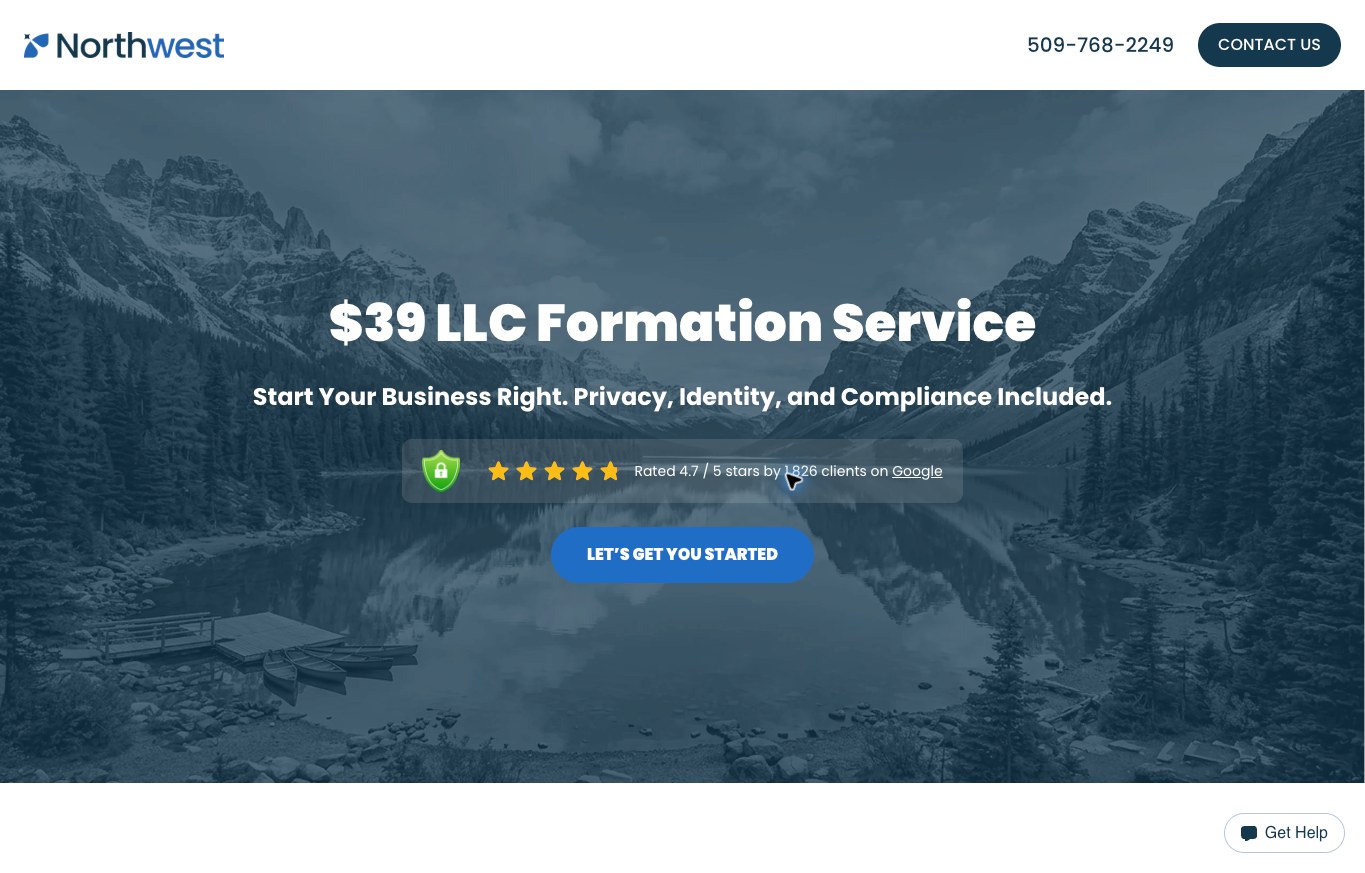
Write down the agent service included in your package, the period it covers and the following year’s charge. Keep the order confirmation. Comparing an introductory formation offer against another provider’s standalone agent price gives you a misleading comparison.
Address privacy needs its own check. Ask which addresses appear on your state’s filing, which address fields the provider lets you use and how regular business mail is handled. A registered agent address does not automatically replace every address a bank, marketplace or payment processor asks for.
Don’t choose Northwest just because a headline mentions privacy. Your state controls public filing requirements, and other organizations have their own verification rules. Check the scope in my Northwest Registered Agent review before you treat an address service as a complete solution.
This option fits a founder who wants focused formation and agent help. The filing service does not settle ownership disagreements, build a personal tax strategy or guarantee a business bank account. Keep those decisions separate from the formation purchase.
Bizee
Bizee is useful because it lets you compare basic filing against paid extras. Its public LLC page shows Basic at $0, Standard at $199 and Premium at $299, each plus state fees. Keep in mind the $0 figure is the provider’s formation fee only.
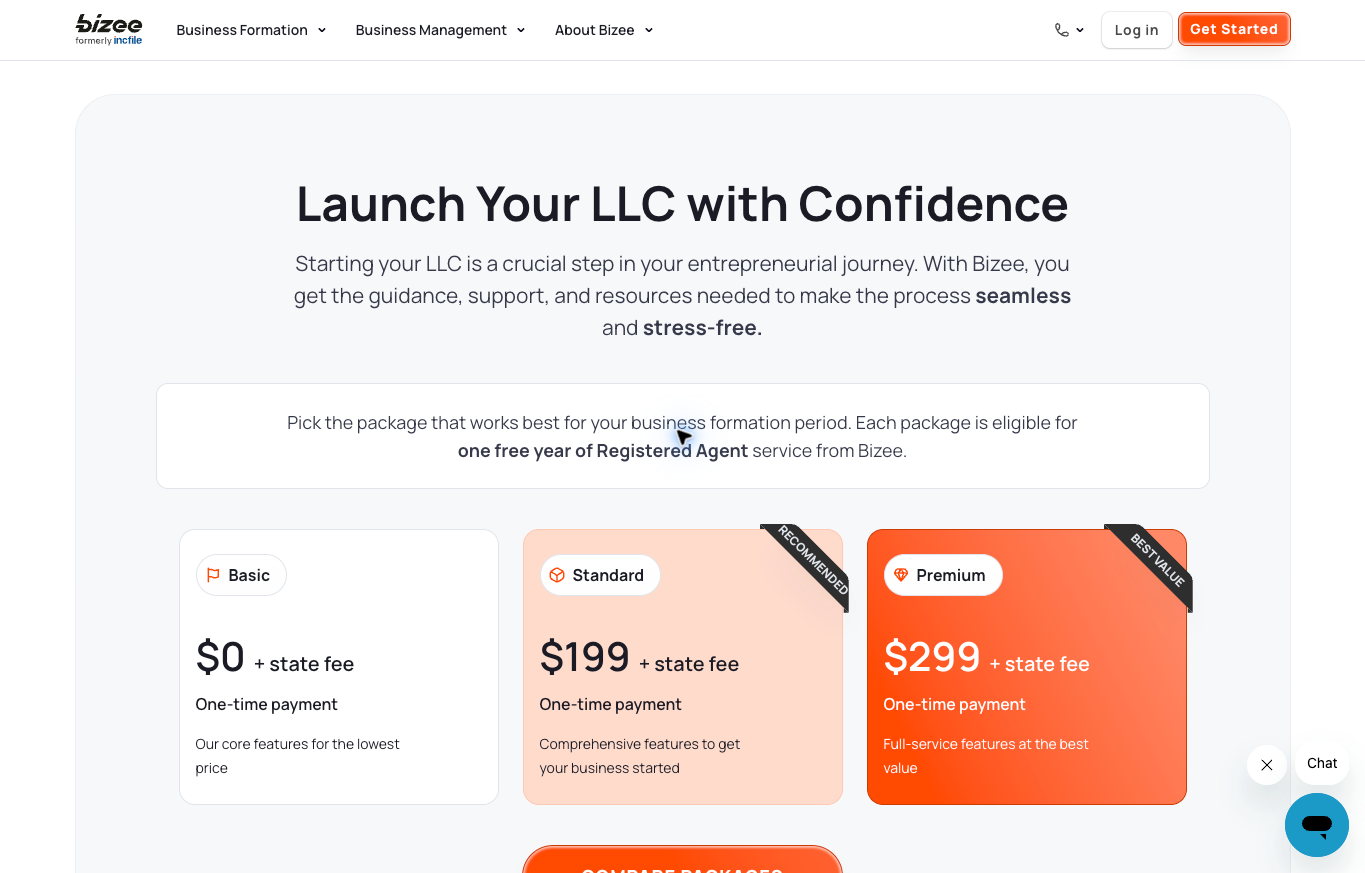
The main LLC page describes eligibility for a free first year of registered agent service. Separate package descriptions have shown different inclusions, so confirm the agent service in your selected order instead of assuming every package carries identical terms.
Ask for the renewal price after any included period. A standalone agent price and a special partner price are different offers. Neither proves your own renewal charge without the applicable terms, so add the confirmed amount to next year’s budget.
Compare the paid tiers against specific tasks. Decide whether you need document prep, EIN help or another listed extra, then price each one. Some founders like paying for admin help. Others prefer to handle straightforward steps themselves after checking eligibility and instructions.
My take is simple. Don’t buy a premium package just because the checkout labels a tier as recommended, and match the package to your situation. For a closer provider comparison, use my Bizee versus LegalZoom guide.
LegalZoom
LegalZoom is worth a closer look when you want formation plus defined support services. The public page captured for this update shows Basic at $0, Managed Service at $249 and Expert Service at $999, plus state filing fees. Other retrieved displays differ, so this comparison names the captured view clearly.
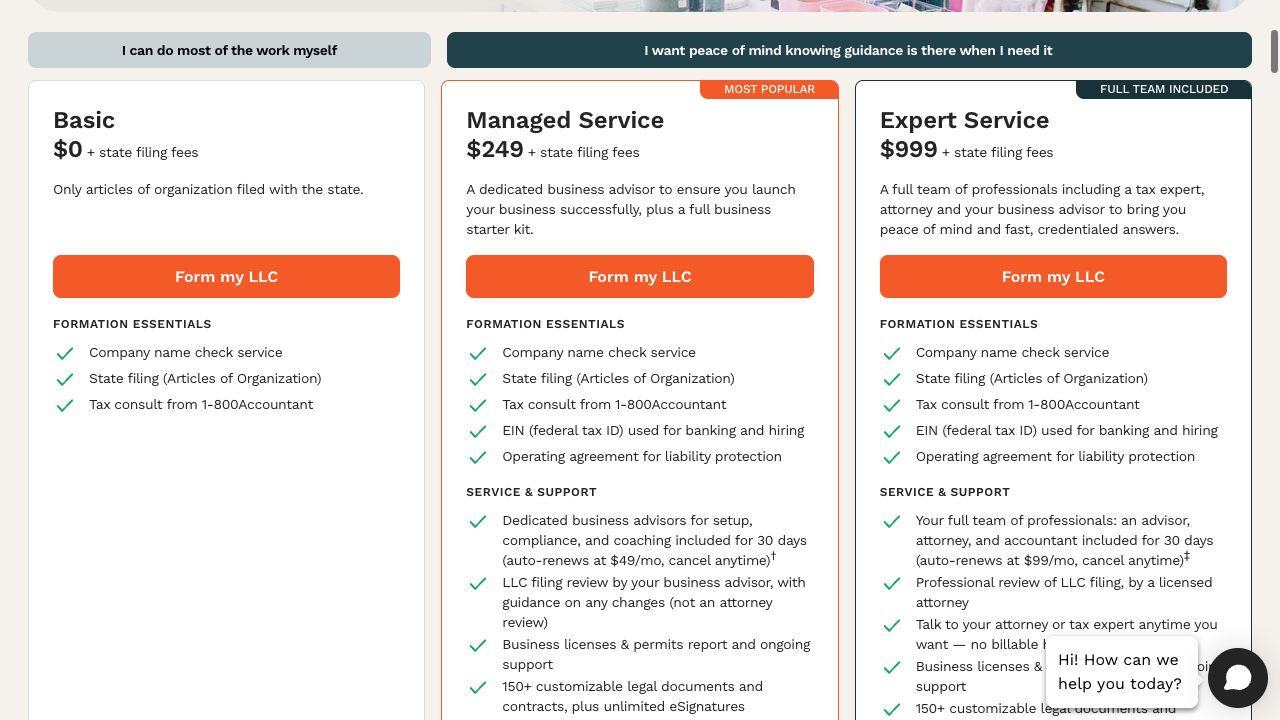
The captured Managed Service description includes 30 days of a Business Advisor Plan, followed by automatic renewal at $49 per month. Its filing review is described as a non-attorney review. Don’t confuse an admin review with personal legal advice.
The captured Expert Service description includes licensed attorney review and 30 days of an Expert Service Plan, followed by automatic renewal at $99 per month. Review the specific consultation, document and support limits before you decide the higher upfront cost is worth it.
Put trial periods on your calendar. Record the renewal date, the cancellation steps and what services you keep after canceling. Optional support, bookkeeping or other add-ons belong on separate budget lines, so don’t treat the formation payment as the final charge for everything you selected.
I’d pick a paid LegalZoom package only after naming a real support need and checking the terms. A service plan does not mean unlimited representation for every business issue. If ownership, contracts or cross-border tax questions are complicated, talk through the scope with a qualified adviser.
MyCompanyWorks
MyCompanyWorks advertises an LLC service starting at $79 plus state fees. I’d look at it if you want organized paperwork, since its public LLC page describes an operating agreement, organizational minutes, a handbook and a state-specific Startup Checklist. Compare the package against the tasks you actually need help with.
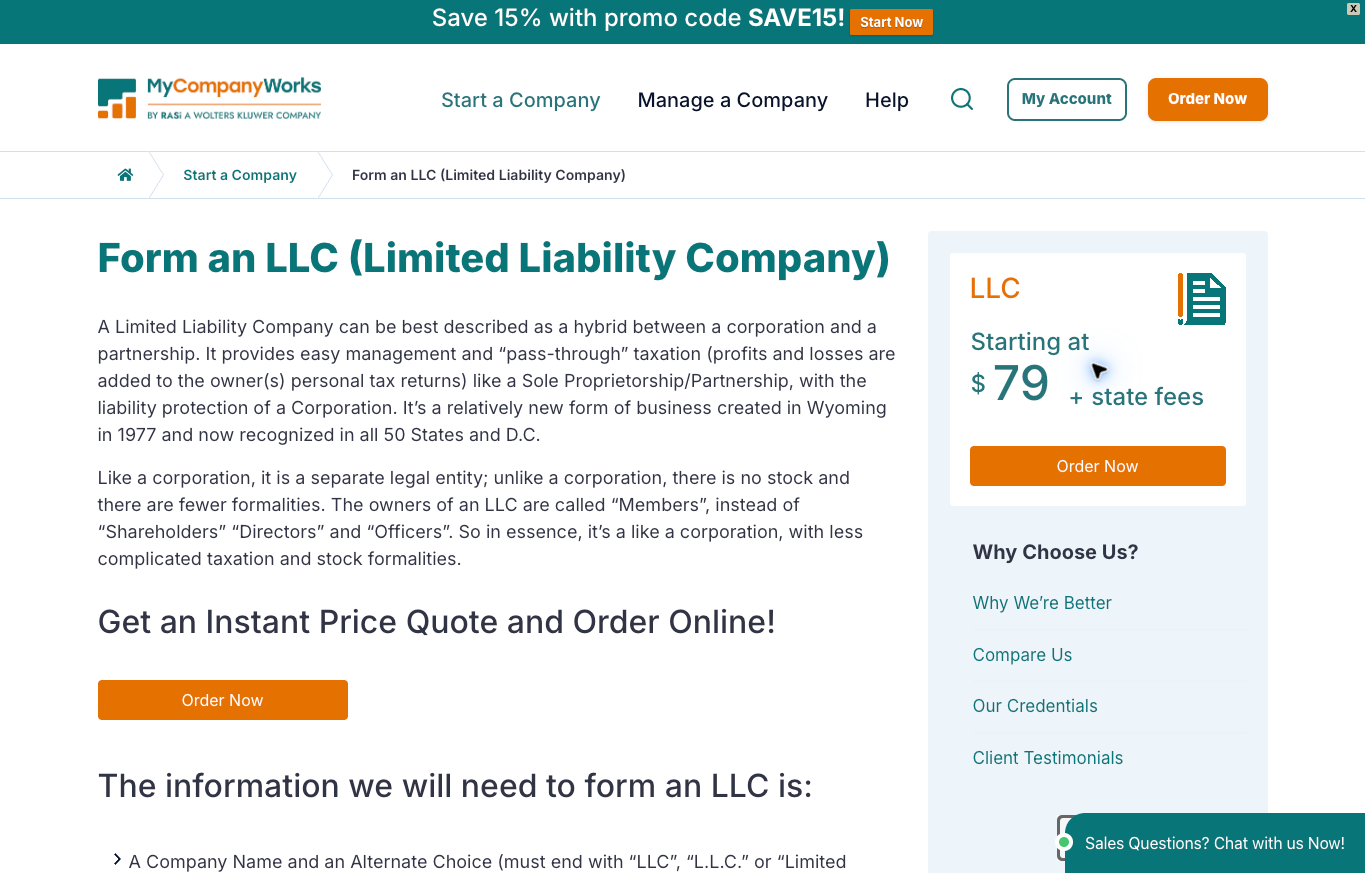
Organizational documents help you keep formation records together. Their value depends on whether the package fits your ownership structure. A document prepared through a service is different from a lawyer reviewing your specific relationship with another owner.
Check which resources come with the starting price and which need another package. Ask about agent service, ongoing support and renewal terms. Tie the comparison to a state-specific order instead of assuming the lowest advertised number buys every listed feature.
Submitting a filing and getting state approval are different events. If you have a deadline, confirm the provider’s prep timing, the state’s current processing time and any expedited fees. Don’t promise suppliers an approved entity date based only on a marketing headline.
This is a reasonable option for someone who wants filing help and an organized set of follow-up resources. My MyCompanyWorks versus Northwest Registered Agent comparison goes deeper on that decision.
Build a two-year budget before ordering
Create separate lines for the formation service, state filing fee, registered agent, optional subscriptions and state maintenance charges. Then add any professional advice you expect to buy. Separate lines show you exactly where a cheap filing turns into a bigger ongoing commitment.
Here’s an original hypothetical example, not a provider quote. Say a founder pays a $50 service fee, a $150 state filing fee and $100 for optional help, so the first cost totals $300. If the next year adds $150 for an agent and $100 in state maintenance, the two-year total hits $550 before accounting or other subscriptions.
Another hypothetical founder pays a $0 provider fee and the same $150 state fee, but picks a $30 monthly service. Twelve monthly payments add $360, bringing the first-year total to $510. The monthly service might meet a real need, but the point is to notice the commitment before you order.
Don’t copy those made-up amounts into your own plan. Replace each line with your provider’s terms and your state’s current charges. Note whether each fee repeats yearly, renews monthly or applies once, and track the date any introductory price ends.
Save the quote, confirmation and cancellation instructions somewhere the person responsible for renewals can find them. A billing calendar prevents surprises and helps you review whether ongoing services still earn their keep. Honestly, chasing a forgotten renewal is a pain in the butt.
Before you submit, check the business name, owner information and contact details against your records. Confirm the notice email is right and pick someone to watch incoming messages. A cheap filing loses its value when a missed notice or wrong detail creates extra follow-up work, so keep corrections and final approved documents together.
Choose the state around your operations
A cheap formation offer does not decide the right state. Where you live, operate, employ people or hold business property shapes the questions to review. Registering somewhere else does not automatically remove obligations where your business actually operates.
Foreign qualification in another US state is separate from forming an entity in a foreign country. The terms overlap, but the rules cover different situations. The SBA’s guide to registering your business explains state registration, registered agents and foreign qualification, and a state agency or qualified adviser can answer questions about your specific operations.
If you live abroad like I do, ownership, residence and business location each need separate analysis. A US LLC does not automatically remove tax obligations in your home country or your current country of residence. Formation also does not guarantee banking, payment processing or marketplace eligibility.
So what you should do is settle the state and ownership questions before you buy a filing package. Changing the structure later usually creates more work than reviewing the decision early. The provider prepares a filing, but you’re still responsible for choosing a structure that fits your situation.
Separate your agent, mailing address and EIN
A registered agent receives designated legal and official notices. A virtual mailbox handles mail under its own service terms. Neither one proves an address satisfies every bank, licensing authority or payment processor, so write down the purpose of each address before you use the same one everywhere.
Look at the public filing fields, not just the provider’s marketing. Different fields ask for different information. Check which information becomes public and whether the provider allows its address in each field, because address privacy is narrower than guaranteed anonymity.
The IRS issues an Employer Identification Number with no application fee, and its official EIN application page says so directly. Paid help is a separate admin service. The online process has eligibility requirements tied to business location and responsible party identification, and applicants outside those requirements need the alternative process.
Follow current IRS instructions on entity formation and the responsible party. Don’t pay an assistance fee because a checkout hints that the government charges for the number. If your ownership or international situation complicates the application, get help suited to that situation.
For business mail, compare a mailbox service’s permitted address uses, scanning allowance, forwarding charges and cancellation terms. Keep mail handling separate from legal notice delivery and from each institution’s address verification rules.
Check current reporting guidance
FinCEN’s current public guidance exempts entities created in the United States and their beneficial owners from beneficial ownership information reporting under its March 2025 interim rule. You can read it on FinCEN’s beneficial ownership information page. Older formation checklists often describe a different requirement, so don’t buy a reporting add-on just because an old article says every new domestic LLC must report.
Entities formed under a foreign country’s law and registered to do business in the United States have a different analysis under the current rule. A foreign owner of a US-created LLC is not the same as a foreign-country-created entity. State foreign qualification also does not set the FinCEN definition.
Review the current official guidance for your entity and any exemptions. This reporting distinction does not erase state maintenance, tax filings, licensing or other obligations. Keep each requirement on its own checklist instead of treating one exemption as general legal clearance.
Use the entity to support an operating business
Once formation is done, organize the approved documents, operating agreement, ownership records and renewal dates. Decide who watches official notices. Review banking and bookkeeping needs separately, and document business transactions from day one.
The Ecommerce Paradise business formation guide covers the broader foundation around an ecommerce business. Read the admin steps alongside qualified legal and tax advice whenever your situation needs personal decisions.
If you’re exploring the model, start with how high-ticket dropshipping works. Selling expensive products means customer support, fulfillment arrangements and supplier relationships. An LLC alone gives you none of those operating systems.
Use my high-ticket niches list to build a research shortlist. Look at product specs, buyer needs, delivery costs and competition before you commit to a category. Formation spending is easier to justify once you understand the business you plan to run.
Work through my high-ticket supplier research guide before you approach brands. Dealer approval, pricing rules and warranty arrangements come from the supplier relationship, not the filing provider.
Supplier Paradise is another resource for supplier research. Verify each potential partner’s requirements directly. Ask about freight damage, returns, lead times and support responsibilities before you build your store around a product line.
So with that said, here are the key takeaways. Pick the cheapest package that covers a real need, which for most people means starting with Northwest. Budget 2 years ahead, separate your agent, mailbox and EIN, and check current official guidance instead of old checklists.
An LLC is a foundation, not a business. It won’t guarantee bank approval, supplier approval, anonymity or tax savings, so keep your expectations realistic and get qualified advice when your situation is complicated.
If you want guidance on niche research and store building after the paperwork is done, look at Ecommerce Paradise coaching. Ecommerce support is separate from legal representation and tax advice, so define the work you need instead of expecting one service to cover every part of launching a business.
Questions founders ask before filing
Which LLC service would I compare first?
I’d compare Northwest’s focused offer against Bizee’s basic filing, then evaluate paid extras separately. LegalZoom deserves attention for defined support needs, and MyCompanyWorks for its organizational resources. The best fit follows your requirements and confirmed costs.
Does a $0 formation service mean a free LLC?
No. The provider’s service fee and the state filing fee are separate. Agent renewals, subscriptions and state maintenance charges also need review, and a $0 starting fee does not mean a zero-cost business.
Does formation include unlimited legal advice?
No. Filing help, document prep and legal service plans have different scopes. Confirm whether a lawyer reviews your situation, how consultations work and which matters are excluded. Keep complicated ownership and tax decisions with the right professionals.
Should I purchase every checkout extra?
No. Name the task first, then decide whether to do it yourself or pay for help. Review any trial and renewal before accepting a subscription, because a package label does not prove a need.
Does an LLC guarantee supplier or bank approval?
No. Suppliers and financial institutions apply their own requirements. Prepare the documents they ask for and answer their questions accurately. Formation also does not guarantee anonymity, tax savings or protection against every liability.
Related formation comparisons
- Northwest Registered Agent versus Bizee
- MyCompanyWorks versus Northwest Registered Agent
- Bizee versus LegalZoom
- Northwest Registered Agent address privacy
- Bizee for non-US founders

Trevor Fenner is the founder of Ecommerce Paradise. His main projects are Ecommerce Paradise, Supplier Paradise, and Review Paradise, which is currently in development. TrevorFenner.com publishes research-based reviews and practical guides to online business tools and remote-work services, with clear affiliate disclosures.