
The best audiobook apps fit the books you want and the access arrangement you understand. Purchased titles, library loans and short summaries are different products.
Check the exact title, edition and narration before comparing subscription prices. A catalog headline does not establish the book you want is included or available in your region.
At Ecommerce Paradise, I connect learning resources with practical action. A business book is useful when you review an idea against the actual operation rather than treat listening as a measured result.
This shortlist compares Audible, an unlinked Libby library route and Blinkist as a summary alternative. The services do not supply identical access. Match the choice to your listening purpose and routine.
The two real provider images retain their October 13, 2026 dates. No audiobook purchase, player test, library loan or learning-performance experiment was completed for this guide.
Disclosure: qualifying purchases through affiliate links earn me compensation at no additional cost to you. I own Ecommerce Paradise and Supplier Paradise. Regional offers and billing-channel terms require their own review.
Compare the access arrangement first
| Option | What you receive | Best starting point | Check before committing |
|---|---|---|---|
| Audible | Full audiobooks through purchases and membership access | A particular book you want to hear in full | Selected plan, purchased versus included titles, credit rules |
| Libby | Your participating library’s digital loans | A library card and a flexible reading schedule | Eligibility, available edition, holds and due date |
| Blinkist | Short summaries and plan-specific learning features | A subject you want to sample before deeper reading | Summary format, selected tier, regional first charge and renewal |
Write down the next two books you want before opening a pricing page. Compare the actual recordings and access terms. An enormous catalog is irrelevant when the particular edition you need is missing.
1. Audible for full audiobooks
Audible belongs on your shortlist when you want full books and a choice of specific titles. Distinguish purchases from included membership access before choosing a plan.
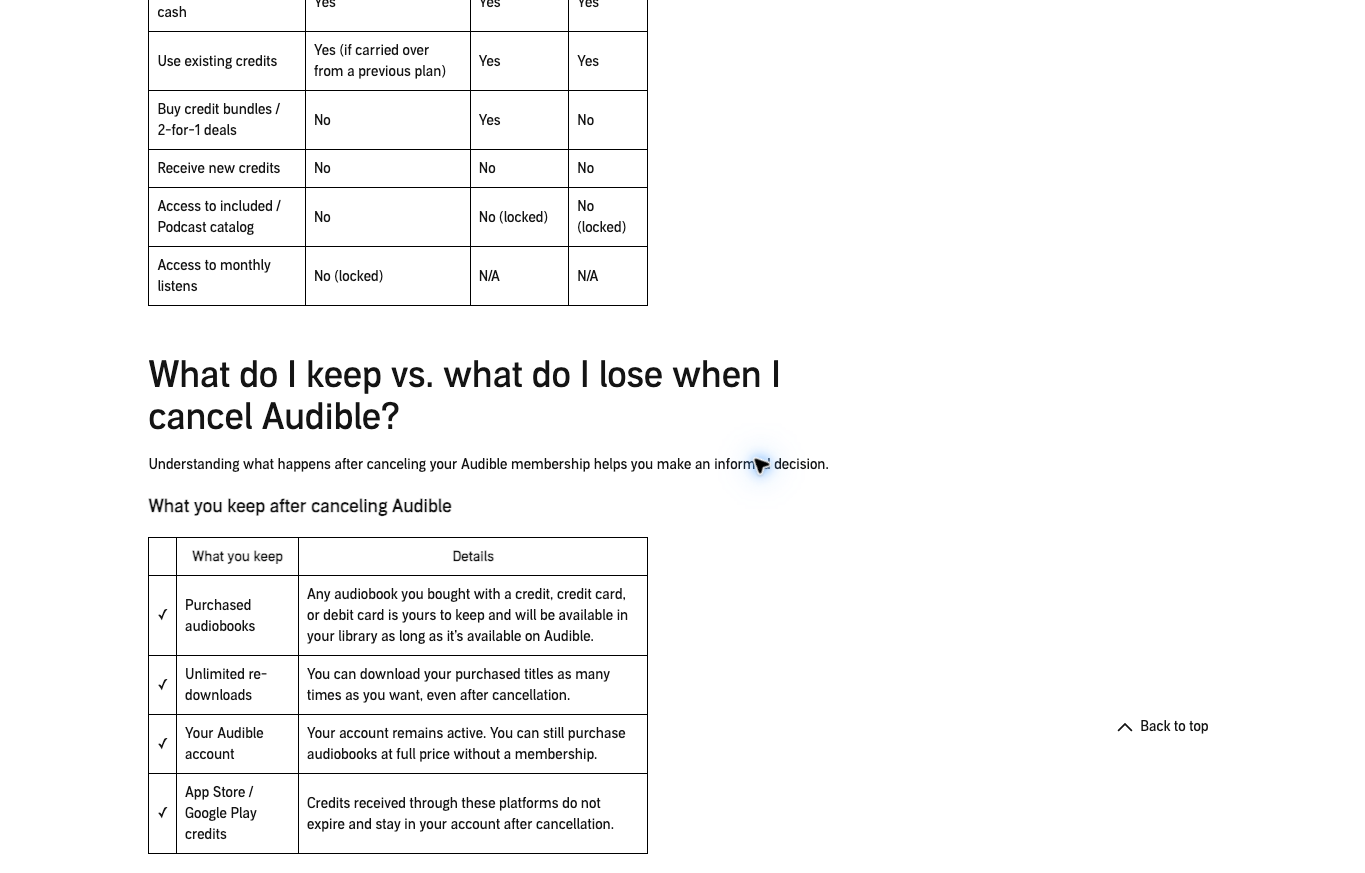
Audible’s current US cancellation guidance says books bought with credits or a credit or debit card stay in your library after cancellation. Included catalog titles lose access. Ordinary unused credits expire after 12 months or upon cancellation. Credits received through App Store or Google Play memberships do not expire and stay after cancellation.
Billing through Apple or Google requires cancellation through the respective store. Deleting the app does not stop the membership. Read the rules for your actual marketplace and billing channel before relying on the US guidance.
The help-page image documents this access distinction. No credit redemption, purchase, player comparison or cancellation test was performed for this article.
My preference is to choose the book first, then compare the applicable offer. A membership deserves a place in your budget when the title and access arrangement serve a specific purpose. A discount alone is a weak reason to accumulate another subscription.
2. Libby for library borrowing
Libby is an unlinked alternative for readers with an eligible participating-library card. Check your library’s collection and the availability of the recording you want. A loan has a due date rather than permanent purchased access.
Your library sets the number of concurrent loans and holds. Ebook and audiobook loans count toward the borrowing limit. Magazines and Extras do not. Read the limits attached to your actual card rather than assuming every library follows one rule.
Libby’s mobile download settings control automatic downloads and Wi-Fi-only behavior. A title-size threshold also changes which loans download automatically. These settings are unavailable in the browser version. Check the selected audiobook’s completed download before depending on offline access.
Borrowing suits a flexible schedule. A waiting list is a poor fit when you need a particular title for a fixed deadline. No library card was registered, loan obtained or mobile download tested during this research.
3. Blinkist for summaries
Blinkist serves a different purpose from listening to an entire audiobook. The short-summary format introduces ideas without reproducing every example, argument and qualification from the original work.
The current official guide distinguishes Basic’s selected daily title, Premium’s summary library, Pro’s additional AI features and Platinum’s live sessions and infographics. Review the selected offer rather than assuming every feature belongs to every paid tier.
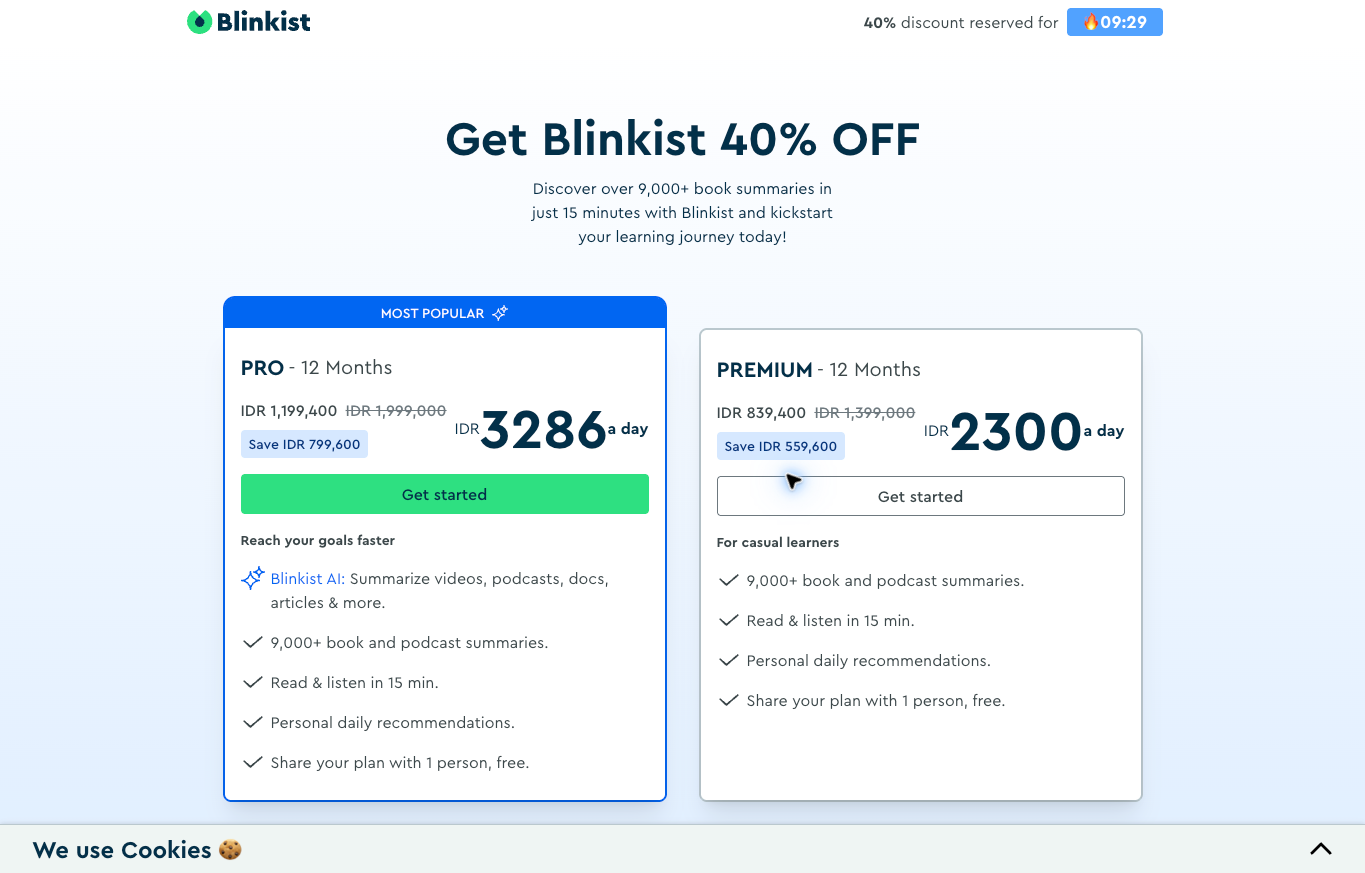
The actual referral image shown here was captured October 13, 2026. The offer uses Indonesian rupiah and shows introductory twelve-month pricing. First-term and renewal charges differ. This dated regional capture is neither a universal monthly quote nor a promise of your account’s eligibility.
I would use a summary to identify a subject worth deeper reading. For a consequential business decision, return to the original argument and current evidence. No summary-quality, AI, retention or learning-outcome test was completed here.
Choose a recording, not a catalog headline
Start with the author, exact title, language and edition. Similar titles do not establish identical content. An updated business book and an older recording deserve separate evaluation, especially when the examples depend on a platform, market or regulation.
Check whether the recording is abridged. Look at the narrator and duration. If a sample is available, listen before paying. Choose a voice you find comfortable rather than relying on someone else’s preference for a narrator you have never heard.
A sample answers a narrow question about the recording. A few enjoyable minutes do not establish your experience across an entire book. Listen for clear pronunciation, pacing and how easily you follow a difficult passage.
For nonfiction, check references to diagrams, worksheets or companion material. A chapter built around a visual exercise needs more than headphones. Confirm which supporting materials accompany the selected edition and where you would access them.
A practical shortlist needs room for a rejected option. If the narrator, edition or format does not suit you, choose another recording or read the book instead. There is no reason to force an audio purchase simply because you searched for an audiobook app.
Match the book to your available time
Use your actual schedule. A regular walk, commute or household task offers a different listening environment from a flight with interruptions. Decide where the session belongs before adding several books to a queue.
Here is an original planning example, not an app test. A ten-hour recording takes twenty thirty-minute sessions at normal speed, excluding pauses and replay. If you only have three such sessions per week, plan for roughly seven weeks rather than an ambitious weekend.
Compare this schedule with a loan’s due date or the period of subscription access. The book’s duration and your calendar belong in the same decision. A library hold becoming available does not create extra hours in your week.
Playback speed is a personal setting, not a measure of understanding. Try a short passage yourself and explain the argument afterward. Reduce the speed or replay a section when the content becomes difficult to follow.
Keep entertainment and focused study separate. A novel during routine chores serves a different purpose from reviewing a detailed negotiation argument. For material you intend to apply, leave enough attention for notes and follow-up questions.
Plan a stopping point before a session. A chapter break or a specific section makes returning easier than listening until a notification interrupts you. Record your place and the next question rather than keeping an elaborate listening streak.
Budget for the billing period you accept
Write down the total first charge, billing period, renewal amount and renewal date. A displayed monthly equivalent does not establish monthly billing. An annual offer requires a full-year spending decision even when the page divides the price into smaller units.
Check promotional eligibility and the transition to regular pricing. Record the accepted terms before purchasing. A referral page, account offer and app-store subscription are separate places to inspect, with their own displayed conditions.
Consider this hypothetical budget. A membership priced at $15 per month costs $60 across four paid months. Finishing one book during those months does not reduce the spending to $15. These numbers illustrate a budget review rather than quote any provider’s current price.
Purchased books, credits and subscription access need separate entries in your comparison. Avoid assigning a cash value to every advertised perk unless you expect to use the perk. A long list of unused features adds little to your actual listening plan.
Before renewal, look at recent use and the next title you want. Keep an option when the arrangement still fits. Cancel or reconsider through the appropriate billing channel when the original purpose has changed.
Do not redeem a credit solely to avoid admitting the membership was unused. Choose a title you want and check the credit’s applicable rules. For a disputed charge or unclear entitlement, ask the provider about the actual account rather than relying on a general comparison.
Check offline access before traveling
Prepare on reliable Wi-Fi. Open the selected app, inspect the title’s download status and confirm enough device storage. A book appearing in a library view does not establish a completed download.
Verify access yourself before departure. Use the device and account you expect to carry. This guide does not establish offline performance on your phone, and a screenshot of a public provider page supplies no evidence of a working download.
Check the loan due date and membership conditions alongside the downloaded file. Offline storage does not change the underlying access agreement. Keep the distinction between a file inside an app and an unrestricted audio file clear.
Bring a suitable charging arrangement and confirm your headphones work with the selected device. Check available space again when downloading several lengthy recordings. Avoid using a scarce travel connection for a download you intended to complete before leaving.
For an important work session, keep an alternative reading plan. A written note, accessible text edition or a rescheduled review is preferable to depending on unverified access. Choose the alternative within your own access rights.
Keep one useful note from each study session
After a nonfiction session, write the central argument in your own words. Include the author, title and chapter or timestamp. A short note with a clear reference is easier to investigate than a large folder of disconnected excerpts.
Separate the author’s claim from your interpretation. Record supporting evidence, assumptions and unanswered questions. If a book presents a historical business example, do not silently turn the example into a current rule for your own operation.
Choose one practical follow-up. Check a supplier’s actual policy, compare a proposed process with your records or outline a question for a qualified adviser. Listening supplies a starting point for investigation rather than proof of a commercial result.
For a summary, record the format alongside the title. A summary selects parts of the original work. Seek the full context before repeating a detailed claim or making a decision with financial, legal or operational consequences.
Avoid collecting passages solely for the size of the collection. Keep notes you expect to revisit. Remove duplicates and distinguish a quote from a paraphrase so your own writing does not misattribute the author’s words.
Review the action separately from the listening session. Finishing a chapter and completing supplier research are different events. Mark the research complete after obtaining the necessary evidence, not after hearing a convincing business story.
Connect business reading with the actual work
If ecommerce is your focus, start with the high-ticket dropshipping overview. Learn who sells the product, who fulfills the order and which responsibilities stay with the retailer. A motivational book does not settle those operating questions.
Use the high-ticket niches list to organize product-category research. Choose a focused customer and product need, then investigate demand, competition and supplier access. Do not treat a book’s broad endorsement of ecommerce as validation of a particular niche.
For sourcing, follow the high-ticket supplier research guide. Record dealer requirements, territory restrictions, shipping responsibilities and warranty handling. General negotiation advice becomes useful only after you understand the actual proposed relationship.
Supplier Paradise is another owned research resource. A supplier lead still requires verification. Confirm product information, order acknowledgment, returns and the responsible contact before making a promise to a customer.
Work through the business formation guide for setup questions. Keep legal and tax decisions tied to your circumstances and qualified advice. A recorded chapter does not replace a current agreement or a professional review.
When you need help defining the next business task, review Ecommerce Paradise coaching. Confirm the service’s actual scope and your responsibilities before purchasing. Treat coaching as a separate decision from an audiobook membership.
Choose another format when audio falls short
Audio is one learning format. Dense tables, software demonstrations and exercises often require a screen or written reference. Choose the format around the task rather than insisting every subject belongs in your listening queue.
My online courses comparison covers structured learning options. Check the individual course’s syllabus, access period and prerequisites. A course catalog name does not establish a particular instructor’s fit for your needs.
For reviewing a concept through another medium, use the course video hosting comparison. Hosting software is a delivery decision, separate from the quality of the instruction or the learner’s results.
If note organization is becoming the problem, read my productivity apps comparison. Choose a small routine you will maintain before adding another tool. An empty workspace does not solve an unclear learning objective.
The AI content creation tools guide discusses other research and writing workflows. Review generated summaries against the original source. Do not substitute a generated explanation for evidence when the specific detail matters.
For readers moving into retail operations, my dropshipping suppliers comparison addresses a separate selection process. Keep your reading notes connected to verified business requirements rather than a growing collection of tools.
Check cancellation and access separately
Find the actual billing account before canceling. Confirm the renewal date and follow the instructions for the provider or app store responsible for the subscription. Save the confirmation and review the resulting account status.
List purchased titles, unused credits, included catalog items and borrowed content separately. Each category involves a different question. A retained purchase does not establish continued access to every book previously displayed in the app.
For library loans, review the due date and the process available through your library. For summaries, review the selected subscription and the access period. Do not apply Audible’s credit exception to another service.
If the account display conflicts with your confirmation, contact support with the relevant record. Avoid sharing passwords or full payment details in an ordinary support message. Describe the specific subscription, charge or title access issue.
My starting point
For a full recording you want to revisit, compare the specific Audible purchase and membership terms. For flexible borrowing, check your eligible library’s Libby collection first. For sampling an idea, consider Blinkist with the summary format clearly understood.
Choose the next title and a realistic listening schedule before paying. Keep the accepted billing terms and review your actual use before renewal. The best choice is the arrangement you understand and intend to use.
This guide combines current public provider research with the two dated, real provider captures. No app installation, purchase, library loan, listening experiment or private account inspection was performed. The images document public information rather than prove playback, accuracy or learning results.

Trevor Fenner is the founder of Ecommerce Paradise. His main projects are Ecommerce Paradise, Supplier Paradise, and Review Paradise, which is currently in development. TrevorFenner.com publishes research-based reviews and practical guides to online business tools and remote-work services, with clear affiliate disclosures.