

The best online courses help you build one specific skill and finish real work with it. So start with the project, your current level and how much study time you actually have. A stack of certificates does not prove you can do the job.
Here’s what I’d do first. Pick one learning outcome before you shop. Explaining a marketing report, writing a campaign brief and checking AI-generated copy all need different lessons, and a bigger library is not automatically a better starting point.
I started Ecommerce Paradise in 2015 as an education business, and my focus has always been applying what you learn to a real business. Choose a skill tied to your next project, then compare the course content and the practical work it asks of you.
This guide compares a structured Google marketing certificate, a focused AI-for-marketing course, a broad Udemy lesson library and foundational AWS prep. The 4 directions serve different goals. If you’re an online-store beginner, you don’t need every subscription or credential on this list, and my guide to what high-ticket dropshipping is shows the model I’d learn alongside them.
A note on research. Public course information was refreshed October 13, 2026, and the provider screenshots keep their October 12 capture dates. I have not enrolled in or completed these programs, tested teaching quality or verified graduate outcomes for this comparison. Workload estimates are provider descriptions, not personal completion results.
Disclosure: some links are affiliate links, and qualifying purchases earn me a commission at no extra cost to you. I own Ecommerce Paradise and Supplier Paradise. None of these learning options promises a job, income or an exam pass.
Compare the learning scope
| Learning option | Provider | Best fit to investigate | Published workload or format | Main check |
|---|---|---|---|---|
| Google Digital Marketing & E-commerce Professional Certificate | Coursera | Structured beginner marketing and ecommerce study | 8-course series. Provider estimate of 6 months at 10 hours a week | Selected enrollment cost and completion requirements |
| AI for Marketing | Code Labs Academy | Focused AI-assisted marketing project | Self-paced. 5 modules and 15 advertised course hours | Access, mentor arrangements and current fee |
| Digital Marketing Masterclass 2026: AI Marketing Course | Udemy | Broad marketing and AI lesson library | Inspected syllabus: 66 hours 48 minutes | Relevant sections, purchase option and practice time |
| AWS Certified Cloud Practitioner training | Whizlabs | Foundational AWS study and exam preparation | Videos, practice resources and package-dependent lab options | Exact package and separate AWS certification requirements |
Use the “best fit” column as your filter. If none of those rows matches the skill your next project needs, skip the purchase for now. That’s honestly a fine answer.
Four learning paths worth comparing
Google’s Digital Marketing and E-commerce certificate
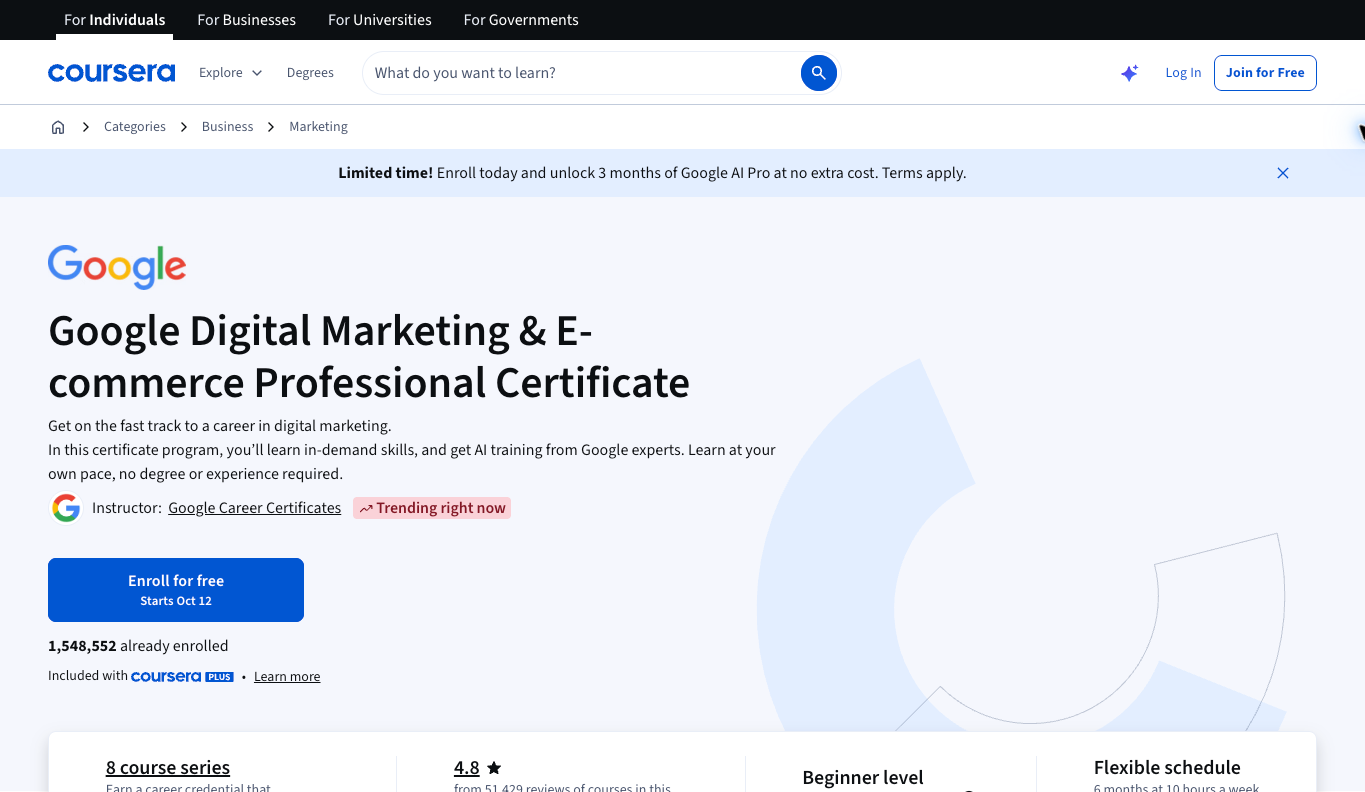
The Google Digital Marketing & E-commerce Professional Certificate on Coursera gives you a structured beginner sequence. The current Coursera certificate page lists 8 courses and says no degree or prior experience is required.
Its stated curriculum covers marketing fundamentals, customer acquisition, email, measurement and ecommerce work. The provider estimates 6 months at 10 hours per week. Use that estimate for planning, not as a personal completion guarantee.
I’d look at this one when you want an ordered learning path with assignments. Review the actual course list and completion requirements before you pay. A recognizable credential name does not replace understanding the work.
Check the enrollment and subscription terms you’d actually pick. An enrollment button or inclusion badge does not mean a free certificate, universal subscription access or a job at Google. Degree credit requires the relevant institution’s separate arrangement.
Code Labs Academy’s AI for Marketing
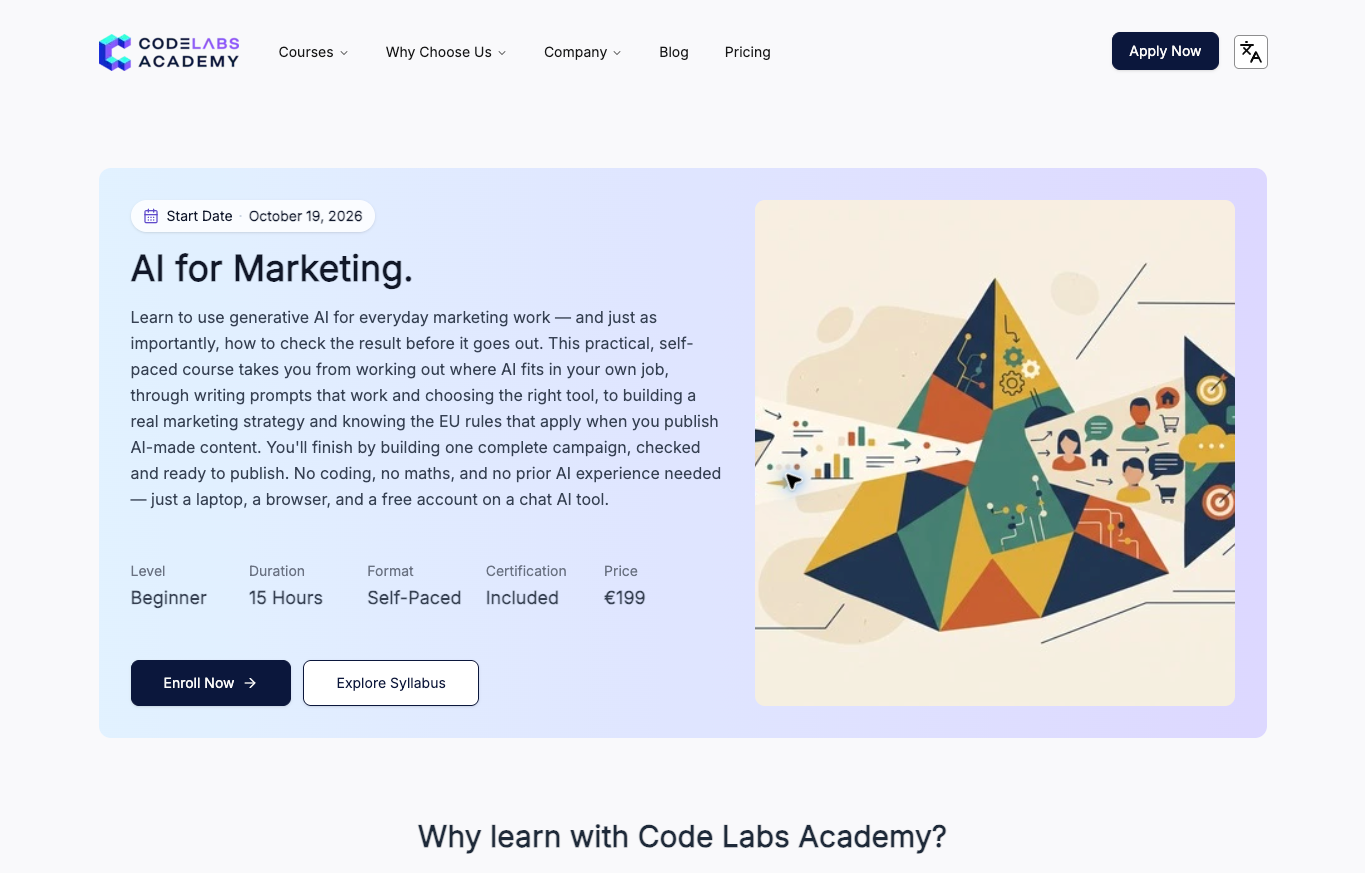
Code Labs Academy describes AI for Marketing as a beginner, self-paced course with 5 modules and 15 advertised hours. Its public description requires no coding, maths or prior AI experience. That’s a pretty low barrier to entry.
The curriculum covers AI use, prompting and tool selection, strategy, EU publishing rules and a campaign capstone. This is a focused project direction, separate from the academy’s longer live bootcamps.
The live page reviewed October 13 showed €199 and an October 19 start. Both are dated provider offers. Confirm your fee, start date, access and feedback arrangements before you buy.
I’d use the capstone to judge the fit. Prepare a campaign draft and explain its evidence and revisions. Course coverage does not prove campaign profit, accurate AI output or legal clearance for your business.
Udemy’s Digital Marketing Masterclass 2026
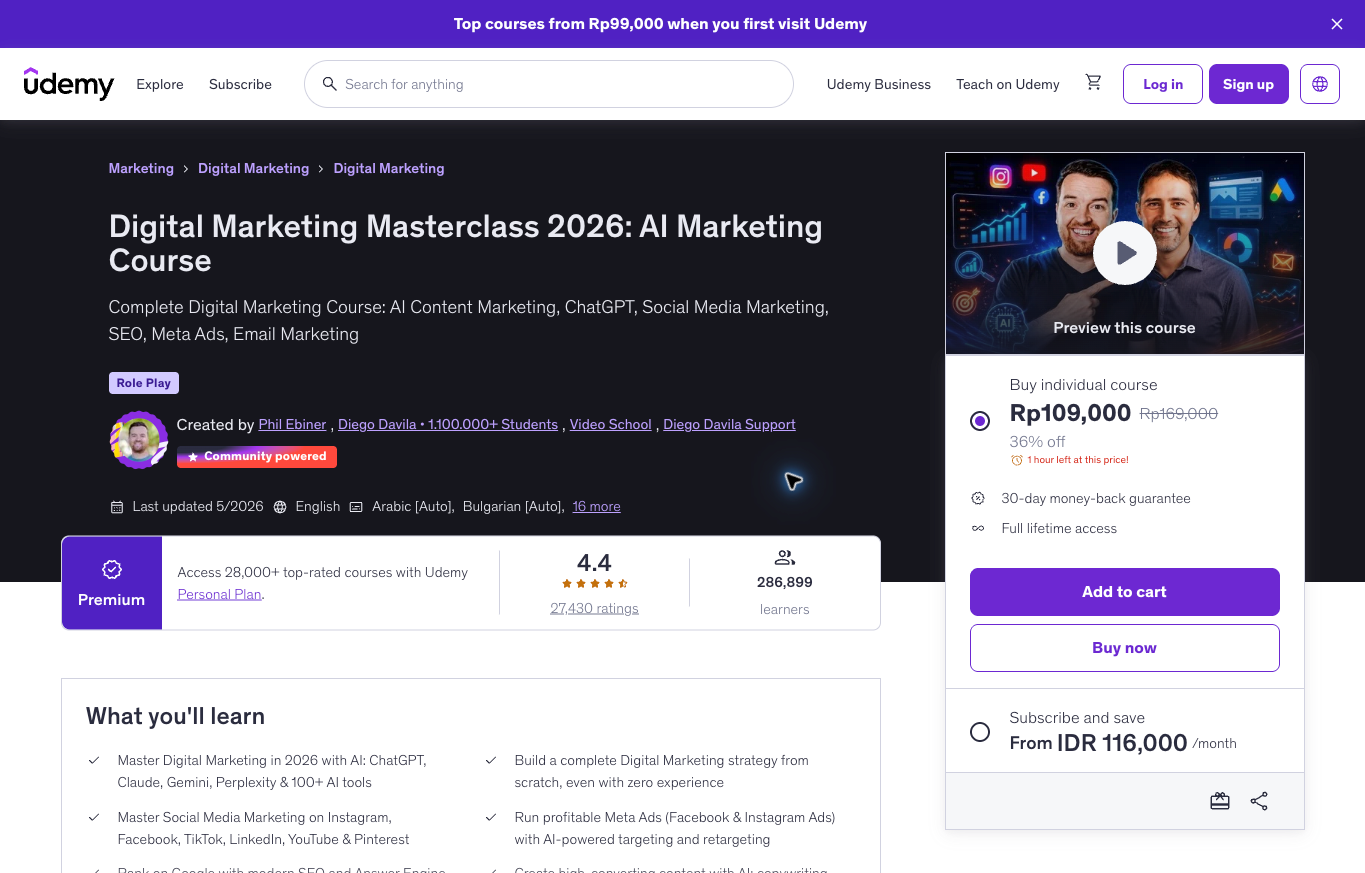
The Digital Marketing Masterclass 2026: AI Marketing Course on Udemy is the broader lesson-library option. Its live page lists 45 sections, 638 lectures and 66h 48m of material, with a May 2026 update.
The public syllabus covers audience work, AI-assisted marketing, SEO, Meta advertising, email and analytics. These are curriculum descriptions, not lessons I completed or strategies I tested for this article.
I’d pick one relevant starting block instead of treating the whole library as homework. Compare the available previews with your level and your next project. More video hours do not automatically mean better value.
Review the exact purchase or subscription that includes the course. Regional promotions and access arrangements differ. A current title or update date also does not prove every software walkthrough is still current.
Whizlabs’ AWS Cloud Practitioner preparation
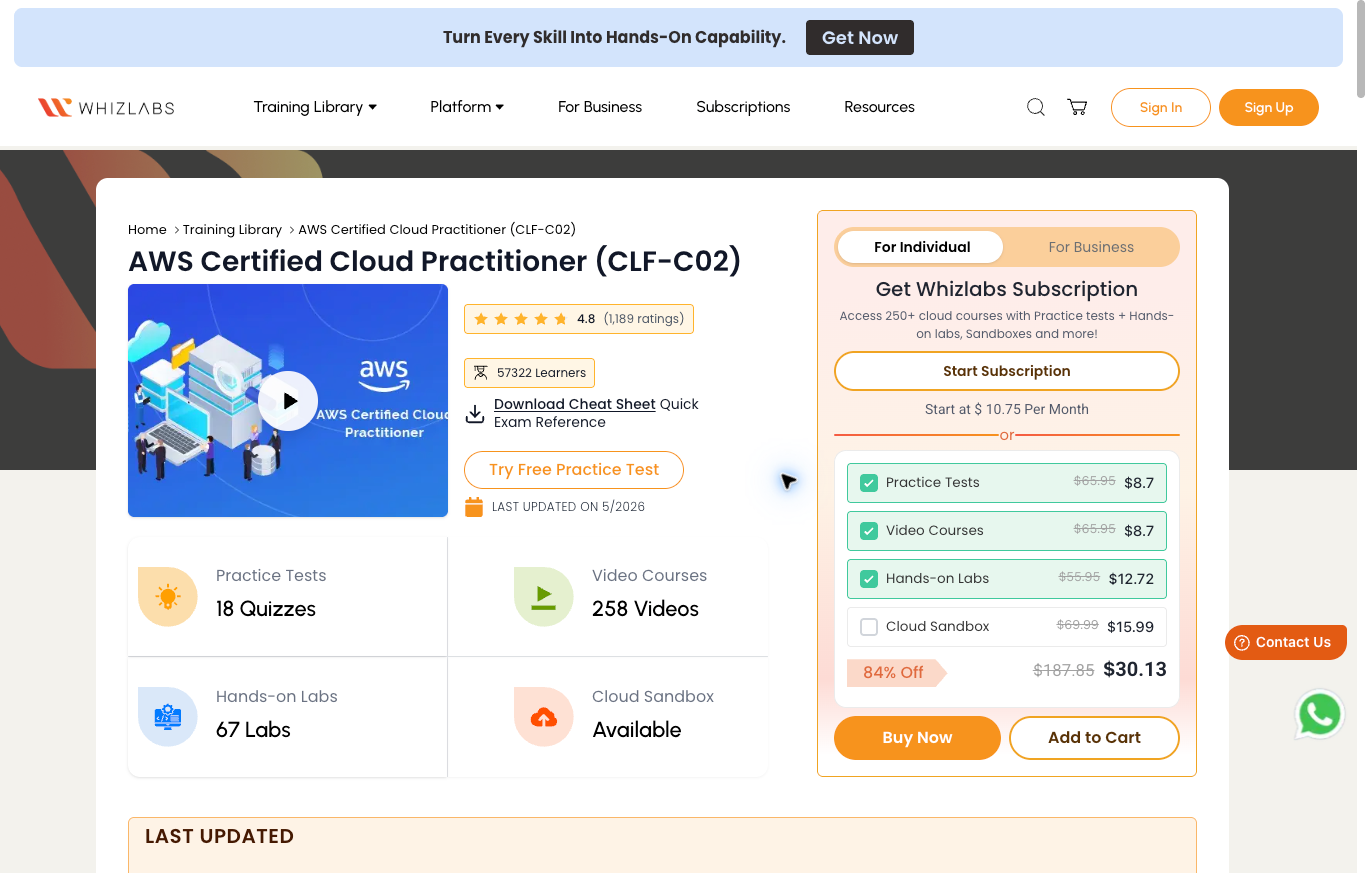
Whizlabs offers AWS Certified Cloud Practitioner CLF-C02 training through videos, practice resources, labs and sandbox options. Look at this one when you have a clear foundational cloud-study goal.
The current public page shows different resource counts and one-year versus two-year access statements in separate sections. Confirm your selected package in writing instead of applying one count or duration to every option.
Training is not the same as AWS certification. Finishing third-party material does not award the AWS credential or guarantee an exam pass. Check AWS’s own Cloud Practitioner certification page for current requirements, and budget for any separately purchased voucher.
The official CLF-C02 exam guide lays out what the exam covers. Use it to check whether any prep package lines up with the actual content.
A store-launch project does not automatically need cloud certification. Choose Whizlabs when the subject fits your actual work, and use practice explanations to understand concepts instead of memorizing a score. No practice exam or lab was tested for this guide.
Choose one demonstrable learning goal
Describe the job you want to do after studying. Writing an email sequence, explaining a marketing report and understanding cloud basics all need different learning paths. A broad subject label gives you less direction than a defined task.
Make the first outcome small enough to review. A campaign brief with an identified audience, message and measurement plan is a workable project. Trying to learn every marketing channel before doing anything gives you no clear finish line.
Check the prerequisite level before you compare provider names. A beginner sequence makes sense when the subject is new to you. Advanced material assumes knowledge you need to identify and build separately.
Also separate an ordered program from a reference library. The first gives you a sequence to follow, and the second answers selected questions. Choose the one that matches your current project, not the biggest library on sale.
This is the same thing I teach in ecommerce. Go deep before you go wide. One skill applied well beats 5 courses half-watched.
Budget practice alongside lesson hours
Advertised video hours are only part of the schedule. Exercises, revision, unfamiliar concepts and project review all add work. Finishing playback does not mean you understand it or finished the assignment.
Here’s a hypothetical schedule. 2 sessions of 90 minutes give you 3 hours per week, so 15 advertised hours take 5 weeks before extra practice. A roughly 67-hour library needs about 23 weeks of playback at the same pace.
Those calculations are planning examples, not completion predictions. Set aside the sessions before you buy. A smaller course often fits an immediate skill better than a long program that needs a quiet month you don’t have.
Leave time to apply each lesson instead of filling your whole calendar with videos. Then review your actual pace after the first few sessions. Notice where you repeat material or need another explanation, and adjust instead of treating the provider’s estimate as a deadline every learner hits.
Review the lessons relevant to your project
Look at the curriculum, prerequisites and available previews. Find the lesson that serves your intended task. A current headline or popular provider does not tell you whether the program covers your specific gap.
Separate concept teaching from interface demos. A principle often applies across several tools, while a software walkthrough depends on how the product works today. Compare setup instructions with current official documentation before you apply them.
Ratings and enrollment totals help you find material to investigate. They don’t prove teaching quality for your needs. Read the scope closely enough to tell a full beginner sequence from a short intro or a narrow feature demo.
Keep a short gap list while you study. Note an unexplained prerequisite, an outdated screen or a topic outside the program. Solve that particular question before assuming you need another full subscription.
Finish a project and explain the decisions
A useful project shows the skill. For marketing study, prepare an audience brief, message and measurement plan. For AI-assisted work, keep the source checks, rejected suggestions and revisions behind the final draft.
Start with one deliverable. An approved landing-page draft is a clearer result than an unfinished plan to redesign every page. Choose a project with a clear owner, audience and review process.
Do the work yourself instead of copying an instructor’s example and calling it original. Explain why you chose the audience, wording or technical approach. Note which parts would change for another business.
Use fictional or properly authorized sample information when real customer records aren’t needed. Keep private data out of public forums and demos. Practice should never expose someone’s identity or confidential business material.
Use a practical project review
Write acceptance checks before you start the assignment. For a campaign brief, name the offer, intended reader, approved facts and measurement question. For a technical exercise, describe the expected behavior and resources required.
Review the output against those checks instead of grading it on looks. An attractive presentation with invented product claims needs correction. A technical explanation built on an unsupported assumption needs another source or a qualified reviewer.
Keep observations separate from predictions. A fictional campaign plan is not evidence of sales, and a practice answer is not an official exam result. Record what you completed and which outcomes you didn’t measure.
Ask for feedback on a specific part of the work. A reviewer gets a clearer task when you name the intended audience, current draft and open question. General requests for an opinion usually produce less useful direction.
Then revise and keep the reason for each change. Another reader should understand which version was reviewed and which evidence supports the final choice. No course project or teaching-quality experiment was performed for this comparison.
Keep credentials and outcomes separate
A completion certificate, a Professional Certificate, an academic degree and a vendor certification are all different things. Identify the credential offered and the requirements to earn it before you pay for access.
For a career or academic goal, check what the relevant employer or institution expects. A recognized name does not mean automatic credit or employment. For your own business, look at the practical work alongside any badge.
Describe completed work accurately. Viewing a module is not completing a certificate sequence, and third-party practice does not award an AWS certification. A provider testimonial is also separate from an outcome independently verified for this article.
None of these programs offers a universal job, income or exam guarantee. Choose the learning scope around your goal and review the actual credential process apart from the promotional wording.
Compare the fee and access commitment
Figure out what the purchase includes: one course, selected resources, a bundle, a subscription or a cohort. Confirm access length, support and any extra software or equipment before you compare prices.
Keep annual charges separate from monthly equivalents. A promotion does not tell you the renewal amount. Read the trial, cancellation and refund conditions for the option you pick instead of assuming every course uses the same terms.
Here’s a hypothetical. A $40 subscription used for 6 months totals $240 before other expenses. A one-time $100 course is a different commitment, but the lower total doesn’t fix a curriculum mismatch, and these figures are budgeting examples, not provider quotes.
Review the resources your project needs. A required app, device or separately purchased assessment adds to the plan. Include study and review time alongside the enrollment cost.
Confirm what happens to your own work when access ends. Save permitted project files and follow the instructor’s content rights. Don’t republish course lessons or downloads as your company’s training library without permission.
Build a study routine you will maintain
Pick a starting section and a repeatable study window. Put the practical exercise right beside the lesson in your schedule. You don’t need a learning dashboard when you have a clear next task and the time to do it.
At the end of each session, write down the next action. Finish an exercise, clarify a prerequisite or revise one project passage. A specific note makes it easier to come back than a vague “study more.”
Review the first sessions before you add another course. Check whether you understand the explanations and can finish the proposed work. A poor fit deserves a deliberate change, while hard practice often just needs repetition, not another purchase.
My take: apply one useful skill before you widen the training list. The next purchase should fix a gap you’ve actually identified. Comparing discounts over and over does not produce a finished project.
Match the format to your equipment and working week
Check the device and software requirements for the lessons and assignments. A phone that plays a preview doesn’t automatically handle a spreadsheet, design task or cloud exercise. Confirm your setup before you pay.
Think about connectivity and where you’ll study. I’ve been a digital nomad since about 2019 and I’m based in Bali, so I know internet can be unpredictable on the road. If that’s you, check the permitted download and access arrangement, and review a live cohort’s actual timetable and time zone.
Decide how much feedback you need. Recorded lessons, peer discussion and scheduled mentor sessions give different kinds of help. Ask what comes with the course you pick instead of assuming every support statement applies at any hour.
Keep your work commitments visible in the plan. A course that serves your next business task deserves priority over a bigger program with no immediate use. Choose a workload you can keep up with alongside everything already on your calendar.
Keep an honest record of learning progress
Record the sections you finished, the exercises you attempted and the project changes you made. Separate watching from practicing. That gives your next session a clear starting point without overstating the result.
Keep the original assignment and the reviewed version of your work. Note the source behind each factual claim and the person who gave feedback. A portfolio item is more useful when you understand its basis and limits.
For a fictional marketing exercise, record the audience assumption and the information that still needs business approval. Don’t call the campaign successful just because the draft is done. Real performance needs a proper authorized evaluation.
If an exercise involves someone else’s business or assets, confirm you’re allowed to use them. Keep confidential records and account access out of public course discussions. Learning does not give you authority to change a live campaign or share private material.
Connect study to the business model
My high-ticket dropshipping guide explains the retail model I teach. General marketing or cloud study is a separate choice. A course does not set up a store’s supplier relationships or operating responsibilities.
The high-ticket niches list gives you categories to investigate. Give a marketing assignment a defined audience and an accurate offer instead of writing around a product nobody has evaluated.
My supplier sourcing guide covers commercial verification. An attractive campaign draft does not confirm product access, stock or delivery promises.
Supplier Paradise is a research resource I own. Directory leads support investigation, not automatic supplier approval. Keep the learning exercise separate from the business facts that need verification.
The business foundation checklist covers administration and ownership. Finishing a course does not replace the records, permissions or professional review your business needs.
How I would choose the best online courses
All right, here’s how I’d decide. Pick the next skill, then match the prerequisite level, format and practice commitment. The Google program gives you a structured marketing path, and Code Labs gives you a focused AI campaign project.
Udemy gives you a broader lesson library, while Whizlabs covers a cloud-study goal. Review Coursera’s program options if you want an ordered sequence. Compare the alternatives against the same learning outcome instead of buying every option because each sounds useful on its own.
Pick one starting project and confirm the current purchase terms. Keep catalog descriptions separate from evidence of teaching quality. This comparison used public research, not access to paid classrooms or verified graduate outcomes.
If your goal is an online store, go check out my free ecommerce mini course first. It’s a quick way to see how I approach niche selection and store building before you spend money on broader marketing training. Start small, finish a project and build from there.
Frequently asked questions
Is one course best for everyone? No. Choose the skill, prerequisite level, format and practical project before comparing programs.
Does a free enrollment button establish a free Google credential? No. Review the selected Coursera enrollment arrangement and certificate requirements separately.
Is a longer course always better value? No. Review relevant lessons and practice time alongside the advertised length.
Does Whizlabs completion award AWS certification? No. Training and practice are separate from AWS’s assessment requirements.
What should come before another course purchase? Finish a useful project, explain its choices and identify the next genuine skill gap.
Related guides
My AI content tools comparison covers research and editing alongside software.
The affiliate-email software guide covers provider and content fit.
Read the keyword research tools guide for clearer audience questions.
My course-building platforms comparison covers publishing lessons, a separate job from choosing study material.
The high-ticket dropshipping explainer introduces the wider retail model.

Trevor Fenner is the founder of Ecommerce Paradise. His main projects are Ecommerce Paradise, Supplier Paradise, and Review Paradise, which is currently in development. TrevorFenner.com publishes research-based reviews and practical guides to online business tools and remote-work services, with clear affiliate disclosures.