
The best private label manufacturers are the ones that can make the product you actually want to sell, under terms your business can support. There is no useful universal ranking that treats a coffee roaster, an apparel factory and a print-on-demand network as interchangeable.
I would start with a product specification and a fulfillment plan, then build the shortlist. If you skip those steps, a manufacturer can look like a great option until you discover that its minimum order, packaging or delivery model does not fit the business.
At Ecommerce Paradise, I focus on clear supplier relationships and practical operations. Private-label production needs that discipline too, but it creates different responsibilities from becoming an authorized dealer for an existing brand.
This guide uses three category-specific examples: Sonoma Roasters and Temecula Coffee Roasters for different coffee-production workflows, and Impact Manufacturing Corp for apparel. Their public capabilities were checked October 11, 2026. I have not inspected their factories, ordered samples or negotiated terms for this article.
These are examples to investigate, not verified approvals or a promise that one will be best for your product. Manufacturer statements are attributed to the public pages; pricing, quality and commercial fit still require your own review.
Affiliate disclosure: some links are affiliate links, and I may earn a commission at no additional cost to you. I own Ecommerce Paradise and Supplier Paradise. The manufacturer examples and separate on-demand alternative are based on public information, not a production test.
Start with a clear sourcing brief. Explore Supplier Paradise as a discovery resource →
Quick comparison: three category-specific examples
| Example | Category | Publicly stated model | Next verification |
|---|---|---|---|
| Sonoma Roasters | Coffee | Inventory-based private label and toll roasting; no dropshipping | Actual MOQ, specifications, quote and reorder plan |
| Temecula Coffee Roasters | Coffee | Private-label coffee fulfillment and dropshipping workflow | Selected product costs, labels, integration and service terms |
| Impact Manufacturing Corp | Apparel | Development, samples and apparel production services | Materials, sizing, sample acceptance and production terms |
These examples illustrate fit, not a universal ranking. A coffee production model cannot answer an apparel specification, and a bulk manufacturer may not fulfill individual customer orders. Confirm the company and service match your project before comparing prices.
Start with the product and operating model
Write down what the finished product must be, how it is packaged and where it will be sold. An existing product with your label is a different project from a custom formulation or a new garment pattern. The manufacturer needs to understand that difference before it can give you a useful quote.
Also decide whether you intend to hold inventory or have individual orders fulfilled for customers. Private labeling does not automatically mean dropshipping. A production partner may ship a bulk order to your facility and have no interest in handling one customer parcel at a time.
Separate manufacturer capabilities from the services another company coordinates. A directory helps you discover suppliers. A sourcing company may manage a project. A print-on-demand network connects you with production providers. None of those labels proves that the company itself runs the factory you need.
Three manufacturer examples to build a shortlist
1. Sonoma Roasters: inventory-based private-label coffee
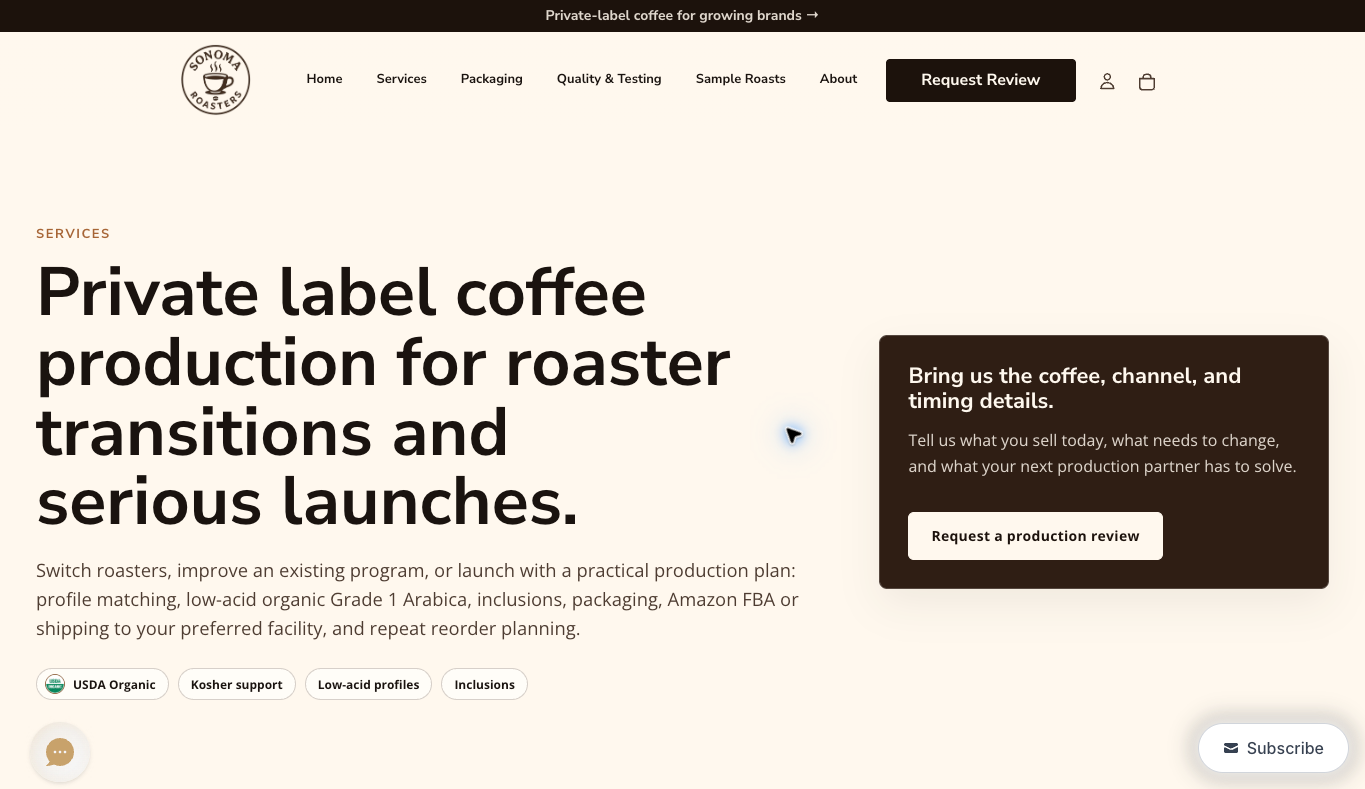
Sonoma Roasters’ public service page describes private-label coffee, toll roasting, packaging and shipment preparation for inventory-based programs. It explicitly says it does not offer dropshipping. That distinction matters more than a general claim that the business does private label.
The inspected page listed a starting minimum of 144 units, or eight cases, per flavor or SKU. It also explained that final minimums can increase with packaging format, labeling, testing and other requirements. Do not treat that starting number as a guaranteed quote for your project.
I would investigate it if your business can support stocked inventory and a repeat production plan. The next questions are about the exact product specification, sample approval, packaging and reorder process. A manufacturer describing those capabilities does not prove your product or budget fits.
Choose the category before choosing a factory. Explore the free niches resource →
2. Temecula Coffee Roasters: a stated private-label fulfillment workflow
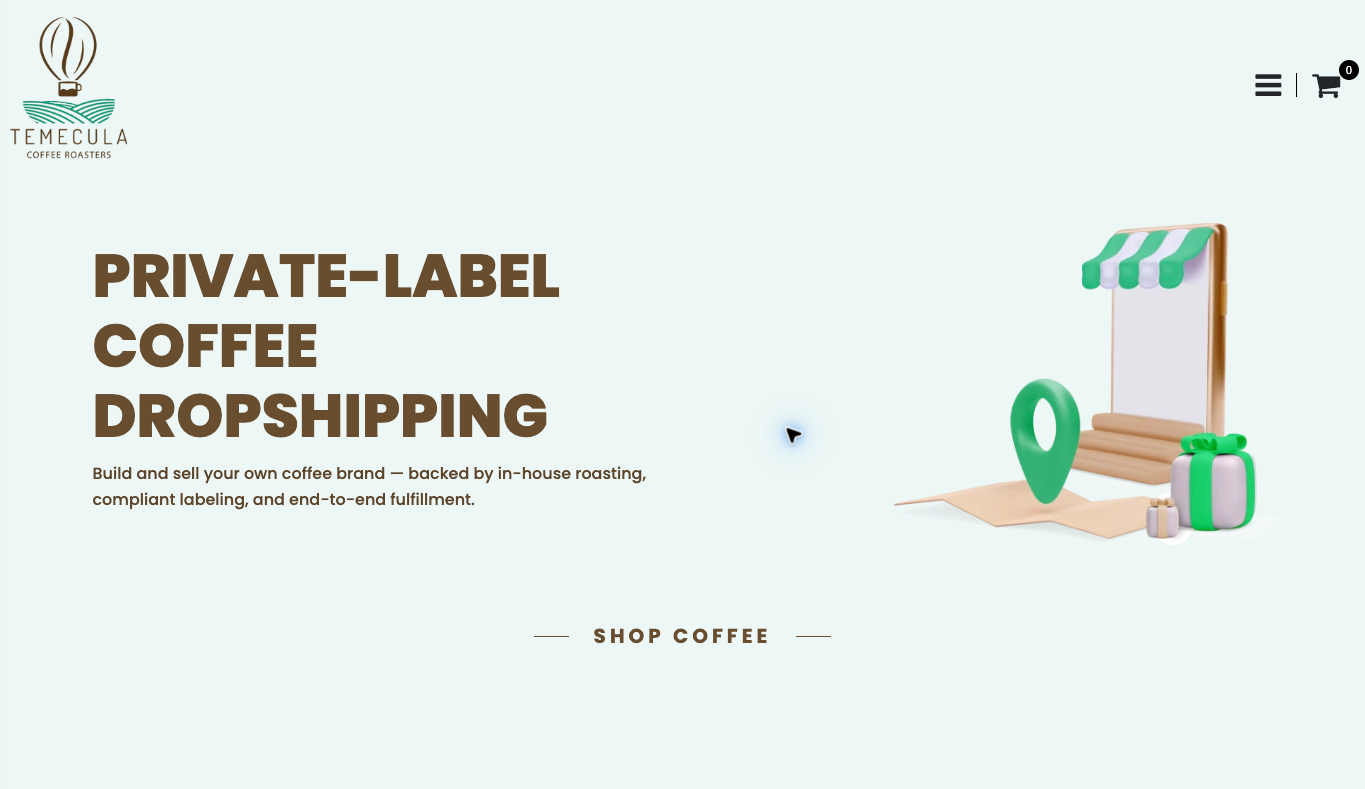
Temecula Coffee Roasters’ public page presents private-label coffee dropshipping and says its own team handles sourcing, roasting and fulfillment. It also describes a label and Shopify order-status workflow. Those are provider statements, not a hands-on integration test in this guide.
The page advertised no monthly fees for the described service. I would still request the actual cost for the product, packaging and destination you intend to use. No monthly fee does not mean free production, free samples or a profitable order.
This is a different starting point from a bulk-production arrangement. Confirm which products qualify, how labels are approved, what the current integration requires and how returns or delivery issues are handled. Do not assume every item on a catalog uses the same fulfillment terms.
3. Impact Manufacturing Corp: apparel development and production
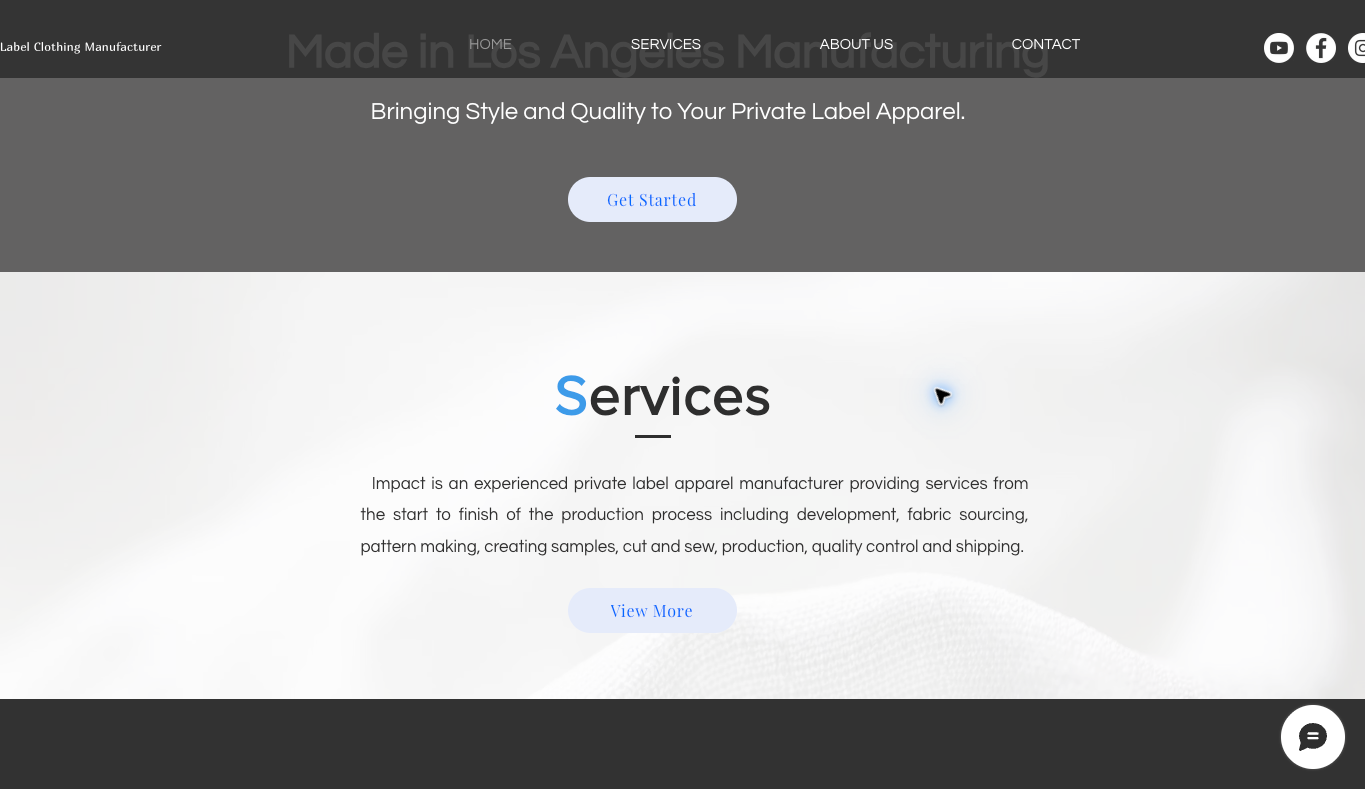
Impact Manufacturing Corp’s public site describes private-label apparel work including development, fabric sourcing, pattern making, samples, cut-and-sew production, quality control and shipping. That makes it an apparel example, not a manufacturer for every private-label category.
For this type of project, I would define materials, sizing, colors and acceptable sample results before comparing quotes. Ask how minimums apply across sizes and colors, who owns the pattern and which part of production the company performs or coordinates.
The site describing quality control is not independent proof of production quality. Get the process, acceptance criteria and defect resolution in writing. A successful-looking website does not replace a sample and a commercial agreement.
When fashion on demand is a different fit
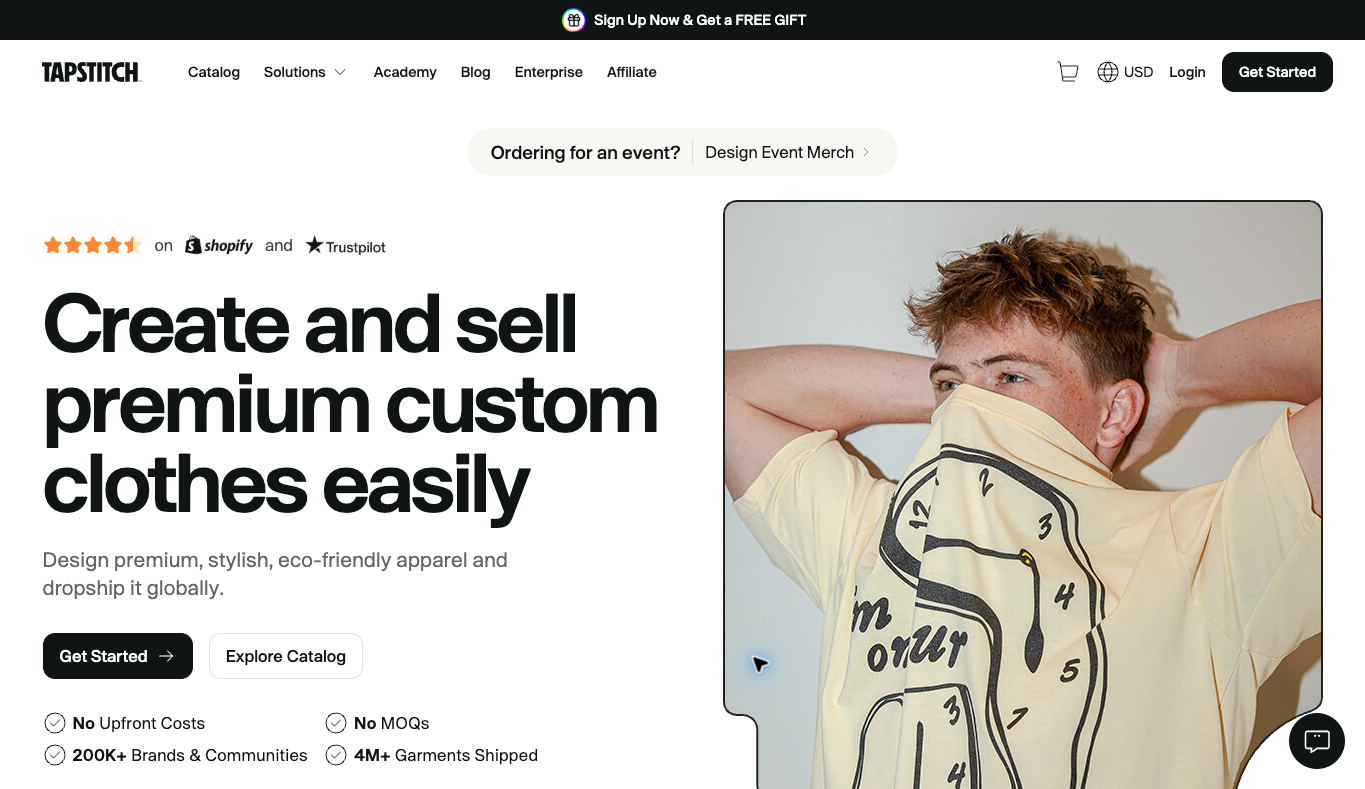
If your apparel idea uses existing blanks with your designs, Tapstitch is a separate option to evaluate. Its public site describes garment customization, branding services and production with direct-to-customer delivery. That is not the same project as commissioning a new pattern and a custom cut-and-sew collection.
The inspected page advertises no minimum orders. Keep that in context: you still need the selected garment, decoration and delivery costs. A low-inventory workflow does not prove demand or make the difference between the selling price and production cost your net profit.
Its public shipping explanation separates selected U.S.-fulfilled items from the broader internationally fulfilled collection. Check the exact product and destination before making a delivery promise. I have not ordered a sample or tested its store integration for this guide.
I would review Tapstitch’s current customization options if those constraints match the business. Confirm the branding scope, sample process and return responsibilities before a launch. If you need a product built to a new specification, keep researching the actual manufacturing arrangement instead.
Send the same specification to every candidate
A useful quote starts with a useful specification. Describe the finished product, materials or ingredients, packaging, label requirements and intended sales channel. Include the quantities and the changes you need compared with the manufacturer’s standard product.
If you send three different descriptions to three companies, the quotes will not be directly comparable. One may include packaging, another may assume you provide it and another may quote only the production step. The lowest number may describe less work.
I would keep a versioned brief and ask each candidate to identify what is included, excluded or still unanswered. That lets you compare the actual scope without relying on a sales conversation you cannot reconstruct later.
Also ask which company performs the work and which parts are subcontracted. A coordinator can be useful, but you should understand who controls production, quality and communication. Do not infer factory ownership from the word manufacturer on a website.
My supplier sourcing guide covers the relationship and verification discipline. Private-label manufacturing adds product-development questions, but the need for clear responsibilities stays the same.
Samples and acceptance criteria come before a large order
Decide what an acceptable sample must demonstrate before you review it. That might include materials, fit, finish, packaging or the agreed product characteristics. A sample that looks nice is not necessarily evidence that it meets the specification.
Ask whether the sample represents the intended production process and materials. A hand-prepared sample can differ from a commercial run. Confirm what changes, if any, will happen between approval and the first order.
Write down the acceptance criteria and the process for a failed sample. Then ask what happens if the production batch differs from the approved version. You need a clear resolution path before a large amount of inventory arrives.
For categories with safety, labeling or other regulated requirements, obtain appropriate documentation and qualified review. Do not treat a provider saying compliant as proof that every product, label and market meets the requirements. This guide is not a certification or legal opinion.
Do not claim your product has an exclusive formula, pattern or design simply because it carries your brand. Ownership and exclusivity need their own confirmed terms. Get professional help reviewing an agreement when those rights matter to the business.
Connect sourcing to the store’s operating plan. Review the Ecommerce Paradise store build service →
Compare landed costs, not just the unit quote
Here is a hypothetical example, not a manufacturer quote. Suppose 500 finished units cost $8 each, packaging costs another $1 per unit, setup is $300 and inbound freight is $200. The initial total is $5,000, or $10 per unit across that batch.
If you sell a unit for $25, the $15 difference is not automatically profit. You still need to account for customer fulfillment, selling fees, returns, marketing and general overhead. A production cost calculation and an operating profit calculation are different jobs.
Now suppose only 300 units sell during the period you planned. You still paid for all 500, and the remaining stock ties up cash. A profitable-looking unit quote does not remove inventory risk or establish demand.
Separate one-time setup expenses from repeat-order costs. Then ask what changes when quantities, packaging or materials change. Your first order and your tenth may have different economics, but do not assume a future discount without an actual quote.
Also ask who owns extra packaging or materials bought for the project. If those items remain at the factory, know how they are recorded, stored and used on a reorder. Small untracked costs can become a recurring source of confusion.
Record the production handoff before you launch
I would keep one production record for the agreed product. Include the specification version, approved sample reference, label artwork, quoted quantity and the responsibilities each company accepted. That record gives your team something concrete to check when the finished batch arrives.
Decide how a change gets approved. A material substitution, different package or revised label can affect the product you intended to sell. Ask the manufacturer to identify changes before production, and record the decision rather than letting a quick message become an undocumented new specification.
Break the proposed lead time into milestones. Sample preparation, artwork approval, production, inspection and freight are different stages. Ask what starts the clock for each one and what information your business must supply. A quoted production period is not automatically the customer’s delivery date.
Also agree on how a problem is reported. If the shipment differs from the approved specification, your team needs to know what evidence to retain and whom to contact. Photos, quantities and the relevant batch reference are more useful than a vague message saying the order looks wrong.
Clarify the proposed resolution before placing a large order. Would a confirmed defect lead to replacement, rework, credit or another agreed response? Who handles the freight and what must happen before selling affected stock? Those are questions for the actual agreement, not a universal manufacturer policy.
Keep one accountable communication owner on your side. That person should know which brief is current, which sample was accepted and which questions remain open. Otherwise, the sales contact, designer and receiving team can each work from a different version of the same project.
Run through a simple receiving scenario before launch. Ask where the cartons will go, who checks the quantity and what happens if the product is delayed or cannot be accepted. You do not need to invent a disaster; you need a practical next step for an ordinary exception.
Finally, separate a production confirmation from permission to make a sales promise. Your store should use the confirmed product details and delivery arrangement, not the most optimistic estimate in an early conversation. If a critical point remains unresolved, keep that part of the launch on hold.
Confirm the fulfillment and reorder workflow
Private-label production does not tell you how the finished inventory reaches a buyer. Confirm whether the manufacturer ships bulk orders, sends stock to another facility or fulfills individual orders. Each arrangement creates different responsibilities.
For direct fulfillment, check the order transmission, acknowledgement and tracking process. Ask what happens when stock is unavailable or an address is incomplete. Your store needs accurate customer updates, not an assumption that the factory will handle every exception.
For bulk production, plan receiving, inspection, storage and outbound fulfillment. Check the packaging and carton information the receiving facility needs. Do not promise an arrival date before the production and freight arrangement is confirmed.
Then plan the reorder. Record the lead-time assumptions, the point at which you review remaining stock and the person responsible for placing another order. A successful first batch is not the same as a reliable repeat supply chain.
Supplier Paradise can help organize discovery, but it does not replace those confirmations. The manufacturer or service provider needs to answer the actual project questions.
Keep private label distinct from high-ticket dealer dropshipping
In private labeling, you are building a product offer under your own brand and may take on development, inventory and documentation responsibilities. In an authorized dealer model, you sell an existing brand under its terms. Those models can overlap in some workflows, but they are not interchangeable.
My high-ticket dropshipping guide explains the store model I teach. Read it as a different route, not a promise that every private-label manufacturer provides dealer-style dropshipping.
The niches list is another place to explore categories. Validate the actual buyer need and costs rather than deciding that a product is worthwhile simply because you can put your logo on it.
Business ownership and records matter in either model. The business foundation checklist gives you a broader setup reference. It does not replace product-specific compliance or a reviewed manufacturing agreement.
Learn the business model before committing to production. Explore the Ecommerce Paradise masterclass →
How I would choose the best private label manufacturers
I would choose the candidate that fits the product specification, fulfillment model and realistic budget. Not necessarily the one with the smallest starting minimum or the most impressive marketing page.
Keep the evidence in three groups: confirmed, provider-stated but not independently verified, and unknown. Public capabilities belong in the second group until you have enough evidence for the actual project. An unknown critical cost or ownership term is a reason to hold.
Define a controlled next step and a stop condition. A sample review or specification clarification may be the next step, but do not spend or accept terms before the business has authorized that action. The purpose is to reduce uncertainty before a production commitment.
Frequently asked questions
Is private labeling the same as dropshipping?
No. Private labeling describes the branding and production arrangement. Fulfillment may involve stocked inventory, bulk shipment or individual-order handling. Confirm the actual operating model.
Does a manufacturer website prove production quality?
No. Public capabilities help you build a shortlist. Samples, agreed acceptance criteria and project-specific documentation are separate checks.
Is the lowest minimum order always the best choice?
No. Compare the product, packaging, setup costs, repeat-order requirements and fulfillment. A low starting minimum may not apply to your specification.
Do I automatically own an exclusive formula or pattern?
Do not assume that. Ownership and exclusivity depend on the actual agreement and need explicit confirmation and appropriate review.
What should I do before ordering a large batch?
Confirm the specification, quote scope, sample approval, quality process, fulfillment and total costs. Keep critical unknowns on hold instead of treating a conversation as a confirmed operating agreement.
Need help connecting the sourcing decision to the business? Explore Ecommerce Paradise coaching →
Related guides
My wholesale supplier comparison separates discovery routes from actual agreements.
The shipping software guide covers the question of who buys labels and handles parcels.
Read the ecommerce platform comparison before choosing the storefront foundation.
My accounting software comparison is relevant when production and inventory expenses need clearer records.
The virtual assistant hiring guide helps define a role before delegating supplier administration.

Trevor Fenner is the founder of Ecommerce Paradise. His main projects are Ecommerce Paradise, Supplier Paradise, and Review Paradise, which is currently in development. TrevorFenner.com publishes research-based reviews and practical guides to online business tools and remote-work services, with clear affiliate disclosures.