
The best Etsy tools answer a specific question about your product, listing or shop. Start with Etsy’s own search information. Add a paid research tool when you know which missing information or workflow you need.
My shortlist is Marketplace Insights for recent first-party searches, Marmalead for keyword comparisons, EverBee for estimated product research, and Alura for a broader research-to-listing workflow. You do not need all four subscriptions.
At Ecommerce Paradise, I teach an independent high-ticket retail model. Etsy has different product requirements. The resources linked here are not permission to list ordinary third-party retail products on Etsy.
Research date: October 13, 2026. This guide uses public product, pricing and help information. I have not connected a seller account, installed extensions, sent customer messages or run a sales experiment for this comparison.
Disclosure: I own Ecommerce Paradise and Supplier Paradise. The Etsy providers are unlinked because the current catalog does not document verified affiliate destinations for them. A redirect to a merchant homepage does not establish affiliate attribution.
Best Etsy tools by research job
| Tool | Review for | Information type | Important limit |
|---|---|---|---|
| Etsy Marketplace Insights | Recent search demand | First-party search and listing data | Time window and free weekly searches |
| Marmalead | Keyword comparison and seasonality | Research metrics and forecasts | Provider grades do not establish ranking |
| EverBee | Product and shop research | Estimated sales and revenue metrics | Estimates do not establish private transactions or profit |
| Alura | Research and listing operations | Research with plan-dependent editing features | Search, listing, shop and automation allowances |
Define the decision before comparing scores. A popular phrase, estimated product revenue and a listing grade describe different information. Keep the source and period attached to each figure.
Marketplace Insights
Etsy’s current help describes search and listing information from the previous 30 days. Sellers receive up to 15 free keyword searches per week, with free-search results available for seven days. Etsy Plus subscribers have an unlimited-search arrangement.
The tool is available on desktop and mobile web, not the native seller app. The help page also states Marketplace Insights does not automatically edit listings.
Use this first for recent Etsy search information. A searched term still needs comparison with your product and the marketplace rules. Search interest does not determine eligibility or profit.
Marmalead
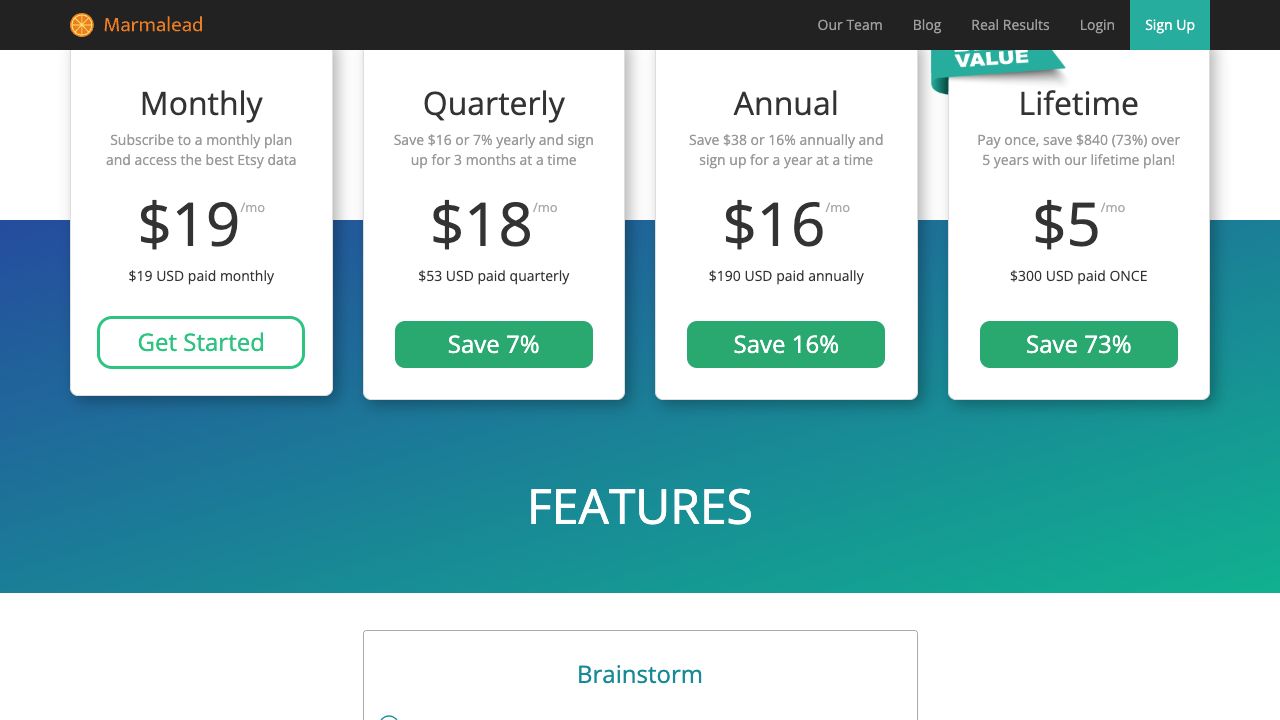
Marmalead describes related phrases, keyword comparisons, seasonality and listing grades. Some search and engagement descriptions refer to expected future activity. Keep forecasts separate from measured outcomes.
The inspected pricing showed $19 USD paid monthly or $190 annually. The annual monthly-equivalent headline is not monthly billing. Compare the complete commitment and selected terms.
A displayed lifetime offer also used a monthly-equivalent headline. Do not read the offer as a low recurring monthly subscription or assume every future feature is included.
Use a score to sort research candidates, then check the phrase against the item. A high grade is not an official Etsy rank or a guarantee of sales.
EverBee
EverBee’s help describes sales and revenue metrics as estimates or approximations. Preserve those definitions even when a marketing headline uses stronger language about seeing sales.
The inspected Hobby plan had limited keyword access and basic research. Growth displayed $299 USD under annual billing. Its monthly-equivalent headline does not establish a month-to-month quote, and the free tier does not include every paid data field.
Use product research to build a shortlist. Estimated units and revenue do not reveal another seller’s production costs or contribution margin. No private merchant transactions were accessed for this guide.
The provider describes MCP access on paid research plans. I did not install or use an EverBee connector for this comparison.
Alura
Alura combines research with listing and shop-operation features. Its Free plan lists limited daily searches and a ten-listing optimization allowance.
Basic, Growth and Professional have different resource limits. Review searches, listing work, connected shops and automation separately. Billing variants were not independently selected here, so this guide does not give a universal paid monthly quote.
Select the workflow you need before buying a wider package. An email-marketing add-on appearing on the product page does not establish inclusion in every plan.
Review generated descriptions and replies before publication. Provider scores and AI suggestions are not verified product facts or tests of your shop’s performance.
Describe the product before researching phrases
Write a plain description of the item and intended buyer. Include the relevant material, dimensions, options and use. For a personalized product, identify which details the buyer supplies and which parts remain fixed.
Build a small list of accurate phrases from this description. Remove terms referring to a different product, material or audience. High search volume does not justify misleading language.
A fictional listing for a personalized stationery item needs an explanation of the final item, available options and required buyer information. The example is a planning exercise, not a product I researched or sold for this guide.
Separate a broad category from a precise description. Compare phrases against the same proposed item instead of changing the product definition to chase each attractive number.
Keep unresolved product questions beside the research. A phrase should not enter the final title before the business verifies the associated claim.
The software helps organize evidence. The seller still owns the decision about an original, accurately described offer.
Read definitions and periods beside the figures
Record the source, measurement period and definition with each number. Recent searches, expected engagement and estimated monthly sales are not interchangeable.
Check whether the figure is reported, estimated or forecast. A precise-looking decimal does not resolve uncertainty about the underlying method.
When comparing tools, note differences in dates and scope before describing disagreement. Two reports using different windows answer different questions.
Estimated revenue is not profit. Production, materials, shipping, advertising and service costs need their own review. A public dashboard does not establish those costs for another merchant.
Use the research to identify the next question rather than declare a product validated. Keep assumptions visible until supported by the appropriate evidence.
No competitor’s private transactions, financial statements or profit were verified for this comparison.
Plan for seasonality and production time
Check the date range before treating a spike as steady demand. Interest around an event or holiday differs from demand across a full year.
Allow for preparation and delivery. Research arriving after a useful production window does not solve the operating problem. Confirm the schedule the business is prepared to offer.
Keep a dated shortlist rather than changing the catalog whenever a new suggestion appears. Review the idea against your capacity, product requirements and the evidence collected.
Record the reason for advancing or rejecting an idea. The notes should explain the decision without depending on memory of a chart.
A forecast supports planning without establishing a guaranteed result. Treat the uncertainty as part of the research record.
This guide did not test a seasonal launch, order production or verify future demand.
Improve the listing with accurate information
Explain what the buyer receives. Include important options and the steps needed for personalization. Make basic details easy to find instead of requiring a message for routine information.
Check AI-generated wording against verified facts. Remove invented materials, certifications, features or delivery promises. Fluent copy does not create evidence.
Use relevant language naturally. Avoid filling the title with unrelated phrases solely because a tool scores them highly. The listing needs to remain understandable to the intended buyer.
Review visuals against the final product and applicable image requirements. A conceptual mockup should not imply an included accessory or a finished result the buyer will not receive.
Research another seller’s presentation for context, not permission to copy the design, images or text. Appropriate rights are a separate requirement.
For your own evaluation, compare the approved listing with the product information before publishing. No listing was edited or submitted through these tools for this guide.
Check Etsy’s product requirements
Etsy’s current Creativity Standards distinguish products made, designed, handpicked or appropriately sourced by sellers. Each category has conditions. Search demand does not establish listing eligibility.
Original designs produced through a production partner require the relevant disclosure and accurate shipping-origin information. Seller-prompted AI creations also have disclosure requirements under the stated standards.
The standards exclude another person’s work and AI prompt bundles from the seller-designed category. Review the relevant item and arrangement rather than using a popular listing as a shortcut.
These are general marketplace distinctions, not a legal ruling about a specific item or intellectual-property concern. Seek appropriate advice when rights or eligibility are uncertain.
Keep the reviewed product classification with the listing notes. A later change to production or personalization needs another check against the applicable requirements.
An independent multibrand retail model does not automatically fit Etsy’s creative marketplace.
Best Etsy tools: compare fees and resource limits
Read the selected plan by resource. Daily searches, saved items, listings, connected shops, AI actions and marketing features have separate allowances.
Compare prepaid annual totals with month-to-month billing. A lower monthly equivalent does not establish the better commitment for an untested workflow.
Check the service and terms required for each feature. A broad optimization label does not establish unlimited editing or access to every data field.
Review the marketplace fee policy for your selling arrangement. Listing, transaction, payment, advertising and regional costs have different conditions. Do not assume a calculator’s default covers every seller.
In a hypothetical example, a $40 order with $24 of direct costs leaves $16 before omitted expenses. If marketplace charges or production time are excluded, $16 is not final profit. The example is neither a fee quote nor a sales forecast.
Include packaging, delivery, customization, software and support work in your own cost review. Use appropriate accounting and tax help for your circumstances.
For your own cost record, identify the currency and whether the selling price includes shipping. Record production and packaging separately, then list the applicable marketplace charges. Keep advertising assumptions visible rather than folding an unexplained allowance into the total. A readable cost record helps the owner identify an omitted expense before approving a product.
Review the information required by a calculator before trusting the output. A populated result does not prove the inputs match your arrangement. Preserve the source of each entered cost and the date checked. Update the record when a supplier changes a price or the planned delivery method changes.
Use one research record the team understands
Choose one place for the shortlist, evidence and next action. Repeating the same search across several subscriptions adds work without necessarily adding a different kind of information.
A useful record identifies the product idea, intended buyer, accurate phrases, relevant dates and unresolved questions. Keep research notes separate from claims approved for publication.
When adding a second tool, state the missing input. A different estimate or score is not automatically a useful second opinion.
For a fictional candidate, record the proposed product, the source window and the question still needing verification. Identify the person responsible for the next check. Do not label the candidate approved merely because several tools display favorable numbers.
Keep the research budget tied to the work. A subscription should answer a question or support an identified task, rather than become a substitute for creating or improving the offer.
Preserve the approved product information and the reason for each listing change.
Review access and customer communication
Check requested permissions and data-handling terms before connecting a seller account or extension. Give the application access appropriate to the authorized task.
Keep customer records out of unnecessary AI demonstrations. Use suitable fictional information when evaluating writing or an interface.
A tool’s follow-up or email feature does not establish permission to add every buyer to a promotional list. Review the applicable consent, opt-out and marketplace requirements.
Check suggested customer replies against the order context. Do not invent a refund, completed production step or shipping date because generated wording sounds reassuring.
Assign ownership of message review and follow-up. The customer needs an accurate answer and a clear next action.
No extension, seller connection, private data upload, permission change or customer message was completed for this comparison.
Evaluate changes without claiming a guaranteed ranking
Record the current listing and the reason for a proposed change. Clearer product information is a useful objective without promising an immediate search improvement.
Avoid changing the title, photos, price and shipping terms together, then attributing every outcome to a keyword. Use an evaluation method appropriate for the shop’s activity and uncertainty.
Separate observations from explanations. Changes in visits, orders or conversion have several possible causes. A provider’s letter grade does not prove the reason for a later result.
Check whether the comparison uses a similar period, audience and offer. Seasonal changes or different product availability affect interpretation.
Keep unsupported performance claims out of the final listing and reporting. A quiet period does not prove failure, and a few orders do not establish a repeatable improvement.
This guide includes no controlled experiment or verified seller revenue increase.
Confirm production and delivery before promising them
Agree on the product specification, packaging and handoff with any legitimate production partner. Review personalization requirements before publishing the buying instructions.
Keep the delivery explanation aligned with the arrangement the business supports. A template’s sample shipping statement is not evidence for your product.
A supplier candidate needs verification. My supplier research guide covers a different retail context, but the distinction between a lead and confirmed commercial terms is relevant to an operating business.
Supplier Paradise is another research resource I own. The directory does not certify Etsy eligibility or an approved relationship.
For a fictional partner handoff, document the approved specification, the information required for personalization and the responsible contact. Review changes before passing a revised promise to the buyer.
No supplier appointment, production order or delivery test was completed for this guide.
Keep the independent-store path separate
Etsy serves an eligible creative offer within its marketplace requirements. An independent store has a different set of operating responsibilities.
My high-ticket dropshipping guide explains the independent retail model I teach. The guide is not an Etsy reselling strategy.
The high-ticket niches list supplies categories for investigation in this separate model. A category does not establish profit or marketplace eligibility.
The business foundation checklist frames administration and professional review. A research subscription does not establish the entity or resolve intellectual-property questions.
Select the channel around your product and the buying experience you are prepared to provide. Do not assume every marketplace accepts the same product arrangement.
Frequently asked questions
Does Etsy provide keyword research? Marketplace Insights supplies recent first-party search information with a limited free weekly allowance and a separate Etsy Plus arrangement.
Are estimated sales verified profit? No. Estimated units or revenue do not establish private transactions, costs or margin.
Does a keyword score guarantee ranking? No. Provider scores and forecasts are research inputs, not official Etsy results.
Does a popular supplier product qualify for Etsy? Demand does not determine eligibility. Review the item and arrangement against the current marketplace rules.
Do I need every tool in this guide? No. Start with the research job and add a subscription only for an identified missing input or workflow.
Related guides
- Print-on-demand companies
- AI content tools
- High-ticket dropshipping niches
- Small-business software
- Ecommerce platforms

Trevor Fenner is the founder of Ecommerce Paradise. His main projects are Ecommerce Paradise, Supplier Paradise, and Review Paradise, which is currently in development. TrevorFenner.com publishes research-based reviews and practical guides to online business tools and remote-work services, with clear affiliate disclosures.