

Paying to distribute a press release is not the same as earning an independent news story. Keep that in mind before you spend a dollar. When I compare the best press release distribution services, I look at 3 things: the announcement, who actually receives it and what deliverables the price includes.
Before you compare prices, decide where your announcement needs to go. Publication on the provider’s own website, delivery to an industry newsroom and a reporter writing an independent story are 3 very different outcomes. Ask for the deliverables in writing instead of choosing based on a wall of publisher logos.
At Ecommerce Paradise, which I started in 2015, I always start with a clear offer and an operating plan. Publicity supports a genuine announcement. Distribution does not finish your product page, set up a supplier relationship or assign someone to answer customers.
This guide compares 24-7 Press Release Newswire, eReleases and a direct PR Newswire quote. You’ll learn how to read package scope, count words and media costs, avoid search-ranking promises, plan corrections and build a realistic budget. A bigger placement count does not mean a better audience or more sales.
If you’re publicizing a store launch, the store itself matters way more than the release. My guide to how high-ticket dropshipping works explains the retail model I teach. I’ll come back to that near the end.
Official pricing, editorial guidelines and service descriptions were reviewed October 13, 2026. I have not purchased distribution, submitted a release or measured a campaign for this comparison. Provider placement statements are package descriptions, not independently tested results.
Disclosure: some links are affiliate links. If you buy through them, I earn a commission at no extra cost to you. I own Ecommerce Paradise and Supplier Paradise. Merchant destinations I haven’t verified stay unlinked.
Best press release distribution services by scope
| Service | Direction to investigate | Public pricing context | Main check |
|---|---|---|---|
| 24-7 Press Release Newswire | Several packaged distribution levels | Distribution starts at $49 per release. The $29 option is site-only | Exact network, word allowance and correction policy |
| eReleases | Packaged national-wire distribution with targeting | Buzz Builder $399, Newsmaker $499, PR Pro $699 | Word count, industry targets and added services |
| PR Newswire | A direct scope-based inquiry | Provider says cost varies with reach and additional services | Current written quote for geography and requirements |
Compare the distribution scope
Start with the recipients and deliverables you need. A site-only post, network distribution and a scoped national-wire package each do a different job. Confirm the complete price for your release instead of comparing entry prices alone.
24-7 Press Release Newswire
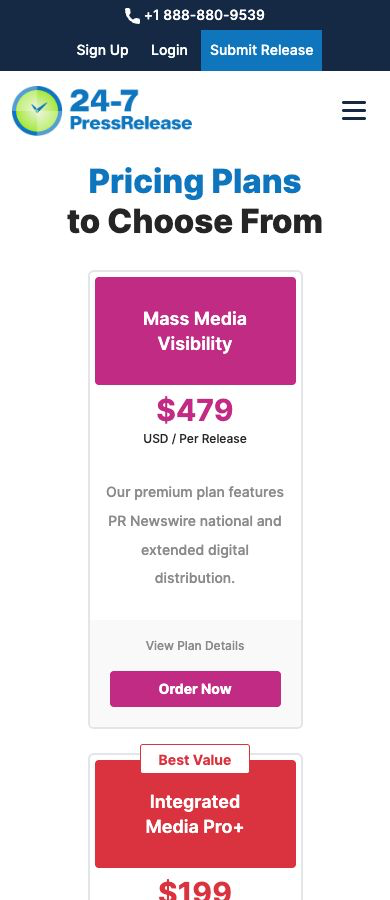
24-7 Press Release Newswire lists several packaged choices. Current USD prices per release are $49 for Visibility Boost, $89 for PR Network Plus, $139 for Integrated Media Pro, $199 for Integrated Media Pro+ and $479 for Mass Media Visibility.
Simple Post costs $29 and publishes on the provider’s own website without additional distribution. Compare that option separately from the packages that send your announcement to a network.
The premium Mass Media Visibility description includes PR Newswire national distribution. Don’t assume that premium scope applies to the lower-priced packages. Ask which destinations, word allowance and media treatment come with the service you pick.
Partner-publication counts describe the provider’s package. They don’t establish journalist interviews, independent stories, indexing, readership or sales. My starting point is the announcement and the audience, not the biggest number on a comparison chart.
eReleases
The official pricing chart lists Buzz Builder at $399 with 400 words and 1 industry target, Newsmaker at $499 with 500 words and 2 targets, and PR Pro at $699 with 600 words and 3 targets.
The chart describes custom national Cision PR Newswire distribution and 2 included images. Image embedding is a separate $150 option. Included image assets and embedded multimedia are different things, so don’t mix them up.
Extra words cost $150 per additional 100-word block or fraction. Another industry target costs $150, and writing added to distribution costs $300. Confirm your order’s scope and full total before you pay.
eReleases stays unlinked here because its documented referral was not verified as a working merchant destination. Reading a public pricing page doesn’t resolve referral attribution. No release order or campaign was submitted for this comparison.
PR Newswire
PR Newswire’s service page describes geographic and industry targeting, multimedia options and reporting. Cost depends on reach and additional services. Request a written quote for your intended country, region, word count and media requirements.
Ask the rep to itemize membership, distribution and optional features. Include your final word count and requested geography in the same request. Compare that dated written quote with the packaged options instead of relying on an old price list.
Confirm exactly what product is being quoted. A brand-authored feature, a sponsored placement and a company news release are different arrangements. Similar publicity language does not mean identical distribution.
PR Newswire stays an unlinked direction for a scoped conversation. No campaign, provider comparison test or independent coverage result was measured for this guide.
Prepare a real announcement
Write down the change, the date and the audience affected before you buy distribution. A product launch, a new location or a documented company milestone gives you a starting point. A routine sales slogan does not become news because you paid to place it.
Put the main facts in the first paragraph. Explain the change without dragging the reader through a long company history. Use the rest of the release for relevant context, availability and the next action.
Check every superlative. Claims about being first, largest or best need a defensible basis and proper review. When you don’t have the evidence, just describe the verified change, because distribution does not prove the announcement.
For a fictional store launch, confirm the live website, product availability and a responsible contact before you announce the opening. Label planning examples separately from completed events. No launch or distribution campaign was performed for this comparison.
Separate delivery, syndicated copies and earned coverage
Distribution describes the delivery arrangement. Syndication places copies of the announcement on partner websites. Earned coverage happens when a journalist or publisher independently decides to cover you, and a purchased package does not roll all 3 into one guaranteed result.
A placement report lists copies or destinations. Read the report’s definitions before you treat a URL count as readership. Potential audience estimates are also different from measured readers and useful responses.
Describe results accurately when you report to your team. A release sitting in a publication’s newswire section is not a reporter’s endorsement. Never present a network logo as proof of an independent product review.
If your goal is an interview, treat the media relationship work as a separate job. Prepare a credible spokesperson and supporting evidence. Sending the release gives people material to consider, not a promise of editorial attention.
Choose the audience before expanding reach
Identify the people who actually need the announcement. A trade buyer, a journalist and an existing customer ask different questions. Write a release they can all understand without assuming everyone needs the same promotional message.
For an announcement aimed at specialty retailers, ask which trade publications or industry lists receive the release. For a local opening, ask about the target city and surrounding area. Write down the provider’s answer before you pay for a broader network.
24-7 Press Release’s FAQ describes an English-language service and says its general distribution does not target one specific geographic area. The dateline shows where the announcement comes from, not a promise of local delivery. Confirm language and location requirements before you choose the service.
Keep a distribution brief next to the release. Record the intended audience, the requested scope and why you picked the package. An editor or marketing colleague should understand the decision without digging through the provider’s sales page.
Count words and media costs together
Count the final headline, summary, body and boilerplate according to your plan’s rules. An editor’s body-only word count can miss chargeable material. Confirm the actual submission format before you approve the purchase.
24-7 Press Release’s guidelines list a 375-word allowance for Mass Media Visibility, including headline, subheading, body and boilerplate. The stated surcharge is $110 per extra 100 words. Don’t carry those rules over to another package without checking its requirements.
Review 24-7 Press Release’s package scope next to your final word count. A shorter, factual release often serves the reader better than several repetitive background paragraphs. Just don’t cut essential qualifications only to hit a lower price.
Treat an uploaded image and a paid image-embedding option as separate budget lines. Ask where each asset appears and whether partners receive the same format. Save the answer next to your final word count and itemized charges.
Give writing, fact checking and approval separate owners
A writing service turns source material into a release. Editorial review checks the provider’s submission requirements. The business is still responsible for the facts and the authorization behind the announcement.
Give the writer a useful brief: the verified change, dates, intended audience, approved spokesperson and supporting records. Flag open questions before drafting instead of asking the writer to fill gaps with plausible-sounding language.
Assign a final approver who has the authority to speak for the organization. The approved version should include the headline, body, quotes, images and destination links. Passing the provider’s review does not replace your own approval.
Ordinary business news is different from regulatory disclosures, legal allegations, medical claims and high-risk financial promotions. Get the right professional review for those subjects. A general distribution package does not give you specialist clearance.
Keep quotes and assets within the permission granted
Use images the business owns or has permission to distribute. A photo visible on a website is not automatically available for your release. Record the source and the permitted use before you add an asset to the submission.
Approve quoted words and attribution with the named speaker. Private correspondence is not permission to publish a testimonial. The FTC’s Endorsement Guides FAQ says endorsements must reflect the honest opinions or experiences of the endorser, so never invent a customer statement just because the release sounds better with one.
Confirm you have permission to name another company or announce a relationship. A supplier lead, an informal discussion and a signed commercial agreement are different stages. Use wording that matches the approved relationship.
Keep the approved copy, asset permissions, claim sources and responsible owner together. Date the approval and mark any later edits. A short, reliable record beats scattered messages about several versions.
Prepare the destination and follow-up
The linked page should explain the announcement and support the promised next step. A product launch needs matching product information and availability. An event needs consistent dates, location and registration details.
Check the destination on desktop and mobile before distribution. Look at loading, readable text, relevant links and the contact route. Sending attention to an unfinished page just creates another support problem instead of a useful conversation.
Pick the right next step. Product details, a quote request or an official statement serve different readers. A release doesn’t need to send every visitor straight to checkout.
Assign someone to review replies and keep the approved information consistent across the website and messages. When an important detail changes, revise the release before distribution, because partner copies are a pain in the butt to correct after publication.
Do not purchase a search-ranking promise
Backlink counts, indexing, rankings and useful readers are different outcomes. A list of placements does not guarantee any particular search result. Never buy distribution because a sales pitch promises automatic rankings.
Google’s Search spam policies list paid advertorial links and optimized anchor text in press releases distributed on other sites as link spam. Google’s guide to qualifying outbound links explains that paid links should be marked sponsored, with nofollow still acceptable. An announcement should inform readers, not try to buy ranking credit.
Keep link destinations specific and useful. Don’t repeat keywords all through the headline and body or attach a link to every noun. The reader needs the relevant official information, not an overloaded sales document.
AI-answer exposure needs evidence too. A provider’s hand-picked case study is not a forecast for your business. Record what you observe in your own authorized campaign without treating an attribution dashboard as proof of cause and effect.
Measure responses separately from placement reports
Start with the question each measure answers. A live URL shows a copy exists. A delivery report describes distribution activity, and a relevant reply shows someone took another step, but none of these alone proves revenue.
Track useful conversations and actions on the destination page. Keep those records separate from estimated audience totals. Confirm the source and measurement period before you compare reports.
Note any other marketing running alongside the announcement. Ads, newsletters and social posts all overlap. Crediting every purchase during the launch to the press release would ignore those differences.
A practical review records the distributed version, confirmed placements, relevant responses and open questions. Use evidence from the actual campaign for any performance claims. This guide includes no measured distribution results or sales improvement.
Read correction and removal rules before release day
Check what can change after distribution. Editing the provider’s own copy doesn’t necessarily update partner copies. Your final approval process has to account for that before the announcement leaves your control.
24-7 Press Release’s FAQ says post-distribution edits affect its own website, not partner sites. Its guidelines also describe retraction limits and state that retractions are unavailable for Mass Media Visibility. Don’t assume every plan gives you universal removal.
Confirm the deadline and procedure for the service you pick. Name the person responsible for spotting errors and requesting corrections. A wrong date, price or company relationship needs attention before distribution, not after.
Before submission, check names, contact details, quotes and attached files for anything you don’t have permission to publish. Keep private customer records out of the release. Correct the approved master copy first, then follow the provider’s process for distributed versions.
Build the budget around the announcement
Build one budget with separate lines for distribution, drafting, extra words, targeting, multimedia and internal review. Compare complete totals for the same announcement. Only choose a higher tier when the extra distribution or service fits a requirement you’ve written down.
For a hypothetical budget, $200 for distribution, $150 for drafting and $50 for assets totals $400 before other expenses. That illustration is not a provider quote or a return forecast. Know the goal before you approve the total.
Compare a one-off launch with a schedule of genuine announcements. Your company’s actual news decides the need. Don’t manufacture milestones to justify a recurring distribution purchase.
Keep direct pitching separate from the package budget. Real media relationships take audience fit, accurate supporting material and a prepared contact. A release does not give you permission to flood unrelated inboxes or publish unapproved information.
Use an approval record another person understands
A useful release record shows the announcement, the approved version, the planned date, the selected package and the total commitment. Store the final headline and body with the permitted assets. Don’t rely on an unlabeled attachment called final.
Shared docs make this easy. I like Google Workspace for this kind of record because Docs, Drive and email live in one account, so the approver, the submitter and the person handling replies all see the same version.
Record who approves factual claims, who submits the release and who handles responses. Those are different jobs. If a colleague is out, the backup needs access to the approved information and the right level of authority for the task.
When the provider asks for a change, identify the exact passage and the reason. Route factual changes through the approver before you resubmit. An editorial request should never quietly change product availability, legal language or the announced relationship.
After distribution, keep the provider’s report and confirmed public URLs with the same record. Mark corrections and unresolved copies honestly. That way the next review can tell the planned distribution apart from what actually got published and how people responded.
Connect publicity to the store’s operating plan
I teach a specific retail model, and publicity is a small piece of it. Announce a verified step in your project without suggesting publicity alone produces a profitable store. I’ve built more than 20 websites over the years, and the ones that lasted had a real offer behind them, not just a launch announcement.
The niches list gives you categories to research. A defined audience and an accurate offer give you a basis for deciding which publication or buyer actually needs the news.
My supplier research guide covers commercial verification. I teach working with USA-based authorized suppliers, so confirm the relationship and permission before you announce a supplier or use its brand in promotional material.
Supplier Paradise is a research resource I own. A directory candidate is not an approved partnership announcement. The business still needs verified terms and proper permission.
The business foundation checklist frames administration and ownership. Keep the announcement’s approver connected to the people responsible for the underlying facts.
How I would choose the distribution service
Here’s the move. I’d start with the announcement, the audience and the complete cost. Then I’d look at a priced 24-7 Press Release package, an eReleases national-wire arrangement or a direct PR Newswire quote, depending on the scope I defined.
Review 24-7 Press Release’s current plans when the packaged options fit your brief. Check the network, word rules, media treatment, approval deadline and correction process before you buy.
I’d only approve distribution after checking the final copy, the landing page and the person handling replies. If any of those pieces are unfinished, finish them first. Then compare the exact package, total price and correction rules against the announcement you plan to send.
Frequently asked questions
Does paid distribution guarantee an independent story? No. Partner publication and wire delivery are different from a journalist choosing to cover the business.
Is Simple Post a network-distribution package? The current $29 description says it publishes on 24-7 Press Release’s own website without additional distribution.
Does the base price describe the entire budget? Review word allowances, writing, targeting and multimedia alongside the selected release.
Does a press release guarantee search rankings? No. Useful publicity is different from buying links to manipulate rankings.
Is every distributed copy removable afterward? Don’t assume universal removal. Read the provider’s correction and retraction rules before you approve the announcement.
My take: get the basics right first
So with that said, here’s the recap. Decide where the announcement needs to go, then compare complete, itemized prices for that exact scope. Paid distribution buys delivery and copies, not independent coverage, rankings or sales.
Count every word the plan charges for, give writing and approval separate owners, and read the correction rules before release day. Keep quotes, images and partner names within the permission you actually have. And measure real responses separately from placement reports.
Most of all, make sure the thing you’re announcing is ready. A finished landing page, a real offer and someone answering replies matter more than which package you pick. It is what it is: publicity amplifies what’s already there.
If you’re launching a store and want help getting the business side right before you announce anything, my private coaching is where I work through your niche, suppliers and launch plan with you one on one. Go check that out if you want a second set of eyes.
Related guides
The business email comparison covers the inbox that handles publicity replies.
My social media tools guide separates the publishing workflow from the announcement.
Read the keyword research comparison when you plan content around audience questions.
The webinar platforms guide covers another format for explaining a launch.
My AI content tools guide covers factual research and human editing alongside drafting help.

Trevor Fenner is the founder of Ecommerce Paradise. His main projects are Ecommerce Paradise, Supplier Paradise, and Review Paradise, which is currently in development. TrevorFenner.com publishes research-based reviews and practical guides to online business tools and remote-work services, with clear affiliate disclosures.