
The best private label manufacturer for you depends on your product and how you plan to deliver orders. A coffee roaster, an apparel producer and an on-demand clothing service solve very different problems. So here’s what I’d do. Pick the production model first, then compare company names.
Start with a written specification, a realistic budget and a fulfillment plan. Your shortlist should follow those decisions. Otherwise a cheap unit price pulls your attention away from minimum quantities, packaging charges and the inventory you’ll have to store.
This guide uses Sonoma Roasters, Temecula Coffee Roasters and Impact Manufacturing Corp as category-specific examples. Tapstitch shows up separately as an on-demand apparel alternative. Public descriptions were refreshed October 14, 2026, and I have not inspected factories, ordered samples or tested integrations for this article.
I’ve been selling online since 2005, and I started my business in October 2010. My first store failed and my second one worked, so I take sourcing decisions seriously. Through Ecommerce Paradise I mostly teach the authorized dealer model, which my high-ticket dropshipping guide explains, but private label is a real option worth understanding.
Disclosure: qualifying purchases through affiliate links provide compensation at no extra cost to you. I own Ecommerce Paradise and Supplier Paradise. The manufacturer examples are research candidates, not approved production partners or guarantees of quality.
Compare the production model first
| Example | Publicly described model | Check before committing |
|---|---|---|
| Sonoma Roasters | Inventory-based private-label coffee and toll roasting, no dropshipping | Project minimum, packaging, approved sample and reorder plan |
| Temecula Coffee Roasters | Private-label coffee with individual-order fulfillment | Selected product quote, labels, order workflow and delivery terms |
| Impact Manufacturing Corp | Apparel development and production services | Materials, size and color minimums, patterns and sample acceptance |
| Tapstitch | Customized existing apparel with on-demand fulfillment | Garment and decoration costs, branding options and return responsibilities |
This comparison is about fit, not a universal ranking. A bulk coffee producer won’t answer an apparel spec. An on-demand garment service is also a different thing from commissioning a new pattern and a custom collection.
Supplier Paradise supports supplier research. A discovery resource doesn’t certify a factory, establish manufacturing rights or approve your product. Verify the company and the proposed arrangement directly before you pay for production.
Sonoma Roasters: stocked private-label coffee
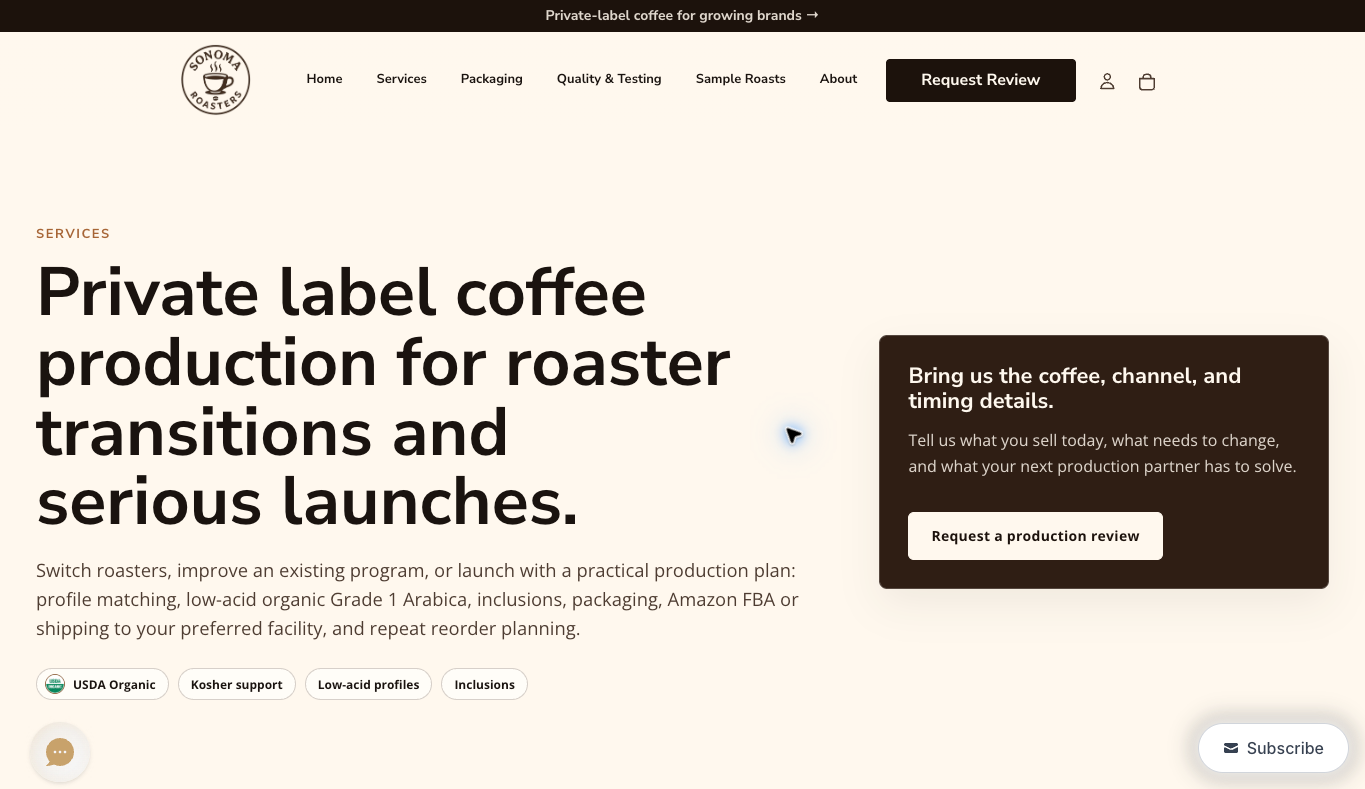
Sonoma Roasters describes private-label coffee, toll roasting, packaging and shipment preparation for inventory-based programs. Its public services page explicitly excludes dropshipping. Look at this model when your business has somewhere to receive inventory and a plan for selling and reordering stock.
The advertised starting minimum is 144 units, or 8 cases, per flavor or SKU. Packaging, testing and other project requirements affect the final minimum. Treat that number as a starting point for a quote, not a confirmed minimum for your spec.
I’d ask about the coffee profile, sample approval, packaging requirements and reorder process. Nail down who owns the agreed profile and artwork. The public description gives you a reason to investigate, but project quality, cost and commercial fit still need evidence.
Temecula Coffee Roasters: private-label order fulfillment
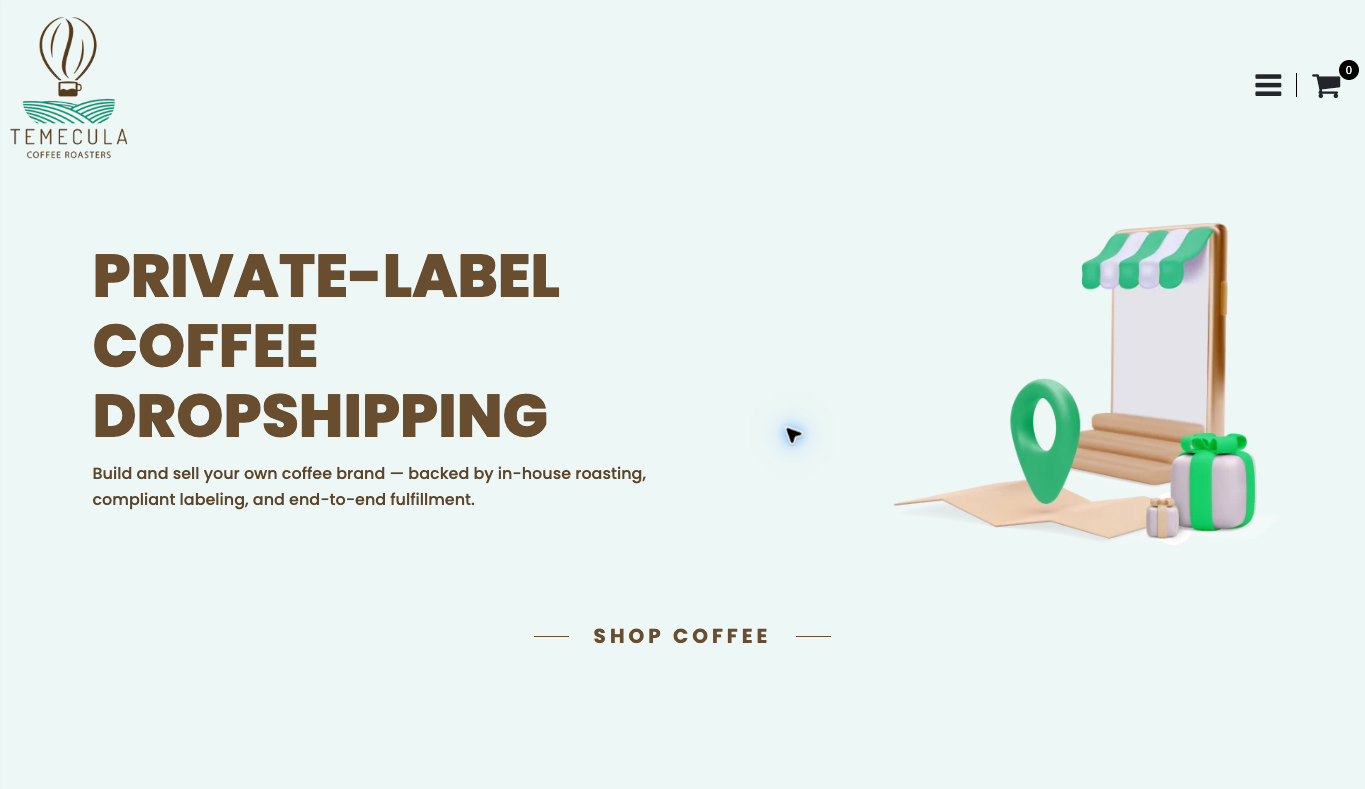
Temecula Coffee Roasters presents a private-label coffee dropshipping service with in-house roasting and fulfillment. Its page describes label customization and Shopify tracking updates. Those descriptions show the offered workflow, not proof that an integration has worked in your store.
If you’re building that store, I like Shopify for this because hosting, checkout and order management are all in one platform, and many fulfillment partners describe Shopify connections. Still test the specific integration yourself before launch.
The page advertises no monthly fees for the described service. Ask for the full price for your selected coffee, label, packaging and destination, because a service with no monthly fee still has production and delivery costs. Confirm which products and destinations follow the quoted arrangement.
Label approval deserves real attention before launch. Agree on the artwork version and check the rules that apply to your product and selling market. Marketing language about compliant labeling is not independent proof of every claim you plan to make.
I’d clarify how orders arrive, when fulfillment starts and who handles delivery problems. Customer support stays part of your business even when another company produces and ships each order.
Impact Manufacturing Corp: apparel development
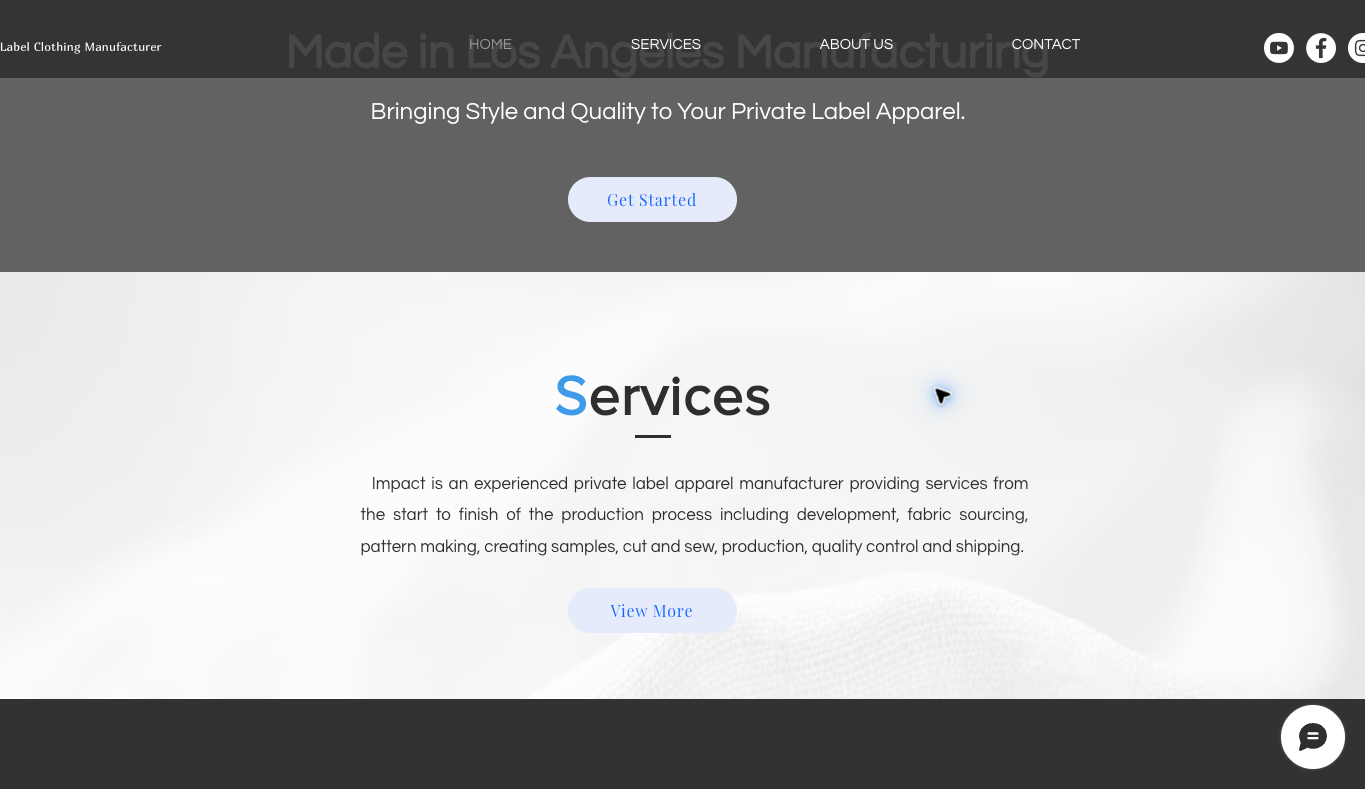
Impact Manufacturing Corp describes apparel work spanning development, fabric sourcing, patterns, samples, cut-and-sew production, quality control and shipping. It’s a candidate for an apparel project, not a manufacturer covering every private-label category.
Spell out materials, measurements, colors and finishing before you ask for a quote. Ask how minimums apply across sizes and colors, who owns the patterns and which production steps they perform versus coordinate. A service description alone doesn’t prove factory ownership.
Set your sample acceptance criteria before you review the sample. Quality-control claims on a website don’t replace evidence from your own project. Agree on what happens if a batch differs from the approved spec, including who pays for rework and freight.
Apparel also comes with labeling rules. The FTC’s guide on textile and wool labeling requirements explains that clothing generally needs fiber content, country of origin and the company name or RN of the manufacturer, importer or dealer. Confirm with your producer who handles each part of the label.
Tapstitch: an on-demand apparel alternative
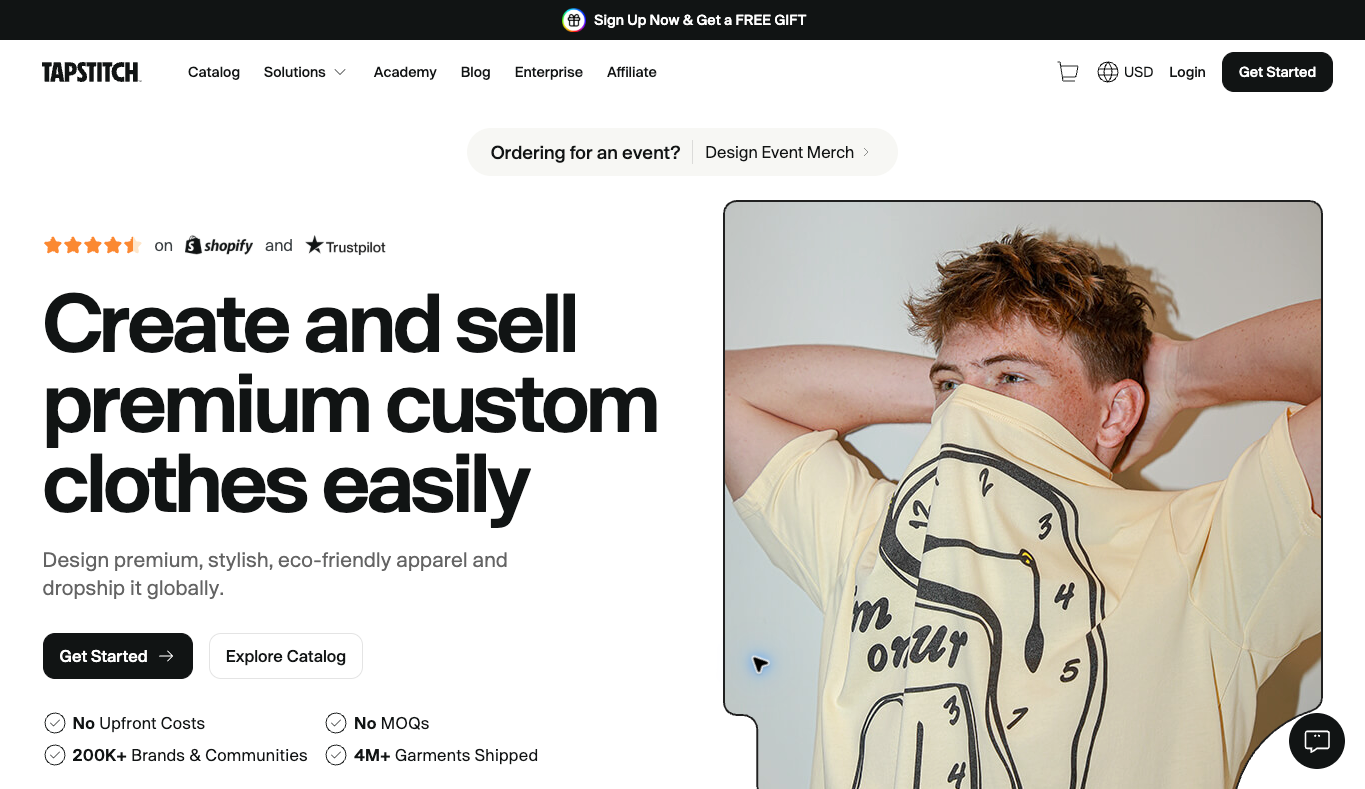
Tapstitch describes customization of existing garments with on-demand production and delivery. That suits a different project from designing a new garment pattern. Check the exact blank, decoration and delivery price before you plan your selling margin.
The homepage advertises no minimums, while the FAQ describes a 1-item minimum and no dedicated sample-order program. Ordering one item is a possible way to evaluate it. No sample order or quality test was performed for this guide.
Current branding descriptions include neck labels, hang tags and insert cards. The FAQ says branded packaging bags are still under development. Confirm what’s available for your garment instead of assuming every part of the parcel carries custom branding.
Selected items use Los Angeles fulfillment, while the wider collection uses international facilities. Check your chosen garment and destination. A US fulfillment headline doesn’t mean every catalog item ships domestically.
Tapstitch’s FAQ assigns customer-return handling to the merchant. Its separate policy requires approval for returns and excludes various accurately produced custom orders that customers later decide they don’t want. Read the terms before you advertise returns, refunds or cancellations to your customers.
Write one specification for every candidate
Describe the finished product before you ask for a price. Include materials or ingredients, measurements, finish, packaging and the intended selling channel. Explain which features come from a standard product and which need development, because a manufacturer needs the same information you’ll use to judge the finished order.
Put a version number and date on the brief. Send the same version to every candidate, then track changes. Different specs create different quotes, and a lower price means little if one company includes packaging while another expects you to supply every label and carton.
Ask each candidate to separate included work, excluded work and open questions. Identify setup charges, sample costs, packaging purchases and freight assumptions. Keep the original quote with the spec version instead of relying on your memory of a call.
Clarify who actually does the production. A coordinator can offer a useful service, but your agreement needs clear responsibility for the factory, quality checks and communication. Don’t assume a company owns a facility just because its website uses the word manufacturer.
The Ecommerce Paradise supplier research guide covers relationship checks around sourcing. Private labeling adds development and ownership questions on top of that. Keep those extra requirements in the brief from day one.
Approve the sample against written criteria
Define what an acceptable sample looks like before one arrives. For apparel, review measurements, fabric, stitching, printing and wash-related expectations. For packaged products, review the agreed contents, packaging and label, and match your criteria to the spec instead of a general impression.
Ask whether the sample uses the intended production materials and process. A hand-prepared demo is different from a production run. Record any proposed differences before approval, including substitutions and changes that need another sample review.
Keep an approved reference sample and photos tied to the brief. Agree on how the finished batch will be checked against that reference. Your team needs something concrete to compare at receiving, especially when the person unpacking cartons wasn’t part of the original supplier conversation.
For safety, labeling or regulated categories, get the right documentation and qualified review. A manufacturer’s marketing claim doesn’t prove the finished product meets every market’s requirements. Don’t make certification, health or performance claims without the evidence to back them.
Ownership needs its own agreement. A logo on a package doesn’t give you an exclusive formula or pattern. Confirm rights to artwork, tooling and product designs, including what happens if you switch suppliers, and have a qualified professional review terms that affect valuable rights.
Your brand name is part of that, too. The USPTO’s trademark basics page explains how federal trademark registration works. Research your brand name before you print thousands of labels with it. This is general information, not legal advice.
Calculate the full batch cost
Here’s an original hypothetical example, not a manufacturer quote. Suppose 500 units cost $8 each, packaging costs $1 per unit, setup costs $300 and inbound freight costs $200. Production totals $4,000 and packaging adds $500, so the complete initial batch costs $5,000, or $10 per unit.
Selling a unit for $25 leaves a $15 difference before customer fulfillment, transaction fees, returns, advertising and overhead. That difference is not net profit. Plug in the selling and operating costs that apply to your business before you decide the production order supports your margin.
If only 300 units sell during your planned period, the other 200 units are still cash tied up in inventory. Unsold product needs storage and a plan. A good unit quote doesn’t prove demand or remove the risk of buying too much stock, and honestly, that’s the part that can be a real pain in the butt.
Separate setup costs from repeat-order costs. Review how a change in quantity, materials or packaging affects the next quote. Don’t build a forecast around an assumed future discount, and ask for a price on the actual reorder quantity and spec.
Account for packaging or materials held at the production facility. Find out who owns the leftovers, how the stock is recorded and whether storage charges apply. Review what happens to those materials if the relationship ends.
To keep these numbers straight, I like Finaloop for this because it’s bookkeeping built for ecommerce, including inventory and cost of goods. That makes it easier to see what each batch really cost once sales start. A careful spreadsheet works at the very start.
For imported or bulk shipments, get a complete cost breakdown for the shipment. Freight, duties, handling and receiving are all separate from factory production, and responsibility depends on your actual agreement. US Customs and Border Protection’s basic import and export page is a starting point, but have a logistics or customs professional check any open charges before you commit.
Paying an overseas manufacturer brings currency costs into the picture. I like Wise for this because it’s built for sending money across currencies, so you can see the conversion before you pay. Check its current fees and limits for your route.
Record changes and production milestones
Keep one production record linking the brief, the approved sample, label artwork, quantity and quote. Name the person responsible for accepting changes. Without clear ownership, the designer, sales contact and receiving team end up working from different versions.
A material substitution or revised label needs approval before production. Record the reason, the cost and the effect on the spec. A short message agreeing to a change is much easier to interpret later when the record includes the final version and the approval date.
Break the schedule into sample prep, artwork approval, production, inspection and freight. Ask what triggers each stage and which information your business needs to supply. A production estimate is not the customer’s delivery date.
Decide how defects will be documented. Agree on batch references, photos, quantities and reporting deadlines. A specific report helps the supplier investigate, so keep affected inventory identifiable while both sides review the issue.
Talk through possible resolutions before you place a large order. Replacement, rework and credit each affect cash flow and timing differently. Clarify who pays freight and how approval works, and don’t assume a manufacturer’s generic policy settles every production exception.
Plan receiving before launch. Confirm the delivery location, appointment requirements, carton information and who checks the shipment. Decide where disputed or damaged stock goes, because a receiving process protects the approved production work from avoidable confusion.
Choose fulfillment and plan the reorder
Private labeling describes branding and production. Fulfillment is a separate decision. Some manufacturers ship bulk orders to your facility, while others offer direct customer delivery, and your store needs a process that fits the real arrangement.
For bulk inventory, organize receiving, storage, stock counts and outbound shipping. Confirm which company buys customer shipping labels and handles delivery exceptions. Prepare what a warehouse needs before you send cartons, including product identifiers and packing requirements.
For individual-order fulfillment, review how orders arrive and get acknowledged. Decide who handles an incomplete address, unavailable stock or a tracking delay. Describe the confirmed workflow in your customer communications instead of assuming the producer handles every exception.
Returns need a specific owner. Your customer deals with your store even when the production partner offers a defect remedy. Review your selling obligations and the supplier’s terms together, and don’t promise customers a return option before you understand the cost and process.
Set a reorder review point using your own sales and confirmed lead times. Record who monitors stock and who approves the next production commitment. A successful first batch doesn’t prove the next shipment will arrive before stock runs out.
Keep supplier performance records as the relationship grows. Note spec changes, missed milestones and resolved defects. Those records support future decisions far better than a general feeling about whether communication went well.
Choose between your own product and a dealer model
Private labeling means an offer sold under your brand, usually with development, inventory and documentation responsibilities. Authorized dealer dropshipping starts with another brand’s products and selling terms. The two models create different work, even when both run on an online store.
My high-ticket dropshipping guide in the intro explains the dealer-based store model I teach. I prefer high-ticket products from USA-based authorized suppliers for most beginners, but read the requirements before you decide which approach fits your budget, experience and time. A private-label manufacturer doesn’t automatically offer dealer-style fulfillment.
Use the high-ticket niches list to research categories. Identify the buyer need and the costs before you invest in product development. Putting a logo on a product doesn’t give customers a reason to choose your offer.
The business foundation guide covers broader setup and records. Product-specific requirements and manufacturing agreements still need their own review, so keep company formation separate from product approval.
If you need to form a company before signing a manufacturing agreement, I like Northwest Registered Agent for this because it handles LLC formation with a registered agent service. I run my own business through a Wyoming LLC. This is general information, not legal advice.
If you want help turning the research into a store plan, look at Ecommerce Paradise coaching. Define the support you need around niche research and operations. Coaching is separate from a factory inspection or a legal review of a manufacturing contract.
Decide what is ready and what needs more evidence
Sort your findings into three groups: confirmed for your project, provider-stated and unknown. Public capability descriptions stay in the second group until project evidence supports something stronger. Label any missing cost or ownership term as unknown.
Pick a limited next step that fits the open question. A spec review, written clarification or approved sample evaluation each reduce uncertainty. Don’t treat a friendly conversation as permission to place a production order.
Set a stop condition before you spend. An unexplained material substitution, unclear rights or a missing landed-cost estimate deserves more review. Move forward once the critical information matches your requirements, not because the launch date feels close.
Questions about private-label production
Is private labeling the same as dropshipping?
No. Private labeling is about the product’s branding and production arrangement. Stocked inventory, bulk shipping and direct customer fulfillment are different delivery models, so confirm which one the provider offers for your product.
Does a website prove manufacturing quality?
No. Public descriptions help you build a shortlist. Samples, acceptance criteria and project documentation are separate evidence, and an attractive website doesn’t replace those checks.
Should I choose the lowest minimum order?
Compare the complete spec and costs first. A small starting minimum often applies to a particular product or packaging setup. Review repeat-order requirements and fulfillment before deciding a low minimum fits your business.
Do I own the product design automatically?
Ownership and exclusivity follow the actual agreement. Confirm rights to formulas, patterns, artwork and tooling explicitly. Get qualified review when those rights matter to the business.
What should happen before a large order?
Resolve the spec, sample approval, quote scope, quality process, rights and fulfillment. Keep critical unknowns on hold. A purchase should follow your business’s approval process and a reviewed production arrangement.
My take on choosing a private label manufacturer
So with that said, here are the key takeaways. Choose the production model first, whether that’s stocked inventory, individual-order fulfillment, apparel development or on-demand garments. Send every candidate the same versioned spec and compare quotes line by line.
Approve samples against written criteria, get ownership and labeling sorted in writing, and calculate the full batch cost including the cash tied up in unsold stock. Don’t place a production order until the spec, sample, rights, landed cost and fulfillment plan all check out.
Keep that in mind and go deep before you go wide. One well-documented product beats five rushed ones. If you want the free starting point I give people researching categories, grab my free list of 1,000+ niches and narrow it down before you contact a single manufacturer.
Related operating guides
- Wholesale supplier comparison
- Shipping software for small businesses
- Ecommerce platform selection
- Accounting software comparison
- Virtual assistant hiring guide

Trevor Fenner is the founder of Ecommerce Paradise. His main projects are Ecommerce Paradise, Supplier Paradise, and Review Paradise, which is currently in development. TrevorFenner.com publishes research-based reviews and practical guides to online business tools and remote-work services, with clear affiliate disclosures.