

The best registered agent services do one job really well. They receive the notices covered by their appointment and get those documents to a responsible person fast. So start with three things: the service scope, the annual fee and the notification process.
Here’s the catch most people miss. A formation discount doesn’t answer any of those questions for a company that already exists. You need to look at the standalone agent service, not the shiny new-LLC bundle.
My shortlist is Northwest Registered Agent, Bizee, LegalZoom and MyCompanyWorks. Northwest is my default recommendation when people ask me about LLC and registered agent service. Still, compare the standalone service separately from any new-business package, and confirm the terms for your entity and state before you appoint anyone.
At Ecommerce Paradise, I teach the operating foundation behind an online store, and I run my own business through a Wyoming LLC. Important notices need an owner and a clear response process. If documents sit in a portal nobody checks, you’re paying for nothing.
Research date: October 13, 2026. This guide uses public provider pages and state information. I have not appointed these providers for this comparison, filed an entity document or tested delivery of legal notices.
This is educational information, not legal advice. Use current state instructions and qualified counsel for your business. Keep that in mind as you read.
Disclosure: some links here are affiliate links, and qualifying purchases earn me a commission at no extra cost to you. I own Ecommerce Paradise and Supplier Paradise. Several company referrals open formation offers first, so for standalone agent service, find the right option and confirm the separate annual fee.
Best registered agent services: fees and scope
| Provider | Inspected service-page price | Important distinction | Review before appointing |
|---|---|---|---|
| Northwest Registered Agent | $125 per year | Legal mail and a limited ordinary-mail allowance | Address use and additional mail services |
| Bizee | $149 per year standalone | Standalone service versus formation-bundle first year | Selected service and renewal terms |
| LegalZoom | $249 per year for eligible first-time agent customers | Automatic renewal with rates subject to change | Replacement-agent proof when canceling |
| MyCompanyWorks | Starting at $119 per year | Selected state, entity and change-of-agent order | Complete quote and appointment process |
These are dated public offers, not quotes covering every entity, state or optional service. State filing fees and extra work need separate review. If an older comparison shows a different price than the provider’s current applicable offer, ignore the old number.
Northwest Registered Agent

Northwest publishes a $125 annual agent service with digital document handling. Its page separates state and legal mail from ordinary business correspondence. That’s why it’s my default pick: the pricing and scope are laid out clearly, so you know what you’re paying for.
The included ordinary-mail allowance is up to 5 documents per year. So don’t budget for unlimited routine mail forwarding under the agent fee. If your business gets regular letters, look at a separate mail product.
Check the permitted use of each address and the price of extra services. Privacy-focused marketing doesn’t remove every ownership or principal-office disclosure from public records.
The company referral opens a formation offer. For an existing entity, find the standalone agent arrangement. Don’t treat the new-LLC headline as the annual agent price.
Bizee
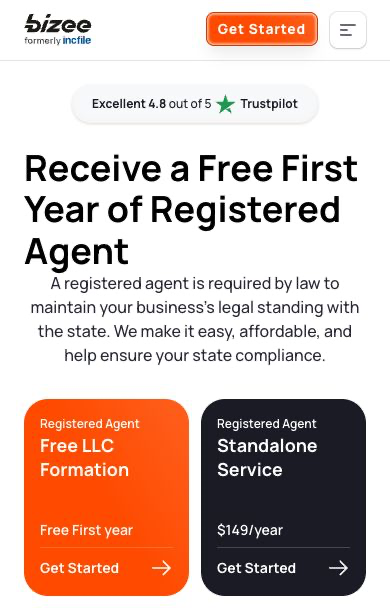
Bizee lists standalone agent service at $149 per year. Its formation offer includes an advertised free first year of agent service. Compare those two purchases separately, because they are not the same thing.
The free first year doesn’t remove state formation fees or lock in every renewal term. Confirm the selected bundle and the later charge before you buy. Bizee makes sense when you’re forming a new company and want the first year bundled in.
Public service descriptions include notifications and portal access to documents. Review the designated recipients and the route to each document. Those are provider capabilities, not notification-speed results I tested.
Some older comparisons list $119. The inspected standalone page listed $149, so I left the lower historical figure out of this comparison.
LegalZoom

LegalZoom displayed $249 per year for eligible first-time registered-agent customers. Its service description includes scanned notices, a compliance calendar and change-of-agent assistance. It’s the priciest option here, so it fits people who want those extras from a big brand.
The price footnote specifies automatic renewal and allows renewal-rate changes. Confirm the current order and renewal terms. Don’t treat the first displayed price as permanent.
The cancellation terms allow a request for proof of replacement-agent designation with the state. Understand the evidence and timing before you end the old arrangement.
Agent service doesn’t automatically include attorney representation or report filing. A calendar reminder is not a submitted annual report. Review the scope of extra services separately.
MyCompanyWorks
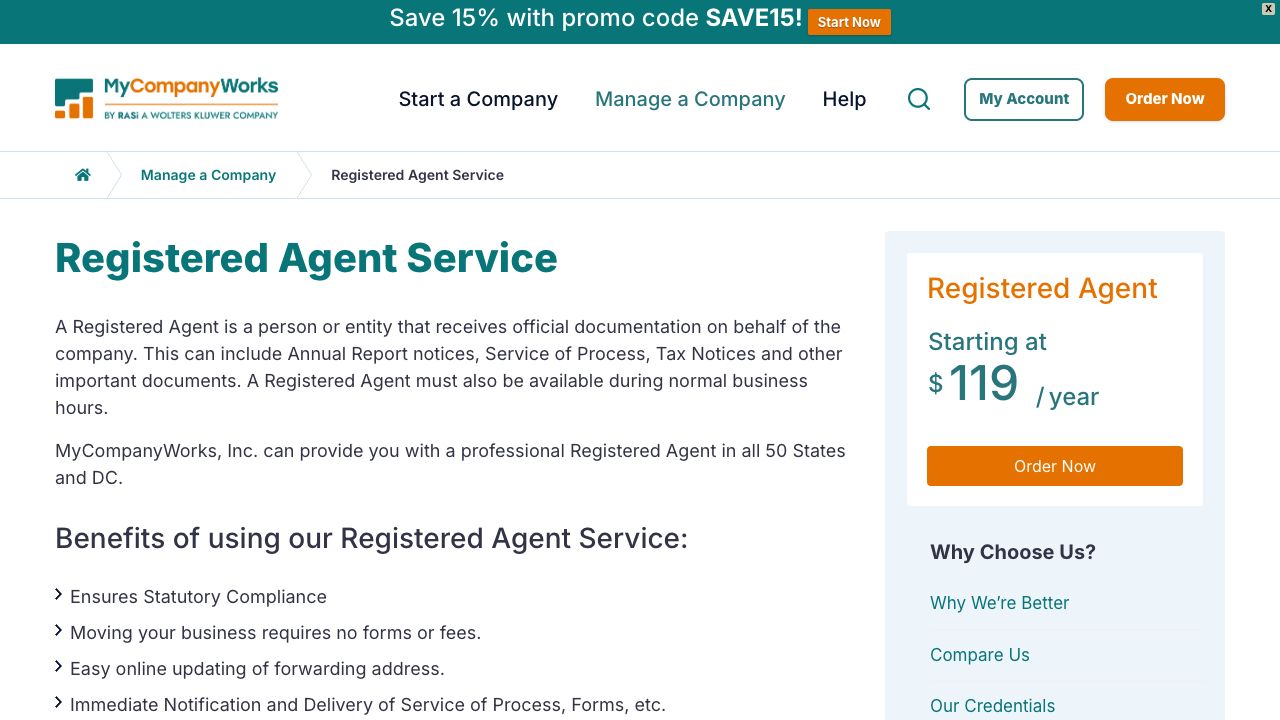
MyCompanyWorks publishes a starting agent-service price of $119 per year. The older $99 figure you might see elsewhere is not the inspected current offer. It’s the lowest starting price on this list, which makes it worth a quote if budget is tight.
Its page describes official-document handling and a change-of-agent order option. The provider supplies the relevant agent address and required signatures after a paid order.
Confirm the quote for your state and entity. Copying a public address does not mean the provider agreed to serve you.
Updating a forwarding address with the provider is a separate task from changing the registered agent or office in state records. Follow the applicable filing requirements. Don’t rely on a convenience statement.
Check the entity and state before selecting the provider
Figure out which entity needs the service and which registrations apply. The provider’s annual fee doesn’t decide the right formation state or whether you need extra registrations.
The Texas Secretary of State’s registered agent FAQs describe eligible individuals and qualifying organizations, with consent to serve. An eligible owner acting as an individual is different from the represented entity naming itself. Under the stated Texas rule, the represented entity can’t serve as its own agent.
State eligibility, office, consent and filing requirements each deserve separate review. Don’t apply one merchant’s general explanation to every jurisdiction. Get proper advice for registrations that go beyond your existing state setup.
Record the entity name, relevant state and requested service in your internal project notes. Keep those details separate from a provider’s promotional package. A new-LLC order and an agent appointment for an existing company are different work.
Take a fictional company reviewing a replacement agent. The first decision is the required appointment. The next is which service meets the state’s requirements and the company’s document-handling needs.
Neither decision is a tax recommendation or an instruction to form in a particular state. This article did not determine the registration obligations of a real company. Legal questions need your business’s circumstances and qualified counsel.
Review registered-office requirements
Wyoming’s official FAQ requires a physical Wyoming office where service of process is accepted. The FAQ rejects a post office box, virtual address or mail-forwarding location as the registered office. Its individual-agent requirements include residence, age and address conditions.
Wyoming’s own guide on how to find or become a registered agent spells out the physical address rule and excludes PO boxes and mail-forwarding services. Read it before you sign anything for a Wyoming entity. My own LLC is in Wyoming, so this rule matters to me personally.
Florida’s instructions for LLC articles of organization separate the principal office, mailing address and registered-agent address. The agent needs a physical Florida street address and has to accept the designation. A post office box that works for a mailing field isn’t automatically right for the agent field.
Review the fields in the applicable state instructions before you complete an appointment. Similar labels don’t mean identical address requirements. Keep the provider’s appointment information tied to the selected entity and service.
A national provider’s presence in several states doesn’t register your company in those states. Verify required registrations and appointments separately.
Use a current official source for your specific entity type. A general comparison page like this one is not a substitute for the state process or an attorney’s advice.
Keep ordinary mail and statutory notices separate
A virtual mailbox handles routine correspondence under its service terms. A registered agent serves a statutory contact function. One company selling both doesn’t make the packages interchangeable.
List the correspondence your business expects. Ordinary letters, customer returns, supplier shipments and legal notices each need a look at the receiving arrangement. Don’t send everything to one address just because a website calls it a business address.
Check the provider’s document allowance and handling process. Ask which correspondence is accepted, which items get forwarded or scanned, and which fees apply outside the included scope.
For Northwest, the 5-document ordinary-mail allowance is separate from the registered-agent function. A business getting regular correspondence should look at a proper mail product. Don’t assume the statutory service covers the volume.
Other organizations decide whether an address meets their own requirements. A merchant providing an address doesn’t guarantee acceptance for a bank application, a principal-office field or any other record.
My virtual mailbox guide covers the separate correspondence decision. Keep the mail service and agent appointment clearly labeled in your records.
Assign responsibility for every important notice
Choose the primary recipient and a backup before you activate the service. Keep the provider’s contact information current. Everyone should know who checks the portal and who escalates a time-sensitive document.
Here’s a fictional document-handling process. It starts with a notification to an authorized owner, who opens the record, identifies the document and follows the escalation route. A backup handles the process during an absence.
Decide how the team records receipt and the next action. Don’t use a general support inbox as the only record of a legal notice. Important documents need proper access controls and a traceable internal process.
Keep the notification, document and response task connected. A message announcing a new file is not proof of a completed legal response. A reminder about a report is not filing evidence.
Use the document and counsel for legal deadlines and required responses. Don’t wait for a routine admin meeting when the situation needs earlier attention.
No real notice was received or processed for this guide. These are proposed operating checks for your own authorized setup. Systems and SOPs matter here as much as they do anywhere else in your business.
Best registered agent services: renewal and switching
Compare the initial purchase and the ongoing service separately. A formation bundle’s included first year is an introductory period. The renewal fee, billing date and cancellation conditions need their own review.
For an existing entity, ask for the right standalone service or change-of-agent scope. Don’t pay for a new formation project when the job is replacing an existing appointment.
Record the order, selected term and renewal information. Assign someone to review billing notices. An automatic charge shouldn’t be the first reminder that an appointment is active.
Confirm the replacement provider’s agreement and the state process before you cancel the current service. A new subscription and an updated state record are two separate results to verify.
Texas’s official guidance requires continuous maintenance of an agent and registered office, with change filings keeping the record current. Ending the provider subscription does not complete the state change. That’s a pain in the butt to fix later, so do it in order.
Review the old provider’s cancellation evidence. LegalZoom’s terms allow a replacement-agent proof request. Keep the filing evidence and effective appointment information together, instead of relying on an email saying a new order was received.
This comparison did not cancel a subscription, sign consent or file a replacement appointment. Those steps belong to the entity’s authorized representative and the right advisers.
Privacy claims need a record-by-record review
Using an agent’s address for an appropriate field doesn’t make you completely anonymous. Ownership, management, principal-office and other information have separate requirements.
Wyoming’s FAQ describes information an agent must keep about represented entities and an authorized natural-person contact. A privacy-focused agent service doesn’t remove those recordkeeping responsibilities.
Review each disclosure concern against the specific record. Ask which information appears publicly, which the provider keeps and what your existing filings already contain.
Don’t choose a service on a promise of being invisible everywhere. Sort out specific privacy concerns with qualified help, especially when your situation creates extra requirements.
Keep private legal records out of public demos and unnecessary shared folders. A sample provider portal doesn’t show the configuration or retention terms of your account.
My guide to registered agent address privacy covers a narrower part of the record review. The provider’s marketing language still needs comparison with the relevant state instructions.
Compare the complete annual cost
Count the required appointments by entity and state. Ask whether the quoted price covers the selected appointment and which extra services carry separate charges.
List the annual agent fee, applicable state filing fees and optional products. Annual-report filing, tax work, ordinary mail and attorney representation are separate scopes unless the order expressly includes them.
A hypothetical budget with 2 service appointments at $120 each totals $240 a year before filing or other costs. The example is not a provider quote. Real multi-state, multi-entity and introductory arrangements need their own terms.
Check free extras for a later charge. Phone, website, address or other bundled products need a look at their continuation and cancellation terms. A long feature list on day 1 doesn’t mean free access forever.
Keep the service choice tied to the work required. Paying more doesn’t automatically fix missing filings or give you counsel. A lower formation headline doesn’t prove a lower ongoing agent cost.
Save the selected order details. A dated quote and a clear scope are way more useful at renewal than a screenshot of a promo banner.
Record exclusions next to the included services. Note any separate mail allowance, document charge or optional subscription in the approved budget. Whoever reviews the renewal should see the full arrangement without digging through old promo pages or purchase confirmations.
Keep the business in control of access and records
The business should know the account owner and recovery route. Don’t put the whole service under a contractor’s personal login without an authorized ownership arrangement.
Document the authorized users, notification recipients and backup owner. Use proper access controls instead of casually sharing one password.
Ask about document retention and the export process. A dashboard screenshot doesn’t prove unlimited storage, permanent access or your account’s security settings.
For your own authorized review, use non-private sample material and the provider’s documented process. Never expose real legal notices just to demo the interface.
Keep appointment records, invoices and correspondence organized by entity and state. Mixing several companies in an unlabeled folder creates confusion about which service a document belongs to.
This guide did not open a provider account, upload private records or test account recovery. The access recommendations describe work for your authorized setup.
Connect the appointment to the wider store foundation
My guide to high-ticket dropshipping explains the retail model I teach. Registered agent service supports one part of business admin, not the catalog, fulfillment or customer service.
My high-ticket niches list gives you retail categories to research. Keep product selection separate from entity, registration and address decisions.
My guide to finding high-ticket suppliers covers the commercial relationship. An agent appointment doesn’t create a supplier agreement or warranty commitment.
Supplier Paradise is a supplier research resource I own. Keep commercial records and statutory notices organized as separate responsibilities.
My business formation checklist frames the bigger admin project. Use legal and tax professionals for obligations specific to your company.
Frequently asked questions
Is registered agent service an LLC formation order?
No. A formation package has a different filing scope, sometimes with an introductory agent-service period. Compare the ongoing appointment separately.
Does any mailbox qualify as the registered office?
Don’t assume that. Review the applicable physical-office rule and the provider’s appointment information.
Is an eligible owner the same as the entity naming itself?
No. Texas’s guidance separates an eligible individual from the represented entity serving as its own agent.
Does the agent answer a lawsuit or file every report?
Not automatically. Receiving and forwarding notices is a separate scope from legal representation and report filing.
Does the first displayed price guarantee the renewal fee?
No. Check the selected term, the renewal conditions and the replacement-agent evidence required for cancellation.
Related guides
- LLC services
- Virtual mailboxes
- Registered-agent address privacy
- Business email providers
- Domain registrars
Final thoughts on choosing a registered agent
So with that said, here’s the short list of takeaways. Compare the standalone agent fee, not the formation headline. Check the state’s own rules for the registered office, and keep ordinary mail separate from statutory notices.
Name a primary recipient and a backup for every notice. Handle renewals and switches in the right order, so the state record gets updated before the old service ends. And read privacy claims record by record.
If I were picking today for a new store, I’d start with Northwest and get quotes from the others for comparison. Your entity and state decide the final answer, so confirm everything with the provider and qualified counsel.
The registered agent is just one brick in the foundation. If you want help with the bigger picture, Ecommerce Paradise coaching covers the high-ticket store operating plan, and legal appointments still need their own separate advice. You can also go check out my free high-ticket dropshipping mini course to see how I teach the business side.

Trevor Fenner is the founder of Ecommerce Paradise. His main projects are Ecommerce Paradise, Supplier Paradise, and Review Paradise, which is currently in development. TrevorFenner.com publishes research-based reviews and practical guides to online business tools and remote-work services, with clear affiliate disclosures.